
Market Assessment Report for Packaged Boilers in India
Boilers are essential for providing steam and hot water in most process industries where production is continuous. A packaged boiler is a factory-made, ready-to-use boiler. They are used in textile industries, thermal power plants, metals and mining industries, chemical industries, among others.
In India, the Ministry of Power (MoP) aims to improve the efficiency of packaged boilers to reduce fossil fuel consumption. The Bureau of Energy Efficiency (BEE), under the MoP, developed appliance efficiency policies for packaged boilers with technical assistance from CLASP.
CLASP supported BEE by conducting a market and technical assessment study. BEE and CLASP reached out to major industry players to estimate the market size, assess energy performance, and understand boiler testing processes.
A structured questionnaire, in-depth interviews, and secondary research provided the following insights:
- The boiler industry in India is dominated by domestic players.
- Thermal efficiency data for 168 models of coal-, oil-, gas-, and biomass-fired boilers was collected and analyzed.
- The market size for packaged steam boilers up to a capacity of 30 Tons per hour (TPH) stood at about 2,400 units in 2019, as reported by manufacturers.
- The market for packaged steam boilers is expected to grow at 3.8% over the next 11 years and reach ~3,600 units by 2030.
- Major players in the packaged boiler market in India include Thermax, Industrial Boilers, Forbes Marshall, Transparent Systems, and Elite Thermal.
- The largest clusters of boiler manufacturing are in Maharashtra, Gujarat, and Karnataka, representing about 90% of the total units manufactured in 2019.
Cumulative energy savings of ~3.1 million Ton of Oil Equivalent (TOE) and reduction of CO2 emissions by ~7.23 megatons (Mt) CO2e is expected from this program between 2024 and 2033.
China’s Path to High-Efficiency Cooling
The recent China Refrigeration Symposium 2024 and the China Cooling Expo 2024 took place in Beijing. China also announced it will promote the use of CO₂ and other natural refrigerants to reduce the harmful environmental impact of cooling systems.
CLASP was there too, to present our global research on the interlinked climate and sustainable development opportunities affordable, efficient cooling appliances can bring, as well as the policy mechanisms that can expedite a country’s transition to efficiency. CLASP research indicates that improved appliance efficiency policies in China would reduce 500 million tons of CO₂ by 2040.

CLASP has supported data and analysis to support China’s policy upgrades for commercial refrigerators, room air conditioners among other appliances. The China Labeling Program covers more than 150 appliances and emphasizes high efficiency standards.
The China National Institute of Standardization (CNIS) and leading universities like Southeast University develop frameworks for improved efficiency policies.
“CLASP has provided international best practices to CNIS and immense support to our technical teams, helping us make significant progress in improving appliance energy efficiency in China. Our efforts will help the country meet its commitments of peaking carbon emission by 2030, and reaching carbon neutrality before 2060,” said Liqiang Xing, Director of Resource & Environment, CNIS.
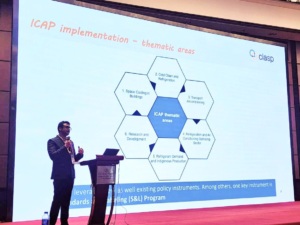
CLASP’s research highlights the opportunity and urgency needed for concerted global efforts to achieve high-efficiency cooling solutions. “The critical role of policymaking in implementation of high-efficiency technologies cannot be overstated. Chinese leaders who set strict standards for energy efficiency are a beacon for the global community”, said Steven Zeng, CLASP’s Program Lead in China.
As CLASP continues to collaborate with international policymakers, industry stakeholders and global partners, momentum for high-efficient cooling is picking up pace. By leveraging collective expertise and shared goals, the path to a more energy-efficient and environmentally sustainable future for cooling systems is increasingly attainable.
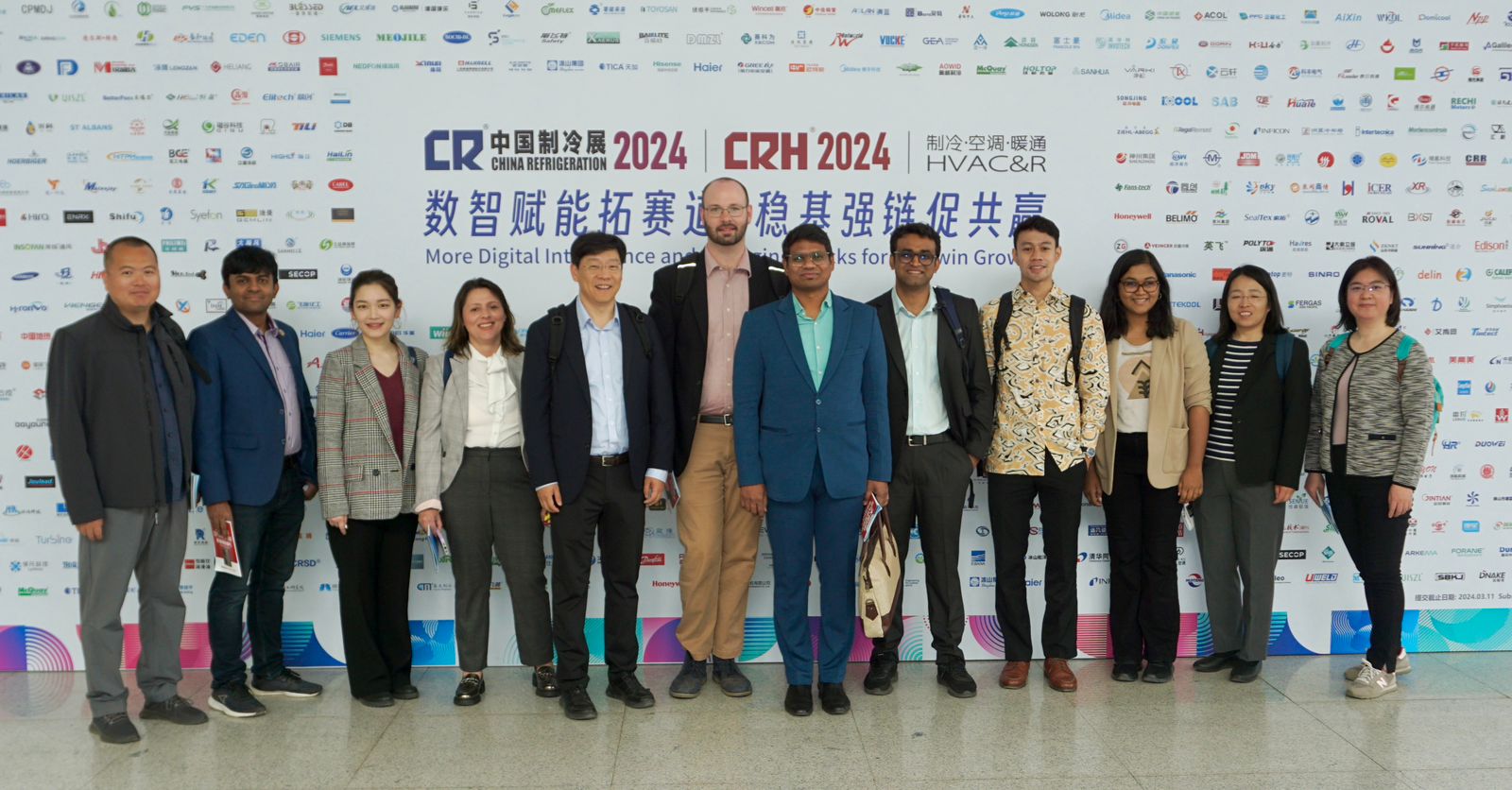
CLASP's global team at the China Cooling Expo 2024
CLASP Chosen to Lead Initiative with Potential to Bring Clean Energy to Millions
Kigali, Rwanda – At the Transforming Energy Access (TEA) Forum in Kigali, Rwanda this week, CLASP was announced as the new host and manager of the Energy Access Institutions Facility, an initiative that seeks to provide core funding and technical assistance to organizations who accelerate access to life-changing, off-grid energy to millions of people around the world.
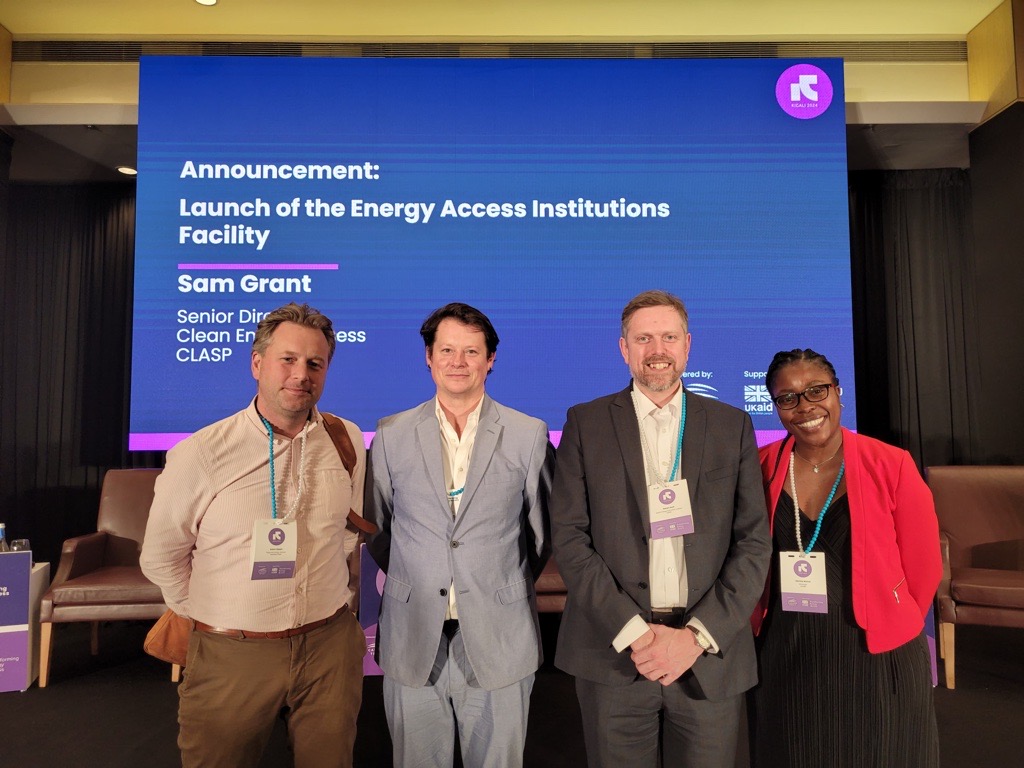
Over the next five years, the Facility’s vision is to deploy $25 million USD to a portfolio of five to ten impactful organizations, known as “market institutions”, that are working to grow the distributed renewable energy (DRE) sector. DRE systems are stand-alone, off-grid energy solutions that generate and distribute renewable energy without needing to be connected to the main grid. Expanding this sector has the potential to transform lives and livelihoods by increasing incomes, empowering women, enhancing educational opportunities, improving healthcare, reducing food waste, avoiding greenhouse gas emissions, and much more.
The Facility’s growing portfolio of organizations is expected to have reach across several countries in sub-Saharan Africa and South Asia, potentially increasing the delivery of renewable off-grid energy to millions of people from low-income communities.
Market institutions that support the following will be eligible to apply to the Energy Access Institutions Facility:
- Clean cooking solutions
- Energy efficient appliances and equipment
- Productive Use of Energy
- Standalone solar systems
- Micro grids and mini grids
This Facility is a result of multiple years of funding and commitment by the UK’s Foreign, Commonwealth and Development Office (FCDO) and the UK charity Shell Foundation (SF), and two years of incubation and development managed by Open Capital. FCDO and SF provided $5.5 million USD in seed funding to the first tranche of market institutions to prove this concept.
In the Facility’s first year, five market institutions, including the Africa Minigrid Developers Association (AMDA), Ethiopia Energy Market Accelerator (EMA), GOGLA, Nigeria Off-Grid Market Accelerator Programme (NOMAP), and the Uganda Off-Grid Market Accelerator, were the first grantees.
The Swedish International Development Cooperation Agency (Sida) has recently announced its commitment to providing approximately $4.5 million USD in funding for this next phase led by CLASP. This support will enable the Facility to disperse further funding to another round of market institutions and accelerate the Facility’s growth. In the coming months, CLASP is committed to securing additional funding from donors who have already indicated an interest in this impactful initiative.
Anders Arvidson, Senior Advisor and Team Lead in Sida’s Power Africa Team, noted:
“The Facility’s vision of accelerating access to clean energy for the world’s lowest-income people strategically aligns with Sida’s mission to reduce poverty around the world by partnering with the private sector in support of market development and mobilization of capital. We are proud to offer our support to take this initiative to its next phase, and to accelerate necessary growth in the clean energy sector. We look forward to working closely with CLASP to realize this vision.”
CLASP was selected because of the organization’s 25-year tenure as the leading, global organization advancing affordable, efficient appliances to mitigate climate change and help communities adapt and thrive. CLASP has proven expertise managing similar programs, including serving as the co-secretariat of the Efficiency for Access Coalition, an initiative supporting off-grid appliance market research and innovation; and as Operating Agent for the Super-efficient Appliance and Equipment Deployment (SEAD), a $20 million initiative under the Clean Energy Ministerial. CLASP also manages the Productive Use Financing Facility, a $6.5 million financing facility to catalyze the uptake of productive use appliances across East, West and Central Africa.
Christine Egan, CEO at CLASP, reflected on how the Energy Access Institutions Facility would push for real impact in the sector:
“The Energy Access Institutions Facility is positioned to impact and enhance millions of lives at a critical moment for sustainable development and global climate ambition. Exponentially increasing the number of people using off-grid, renewable energy and appliances will be a livelihood game changer in regions where access to traditional grid electricity is insufficient or non-existent. CLASP is committed to serving the sector and partnering with essential energy access institutions to deliver and scale collective impacts.”
In the coming months, CLASP will communicate opportunities for involvement and next steps for market-enabling organizations who are interested in participating, as well as donors who are interested in further supporting the Facility.
About the Facility
The Energy Access Institutions Facility is a joint donor initiative to support and strengthen the institutions that are essential for the achievement of Sustainable Development Goal 7, universal access to affordable, reliable, sustainable, and modern energy by 2030. The Facility is supported by the Swedish International Development Agency (Sida) and UK aid via the Transforming Energy Access (TEA) platform.
Learn more about the Facility.
About CLASP
CLASP is the leading global authority with 25 years’ expertise on how appliance efficiency drives climate mitigation, adaptation and improves the lives and livelihoods of people. An international nonprofit with offices on four continents, CLASP collaborates with policymakers, appliance manufacturers, and leading experts to deliver sound policy recommendations, innovative tools, groundbreaking research, and clear pathways to a more sustainable world for people and the planet.
CLASP Study Shows Appliance Efficiency Standards in the US Prevented Up to 4,400 Pollutant-Related Deaths Annually, Valued at $41 Billion
Washington DC, 11 March, 2024 – CLASP’s latest report, “How National Appliance and Equipment Energy Conservation Standards Can Improve Public Health and Advance Justice40 Initiative Goals,” finds that standards adopted over the past 30 years have led to substantial reductions in fine particulate matter (PM2.5) and PM2.5 precursor emissions, which are harmful pollutants that can cause respiratory and cardiovascular health issues such as asthma, lung cancer, or heart disease. Data from 2017 suggest that this reduction could prevent between 1,900 and 4,400 PM2.5-related deaths every year. Using the value of statistical life, this translates to monetary benefits of $18 to $41 billion.
Importantly, CLASP’s study finds that the benefits of these standards are distributed relatively equitably among communities with those designated as disadvantaged by Justice40, an initiative aiming to ensure that 40% of the overall benefit of federal climate investments go to disadvantaged communities, receiving a significant share.
These findings demonstrate the far-reaching positive impacts of standards and highlight the importance of the US Department of Energy meeting its deadlines for updating approximately 50 appliance efficiency standards, including for water heaters, by January 2025. Finalizing all pending standards could avert 2.5 billion metric tons of greenhouse gas emissions while saving consumers nearly $1 trillion over 30 years, according to the agency.
The report outlines actionable recommendations to amplify the benefits of standards and suggests ways to measure their contribution towards Justice40 goals. By implementing these recommendations, policymakers, industry stakeholders, and communities can work together to ensure that national appliance standards continue to drive positive change for all people and the planet.
Read the full report here.
Fighting Extreme Temperatures with the Inflation Reduction Act
The US has experienced extreme and dangerous freezing temperatures this winter – with dozens of deaths attributed to exposure to the bitter cold. Last summer saw sweltering heatwaves across the country shatter previous records.
Heat pumps help people and the planet
Heat pumps – an energy efficient, all-electric indoor space heating and cooling technology – are a key solution for controlling indoor temperatures, while reducing the use of fossil fuels like methane gas and oil.
In 2022, The Inflation Reduction Act (IRA), became the biggest climate investment in US history. It funded electrification efforts to increase the widespread adoption of heat pumps, with the aim to make climate-friendly home temperature control accessible to all communities.
Additional policymakers’ action can drive adoption
According to a new report from CLASP and the Regulatory Assistance Project, the IRA funds are insufficient to increase heat pump adoption to the level needed. The research shows that although the IRA is projected to incrementally increase heat pump deployment this decade, complementary state level policies and initiatives could be the key to supercharging heat pumps implementation as a critical climate-solution.
The report outlines effective and proven tactics to drive heat pump adoption – including community engagement, energy efficiency and performance policies, workforce development and financing mechanisms. Hybrid heating, a strategy developed by CLASP and partners to introduce homeowners to heat pumps by pairing them with legacy heating systems, offers another path forward.
The report advises that state policymakers utilize a combination of these approaches to craft a winning strategy that drives familiarity, acceptance, and widespread adoption of heat pumps to make the best use of federal dollars. This would be a win for people and the planet.
Learn more how CLASP and RAP are supporting accelerated heat pump adoption here.
Improving Public Health & Advancing Equity Goals with Appliance Energy Efficiency Standards
Federal energy efficiency standards for appliances and equipment lead to cleaner air, creating health benefits. By conserving energy, standards reduce both indirect emissions (from power plants) and direct emissions (from fossil fuel appliances). This decreases human exposure to fine particulate matter (PM2.5) pollution, a harmful form of particle pollution capable of entering the lungs and bloodstream and contributing to increased incidences of respiratory and cardiovascular health complications.
This factsheet summarizes the key findings from a recent report that estimates the distribution of public health benefits in disadvantaged communities in the United States. Specifically, it estimates the reductions in PM2.5-related deaths that can be attributed to standards adopted over a 30-year period and explores how standards can contribute to Justice40 Initiative goals.
Net Zero Heroes Event: The Essential Appliances for Climate Action
On 28 November 2023, CLASP hosted a virtual launch of the landmark publication ‘Net Zero Heroes: Scaling Efficient Appliances for Climate Change Mitigation, Adaptation & Resilience’. The event showcased how ten essential appliances, the #NetZeroHeroes, are crucial for achieving global climate objectives and advancing climate adaptation and resilience efforts.
Watch the recording to hear inspirational case studies and powerful data that prove the effectiveness and scalability of affordable, efficient appliance solutions. The Net Zero Heroes flagship report is launched ahead of the 2023 United Nations Climate Change Conference Conference (COP28) to be held in Dubai, United Arab Emirates (30 November-12 December 2023).
Event speakers
Our event featured a diverse group of experts who shared their insights and experiences in the world of energy efficiency, climate action, and appliance innovation.
- Axum Teferra – Clean Cooling Collaborative
- Christine Eibs Singer – Shine Campaign
- Christine Egan – CLASP
- Duncan Gibb – Regulatory Assistance Project (RAP)
- Oliver-Bealby Wright – Consumers International
The event was moderated by Joyita Mukherjee, a CLASP board member and expert in international development and blended finance.
Follow our #NetZeroHeroes digital campaign on social media.
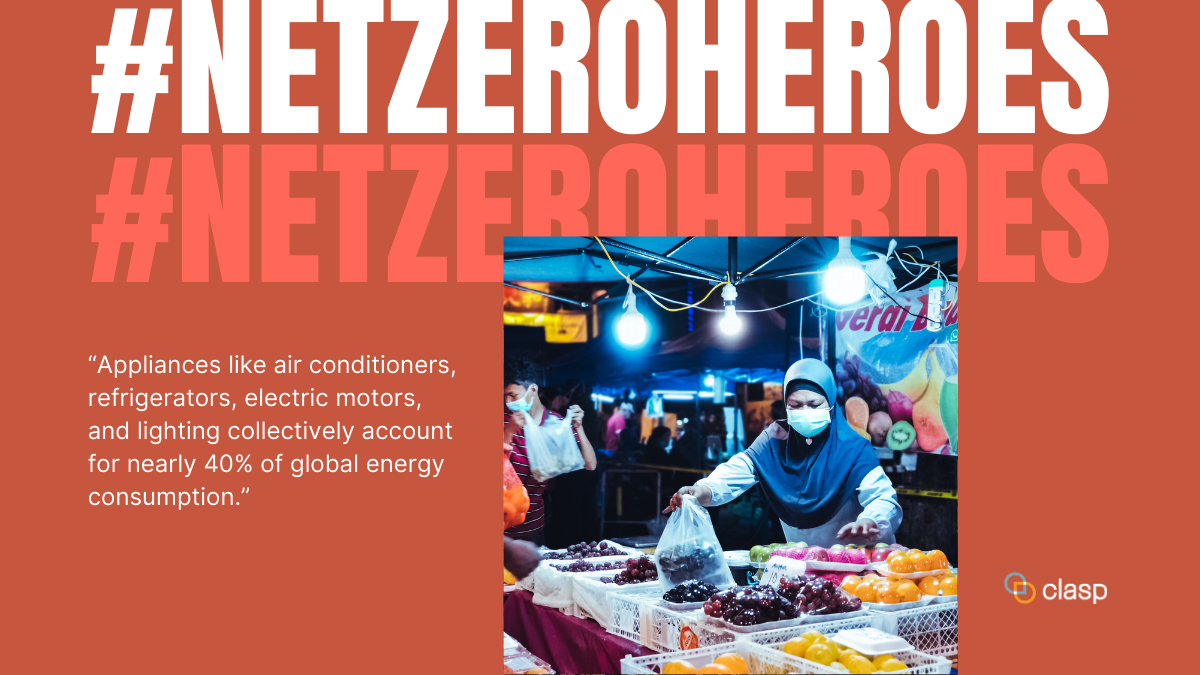
CLASP's Net Zero Heroes Air Conditioners, Comfort Fans, Refrigerator-Freezers, Heat Pump Space & Water Heaters, Electric Motors, Electric Cookers, Televisions, Solar Water Pumps
Net Zero Heroes: Scaling Efficient Appliances for Climate Change Mitigation, Adaptation & Resilience
Efficient appliances, lighting, and equipment are critical climate solutions, situated at the nexus of mitigation, adaptation, and sustainable development.
However, not enough is being done to maximize their benefits. In this report, CLASP lays out actions that must be taken by 2030 to put the world on a pathway to net zero emissions and enable a just energy transition. Our research identifies the ten appliances most vital to meeting global climate mitigation targets and improving people’s lives: the Net Zero Heroes.
Visit the Net Zero Heroes site to read and download the report.
Gas Cooking Appliances Cause Regular Pollution Breaches in Homes across Europe
Brussels, Belgium – Cooking on gas regularly fills kitchens with air pollution above recommended levels, the largest-ever home monitoring study in Europe has found.
The World Health Organization (WHO) daily limit value for nitrogen dioxide (NO2) exposure was broken in most (57.3%) of the homes using gas hobs and/or gas ovens that were tested under normal living conditions by leading scientific researchers.
NO2 levels were found to be almost twice as high in kitchens, living rooms, and bedrooms in homes cooking on gas compared to those using electric appliances, on average. Breaches in 15.9% of homes using electric appliances were caused mainly by outside air pollution blowing in, the researchers say.
The research, commissioned by nonprofit energy efficiency group CLASP, was conducted by the Netherlands Organisation for Applied Scientific Research (TNO). Sensors were placed in 247 homes [1] in seven countries with large populations cooking on gas and childhood asthma cases linked to cooking on gas.
Breaching limit values increases health risks. NO2 can cause inflammation of human airways, coughing and wheezing, reduced lung function, and increased asthma attacks, especially in children. Children in homes with a gas cooking appliance have a 20% increased risk of suffering a lower respiratory illness, the WHO estimates.
Pollution spikes in homes cooking on gas could last several hours and were more intense the longer the cooking time, the researchers found. Added together, the WHO daily limit was breached for 3.25 days over the 13-day testing period, on average. Where kitchens had fans to extract fumes outdoors, they did not clear much pollution. This is because of improper use, the researchers think.
Extrapolating to a year, the data shows that a quarter of homes (25%) cooking on gas breached EU and UK hourly NO2 limits for outside air quality. Authorities across Europe have been forced to respond to breaches of these limits. Yet EU regulators have not set limits for indoor air pollution.
Little has been done to prevent NO2 pollution from gas cooking appliances in Europe, CLASP wrote in its report summarizing the research. Various regulations could limit air pollution from appliances, but fail to, it said. The problem could be corrected at EU level next year when new design and labelling rules are expected to be adopted.
At a stakeholder meeting with EU officials, initially set for 30 November 2023 and postponed until March 2024, CLASP will call for a new EU energy label comparing gas and electric hob efficiency and highlighting pollution levels.
Nearly a third (32.5%) of homes in the EU cook on gas. But few are aware of the risks due to the invisible nature of the pollution, according to a recent opinion poll commissioned by CLASP and conducted by Opinium. If made aware, up to three quarters of respondents (74%) say they would consider getting rid of their gas appliances.
Nicole Kearney, CLASP Europe Director, said: “Our research reveals the severity of air pollution caused by gas cooking appliances in homes across Europe. Cooking up a change starts with awareness. Empowering people with knowledge on the health risks of these products is essential, and they need resources to upgrade to cleaner and healthier hobs and ovens. In turn, governments must protect public health, tackling air pollution at the source and supporting the transition to cleaner cooking.”
TNO senior scientist, Piet Jacobs, said: “Based on our field study data we estimate that in about 25% of the European kitchens cooking on gas the EU NO2 limit value for 1-hour exposure is exceeded, where outside levels were below these values. Changing to electric cooking, preferably combined with use of well-designed ventilation hoods to reduce exposure to high levels of particulate matter from cooking, can bring these values down to below recommended levels.”
Professor Frank Kelly of Imperial College London said: “Gas hobs and ovens are a major source of indoor air pollution, including NO2, which can both exacerbate existing health conditions and potentially lead to new respiratory illnesses. For children with asthma, the presence of gas cooking appliances can intensify their symptoms. Removing these appliances from our homes will improve indoor air quality and mitigate potential risks to public health.”
The scientists also measured for fine particulate matter. In kitchens, this is caused by outdoor pollution blowing in and food cooking, rather than the appliance fuel source. The scientists found no significant difference in emissions between homes cooking on gas and electric.
Ends
CLASP Report – Clearing the Air: Gas Cooking and Pollution in European Homes
TNO Report – Health Effects in Europe from Cooking on Gas – Phase II Field Study
Press releases are available in the following languages:
Dutch, English (UK), English (US), French, German, Hungarian, Italian, Romanian, Slovak, Spanish.
Contacts
- CLASP Europe director Nicole Kearney (EN) +44 75 4486 5924
- CLASP Europe senior communications associate Païline Caroni (EN, FR) +32 473 127 674.
- ICL professor Frank Kelly (EN) +44 (0)20 7594 8098
- CLASP communications consultant Jack Hunter (EN) +33 751 051 805
- TNO press officer Maarten Lörtzer (EN, NL) +31 620420732.
About CLASP:
CLASP is an international nonprofit leading the research and promotion of appliance efficiency and energy access to improve the lives of people and the planet. CLASP works to combat climate change and drive the transition to a more energy-efficient and just future where no one is left behind. Headquartered in Washington DC, and based in Beijing, Brussels, Dehli, Jakarta and Nairobi, CLASP works with governments, appliance manufacturers and partners to advance positive change on a global scale.
Notes
[1] Market research firm Opinium selected 40 homes each in France, Italy, the Netherlands, Romania, Slovakia, Spain, and the UK, where residents cook at least 3 days a week, are non-smokers, and are not near busy main roads or industrial plants. More than 40% of homes include children. One in 5 cook purely on electric, while 4 in 5 cook purely on gas, either ovens, hobs or both. In all homes, sensors were placed in the kitchen, living room and a bedroom to measure NO2, fine particulate matter, and carbon monoxide. Outdoor sensors detected NO2. Participants were told to cook and behave normally. Each was paid €100. Only data from 247 homes that successfully followed instructions over a 13-day period in 2023 were included. The previous largest EU study of exposure to NO2 based on continuous sensor data took readings from 16 homes.
CLASP’s #NetZeroHeroes hit back at the climate crisis with actionable solutions
In the lead up to the United Nations Framework Convention on Climate Change 28th Conference of the Parties (COP28) in Dubai, United Arab Emirates from 30 November – 12 December, CLASP is launching #NetZeroHeroes – a celebration of the people and appliance heroes that are critical in reaching global Net Zero targets and promoting resilience in an already warming world.
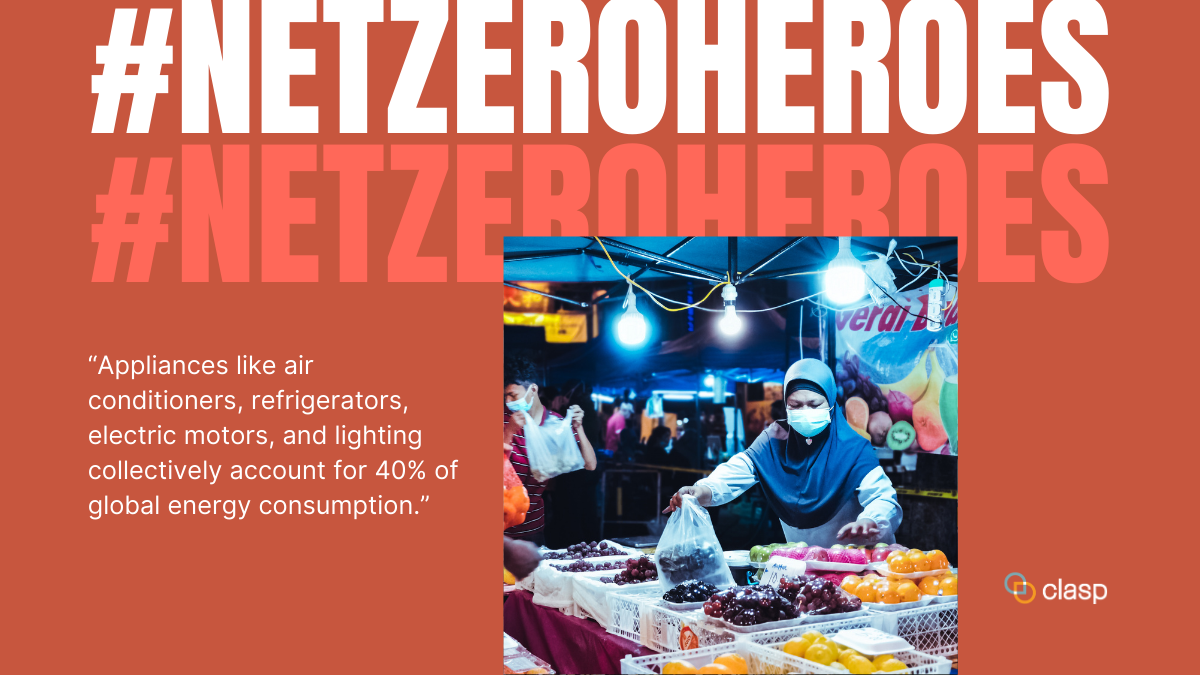
Appliances like air conditioners, refrigerators, electric motors, and lighting collectively have a major climate impact. They are responsible for a staggering 40% of energy-related carbon dioxide (CO2) emissions globally, according to CLASP’s forthcoming report ‘Net Zero Heroes: Scaling Efficient Appliances for Climate Change Mitigation, Adaptation & Resilience.’ CLASP’s research shows how rolling out affordable, energy efficient alternatives is key to mitigating and adapting to the climate crisis and achieving the United Nations’ Sustainable Development Goals.
CLASP's Net Zero Heroes Air Conditioners, Comfort Fans, Refrigerator-Freezers, Heat Pump Space & Water Heaters, Electric Motors, Electric Cookers, Televisions, Solar Water Pumps
Through a series of reports, videos and articles highlighting stories of leadership and expert perspectives from across the sector, #NetZeroHeroes will amplify the urgent and immediate need to deploy efficient appliances at speed and scale to protect people and the planet.
The campaign will culminate in CLASP’s groundbreaking publication, “Net Zero Heroes: Scaling efficient appliances for climate change mitigation, adaptation & resilience” – launching the week before COP28 and available on CLASP’s website.
This research will highlight the transformative potential of efficient appliances by:
- Quantifying appliances’ ability to achieve the emissions reductions needed to meet the goals of the Paris Climate Agreement;
- Indicating where we should scale our efforts this decade for maximum impact;
- Analyzing gaps in access to appliances and recommending where scale-up would better enable communities to adapt in a warming world;
- Providing a roadmap of solutions that governments, investors and other stakeholders can implement today to get on track to net zero emissions and an inclusive energy transition.
Stay tuned and follow #NetZeroHeroes on social media. This page will serve as a homebase for all campaign materials and will be updated regularly.
If you are interested in getting involved with the campaign, reach out to Lexi Ross at aross@clasp.ngo.
Explore the Campaign

Net Zero Heroes
CLASP’s landmark report identifies the ten appliances that should form the basis of an unprecedented efficiency push: the #NetZeroHeroes.
Efficient appliances combat the triple planetary crisis of climate change, air pollution, and biodiversity loss.
CLASP’s analysis finds that the appliance sector accounts for nearly 40% of energy-related CO2 emissions. Appliances are on pace to surpass the IEA’s 2050 net zero targets by over 9 gigatons CO2. At the same time, there are profound inequities in access to appliances, leaving billions vulnerable to the effects of climate change. At least 1.2 billion people lack access to air conditioners and fans, making it difficult to cope as temperatures rise.
The first-of-its-kind report provides a clear roadmap for realizing mitigation and adaptation potential by rapidly increasing the efficiency of the Net Zero Heroes.
Explore the data, recommendations, and analysis, and download the report on our interactive Net Zero Heroes Report Website.
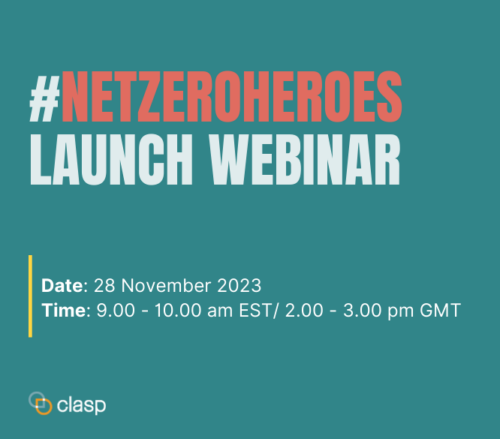
Net Zero Heroes Webinar: The Essential Appliances for Climate Action
This webinar launched CLASP’s landmark publication ‘Net Zero Heroes: Scaling Efficient Appliances for Climate Change Mitigation, Adaptation & Resilience’ with an expert panel.
A compelling discussion about the efficient appliances that are key to mitigating and adapting to the climate crisis.
This webinar launched CLASP’s landmark publication ‘Net Zero Heroes: Scaling Efficient Appliances for Climate Change Mitigation, Adaptation & Resilience’, with a compelling discussion about the efficient appliances that are key to mitigating and adapting to the climate crisis and achieving the world’s Sustainable Development Goals.
During the event, our panelists also discussed inspirational case studies and powerful data that prove the effectiveness and scalability of affordable, efficient appliance solutions. The event panel includes a diverse group of experts who shared their insights and experiences in the world of energy efficiency, climate action, and appliance innovation.
- Axum Teferra – Clean Cooling Collaborative
- Christine Eibs Singer – Shine Campaign
- Christine Egan – CLASP
- Duncan Gibb -Regulatory Assistance Project (RAP)
- Oliver-Bealby Wright – Consumers International
The event is moderated by Joyita Mukherjee, a CLASP board member and expert in international development and blended finance.
Appliance Efficiency in NDCs
In the leadup to COP28, this report emphasizes the opportunity for governments to bolster their climate commitments by integrating ambitious appliance efficiency targets into the next round of NDCs.
Appliance efficiency is an important mitigation solution, but it’s often left out of nationally determined contributions (NDCs)
Nationally determined contributions (NDCs) lie at the heart of the Paris Agreement, guiding the actions of governments around the globe. One climate solution that’s often missing from these plans is appliance efficiency, which is critical to lowering global energy demand and emissions. New CLASP analysis reveals that only 47% of NDCs mention appliances, while a mere 25% reference key policies such as Minimum Energy Performance Standards (MEPS) and appliance labeling. To realize the enormous potential of appliance efficiency, CLASP urges governments to take action.
Getting Appliances Back on Track
This report tracks the progress of 15 countries who signed onto the Appliance Efficiency Call to Action in 2021 at COP26 in Glasgow, which pledged to double the energy efficiency of four product categories by 2030.
Air conditioners (ACs), lighting, electric motors, and refrigerators collectively account for more than 40% of global electricity consumption.
“Getting Appliances Back on Track” is the first publication of CLASP’s #NetZeroHeroes COP28 digital campaign. The report offers valuable analysis to economies already committed to prioritizing appliance energy efficiency, and illustrates a path toward success for governments interested in joining as a Call to Action signatory.
The Global Appliance Stocktake
Director of Climate Research at CLASP and author of the “Getting Appliances Back on Track” report, Matt Malinowski, provides an honest look at where we stand globally with energy efficiency commitments.
Countries are not on track to meet their commitments to double the efficiency of priority appliances.
“In the wake of this year’s alarming UN climate global stocktake, my colleagues at CLASP and I looked back on the Call to Action and wondered: Are countries on track to meet their commitments to double the efficiency of priority appliances? The short answer is no. The long answer is that we are falling behind, but there is a clear path to success.” -Matt Malinowski, Director of Climate Research & author of “Getting Appliances Back on Track”

2023 Tech Trends Series
This series offers up-to-date market insights for off-grid cooling, cooking and agricultural productive-use appliances.
Off-grid refrigeration plays a vital role in a warming world, but new research from Efficiency for Access shows that the sector is struggling.
Building upon the insights presented in Efficiency for Access’ 2021 Solar Appliance Technology Briefs, this Tech Trends series provides a window into the rapidly evolving appliances markets. This series synthesizes technical, impact and market research done by Efficiency for Access and partners into a digestible snapshot.