
The EU Paves the Way for Greener Mobile Devices
Brussels, 4 September 2023 – The European Commission takes a major step to lower the environmental impact of smartphones and tablets. The new rules will decrease costs for consumers, mitigate carbon emissions and reduce the use of critical raw materials used in these devices.
Resource and Energy Efficiency Unite
From June 2025, in line with the new Ecodesign and Energy Labelling regulations, smartphones and tablets entering the EU market will be required to meet minimum requirements and provide information on product energy efficiency, ease of repair, battery lifespan, resilience against dust and water, as well as resistance to accidental drops. The Energy Labelling Regulation introduces a requirement for mobile devices to display the A-G energy class rating, as well as a score for each aforementioned aspect. Further product information will be accessible through the European Product Registry for Energy Labelling (EPREL).
The European Commission said, “These measures help to make the EU’s economy more circular, save energy, cut our carbon footprint, support circular business models and deliver the benefits of the European Green Deal for consumers. Mobile phones and tablets produced according to these rules will save almost 14 terawatt hours in primary energy each year by 2030. This is one third of the primary energy consumption of these products today.”
The combined impact of the Ecodesign and Energy Labelling regulations is estimated to reduce purchase, repair, maintenance and energy-related costs for consumers by 25%, while mitigating 53 megatons of carbon dioxide emissions by 2040. They also aim to decrease the use of new materials for production by 35%, along with a 22% reduction in the use of critical raw materials.
CLASP Research Empowers Repair and Sustainability
CLASP, along with Right to Repair Europe, played an instrumental role in shaping the Ecodesign Regulation. Their research highlighted the challenges EU citizens face in repairing their devices, due to limited options imposed by Original Equipment Manufacturers (OEMs) that only offer repairs for specific key parts.
CLASP found that limited repair options drive consumers to purchase new smartphones and tablets. This ultimately shortens the lifespan of devices and contributes to increased electronic waste, which threatens the repair ecosystem and undermines resource efficiency goals. Following our recommendations, the Ecodesign Regulation comprehensively addresses factors that limit product lifespans and hinder recycling. It ensures the accessibility of spare parts, encourages ease of repair, enhances reliability and promotes second-hand markets.
Nicole Kearney, CLASP Europe Director, states “The European Commission has demonstrated an exemplary focus on prioritizing circularity and the consumer’s right to repair. Ensuring Europeans can more easily repair, rather than replace, their smartphones and tablets, will help reduce e-waste, carbon emissions, as well as costs for consumers.”
Towards a circular electronics revolution
The EU’s leadership on resource and energy efficiency for smartphones sets the precedent for other regions and countries to adopt similar regulations and has the potential to create a ripple effect of positive change. The Ecodesign and Energy Labelling regulations enable a repair over a replace economy, requiring the electronic appliance industry to prioritize product durability and circular economy principles. This framework demonstrates the regulatory capacity to revolutionize the industry, fostering innovation, efficient resource utilization and environmental awareness.
Next steps
The new Ecodesign and Energy Labelling rules were published in the EU Official Journal on 31 August 2023 and will become fully applicable on 20 June 2025. This period offers stakeholders the opportunity to adjust and comply with the new regulations.
For media inquiries and more information, please contact
Païline Caroni
Communications – CLASP Europe
About CLASP:
CLASP is an international nonprofit leading the research and promotion of appliance efficiency and energy access to improve the lives of people and the planet. CLASP works to combat climate change and drive the transition to a more energy-efficient and just future where no one is left behind. Headquartered in Washington DC, and based in Beijing, Brussels, Dehli, Jakarta and Nairobi, CLASP works with governments, appliance manufacturers and partners to advance positive change on a global scale.
CLASP Showcases Universal Labeling Module at the European Sustainable Energy Week
On 20-22 June, CLASP Europe’s team joined the European Sustainable Energy Week (EUSEW) in Brussels to highlight the importance of energy efficiency and online energy labeling in Europe’s efforts to transition to more sustainable energy use.
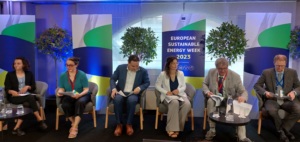
In the session “Tapping the Full Potential of Energy Efficient Products via Digital Tools,” Senior Adviser Marie Baton showcased a new labeling module, which is part of a set of studies and tools which aim to improve online labeling compliance for retailers. CLASP’s labeling module, designed in conjunction with the now ready for retailers to pilot test.
“The online labeling module provides correct, up-to-date information in the right format, in line with EU labeling regulations. Ultimately, the tool helps consumers make greener, more energy-efficient choices which will accelerate the clean energy transition, without increasing the burden on retailers.”
Nicole Kearney, CLASP Europe Director
Earlier this year, CLASP, with Center Data and Ipsos, conducted a behavior study of 4,800 European consumers across four countries to help improve online energy labeling[1]. The preliminary findings indicate that the majority of consumers would be likely or very likely to purchase an appliance online (85%) or do online research prior to visiting a brick-and-mortar shop (93%). CLASP will release the full report by the end of 2023.
As the world increasingly digitalizes, new tools can promote energy-efficient technologies. The panelists, which included speakers from the European Commission, the European Consumer Organisation, EuroCommerce, and Guide Topten, stressed the need for transparency, improved consumer awareness, and more appliance options that are sustainable and efficient.
The European Sustainable Energy Week is the biggest annual event dedicated to renewables and efficient energy use in Europe and is organised by the European Climate, Infrastructure and Environment Executive Agency and the European Commission’s Directorate-General for Energy in Brussels.
More information on CLASP’s online labeling module will be provided in an upcoming webinar, which will be announced in the near future.
[1] This research is being undertaken to develop recommendations for the European Commission in order to simplify energy labeling requirements for online retailers.
CO₂ Avoidance from an EU Phase-Out of Gas Cooking Appliances
CLASP has estimated the potential CO₂ savings from a progressive EU phase-out of gas hobs from the market from 2025 to 2029. This scenario represents the effect of an energy label that compares hobs starting in 2025, followed by the implementation of Ecodesign efficiency requirements in 2029, which gas hobs would not be able to meet.
The policy options and scenarios proposed in the 2022 JRC study only consider incremental improvements of each technology (i.e., gas hobs, radiant and induction, with an exemption of hotplates). With this analysis, CLASP wanted to put forward the CO₂ emission reduction potential of shifting from gas to electric hobs.
Gas cookers regularly breach air pollution limits
Gas cookers regularly breach air pollution limits – study
Fears that winter energy crisis will worsen asthma burden
Home gas cookers cause weekly breaches of air pollution limits, a new study suggests.
The report by the non-profit energy efficiency group CLASP and European Public Health Alliance (EPHA) with technical input [1] by the Organisation for Applied Scientific Research (TNO) suggests that cooking on gas in a typical kitchen without mechanical ventilation causes indoor nitrogen dioxide (NO2) pollution that exceeds World Health Organisation air quality guidelines and outdoor EU air pollution standards multiple times each week throughout the year.
Separate TNO lab tests showed that gas hobs also produced carbon monoxide, ultrafine particles and other pollutants that can cause severe health effects, particularly for children. The number of children in the EU with asthma symptoms occurring within the last 12 months due to cooking on gas is estimated at over 700,000, or 12% of EU child current asthma cases, according to the report.
Over 100 million EU citizens cook on gas, including more than half of all homes in Hungary, Italy, the Netherlands, Romania and Slovakia. Health groups fear that the situation could get especially bad due to the energy crisis this winter, as people reduce ventilation to save heat and money.
CLASP CEO, Christine Egan, said: “People spend the majority of our time indoors. Indoor air quality can have a major impact on our health and well-being. Few people are aware of the harmful risks posed by gas cooking appliances – cooking your dinner could expose you to as many pollutants as second hand smoke. Gas cooking appliances need health warning labels like cigarette packets. EU officials have an obligation to consider these health risks.”
The American Medical Association recently noted that gas stoves increase household air pollution and the risk of childhood asthma and its severity. Previous research has linked home gas use to attention deficit hyperactivity disorder in young children. A recent study suggests that cooking with gas during pregnancy can result in hyperactivity in toddlers. Pollution from gas cooking has been shown to also have negative impacts on the respiratory and nervous systems of adults.
EPHA director general, Dr Milka Sokolović, said: “We fear that indoor air quality could get especially bad this winter in homes using gas cookers, as people reduce ventilation and avoid opening windows to save heat and money during the energy crisis. With fewer air exchanges with the outside, it is increasingly important to tackle indoor sources of air pollution, such as gas stoves. Children and people with pre-existing respiratory conditions are most at risk of negative health impacts.”
For all the health and environmental damage that is linked to burning fossil fuels in our homes, governments have a responsibility to set in place frameworks that lead us away from gas and towards clean electric cooking. The current revision of the cooking appliances regulation provides an opportunity for the EU to prove that it is living up to its Zero Pollution vision and ambition.”
EU officials have a treaty obligation to factor in health when regulating, as recently confirmed by the European Court of Justice. But current domestic cooking standards fail to do so, CLASP and EPHA said. New standards are expected next year. But while the preparatory study acknowledged that cooking “is a significant source of indoor pollutants” with gas creating additional pollution, the study was limited to mitigation measures. Gas cookers should be phased out under Ecodesign regulations, the groups said.
Learn more about CLASP’s efforts to phase out gas cooking in Europe on our webpage here.
Notes
[1] TNO simulated the cooking of typical European meals on gas over a one week period using average cooking techniques in average kitchen conditions with no use of range hoods venting to the outside. In all the simulations where mechanical ventilation was not used, the EU outdoor hourly limit value of 200 µg/m3 NO2 was exceeded indoors above the permitted 18 hours per year. Kitchen size is a factor and ventilation reduces pollution, but vents are often ineffective, insufficient or underused, the report notes.
Contacts
- CLASP Europe Director Nicole Kearney (EN) +44 75 4486 5924
- CLASP Europe Senior Advisor Michael Scholand (EN) +44 7931 701 568
- EPHA Junior Policy Manager Cristina Pricop (EN, RO) +32 499 35 12 89
- CLASP Communications Manager Hannah Blair (EN) +1 225 239 9014
- CLASP Communications Consultant Jack Hunter (EN) +33 751 051 805
- TNO Press Officer Kees Nanninga (EN, NL, DE) +31 88 866 10 17
Translations
Exposing the Hidden Health Impacts of Cooking with Gas
Gas cooking appliances need health warning labels like cigarette packets. EU officials have an obligation to consider these health risksChristine Egan
CLASP CEO
All gas cooking appliances release pollutants that are harmful to human health and the environment. Air pollution has been recognised by the European Environment Agency as the biggest environmental health risk in Europe, while the World Health Organisation included it on the list of ten major threats to global health.
Exposure to high levels of pollution is known to cause strokes, heart disease, lung cancer, and both chronic and acute respiratory diseases, including asthma. The impact of gas cooking on the burden of childhood asthma to be comparable to that of second-hand smoke
With new research, this report:
- Synthesises the health risks of cooking with gas
- Quantifies the societal cost
- Identifies how gas cooking undermines environmental and electrification efforts
- Offers insights on the shortcomings of hydrogen as a cooking fuel
- Gives actionable solutions to phase out gas cooking appliances across the EU-27, in favour of electric alternatives
Visit our Europe Cooking homepage to view the TNO reports and additional resources.

CLASP Joins Civil Society Organisations to Call EU Commission “Phase out domestic gas cooking appliances to protect health”
In a joint letter sent today, the European Public Health Alliance (EPHA) and 14 other signatories call upon European Commission executive vice-president Frans Timmermans and EU Commissioner for Energy Kadri Simson to phase out domestic gas cooking appliances, as they endanger Europeans’ health.
Gas stoves release toxic pollutants that are linked to a number of health problems, such as asthma in children, and coughing, wheezing or difficulty breathing in respiratory disease patients. A significant 7,3% of cases of paediatric asthma in the EU-27, which cost society an estimate 3.5 billion Euros per year, could be avoided if gas stoves were removed from homes – according to a forthcoming study by independent research organisation TNO. The study also reveals that levels of indoor nitrogen dioxide (NO2) often exceeding the World Health Organization standards, applicable both for indoor and outdoor air quality, can be found in kitchens using gas.
Despite gas stoves representing this danger to human health, indoor air pollution from gas cooking remains unregulated at the EU level, the letter notes. The signatories of the letters, who are several health and environmental civil society organisations, ask the European Commission to phase out the sale of gas cooking appliances by setting NO2 emission limits for stoves through the ongoing revision of the Ecodesign and Energy Labelling on Cooking appliances.
In addition to being an effective tool to improve energy efficiency, Ecodesign legislation has a “substantial potential” to contribute to “reduced air pollution” and standards for emissions of nitrogen oxides have long been in place for other products such as space heaters.
This call from civil society comes ahead of the Ecodesign and Energy Labelling Consultation Forum on Cooking appliances on 29 November.
At the meeting, the Joint Research Centre (JRC), the European Commission’s scientific advisory department, will present its study “Preparatory study of ecodesign and energy labelling measures for domestic cooking appliances” which cautions against the dangers of cooking as a “significant source of indoor pollutants” and points to NO2, carbon monoxide (CO) and unburned methane being released by gas stoves.
The global movement against gas stoves is growing. On the same day of the letter’s release, a new coalition is being launched to promote universal access to safe, fossil-fuel-free, affordable and sustainable cooking. The Global Cooksafe Coalition brings together organisations from the spheres of public health, property and the built environment, fair food, renewable energy, energy efficiency, aid and development, and climate change science and advocacy.
Dr Milka Sokolović, EPHA Director General, said: “We must stop burning fossil fuels in our homes. Given the evidence on childhood asthma and other health problems linked to gas cooking, the EU must live up to its commitment to the Health in All Policies approach and support and accelerate the transition to clean cooking through Ecodesign legislation.”
Nicole Kearney, CLASP Europe Director, said: “Gas cooking is also undermining EU economic development plans and the climate agenda. We found that asthma related to gas cooking costs the EU €3.5 billion and individual taxpayers €25 annually. Further, research shows that cooking on gas releases harmful emissions including nitrogen dioxide, carbon monoxide, ultra-fine particles and methane – a fossil gas that, per molecule, has 80 times the global warming potential of CO2.”
Carolina Koronen, Programme Manager at ECOS, said: “Gas cooking appliances are not only a health hazard. They are extremely inefficient compared to their electric counterparts, and they have no place in a renewable-based energy system. Phasing out gas appliances from kitchens is needed to bring European homes out of the fossil fuel era.”
The full letter can be read here.
Learn more about CLASP’s efforts to phase out gas cooking in Europe on our webpage here.
Media Contact:
Cristina Pricop – Junior Policy Manager, EPHA
+32 499 35 12 89/ +40 749 527 020
Notes to Editors
Full list of signatories of the joint letter to the European Commission: European Public Health Alliance (EPHA), CLASP, Environmental Coalition on Standards (ECOS), European Academy of Paediatrics, European Environmental Bureau (EEB), Global Cooksafe Coalition, Polish Society for Health Programs, Bulgarian Association for Patients’ Rights Defence, Institute for Health and Environment (Inštitut za zdravje in okolje), Respire, GLOBAL 2000 – Friends of the Earth Austria, Kyoto Club, ECODES, Natuur & Milieu, Bond Beter Leefmilieu.
EPHA is an umbrella public health NGO, with national and European members representing health professionals, public health organisations, and patients and disease-specific groups. We work on different public health-related topics such as global health, including air pollution, a cross-border threat and the biggest environmental health risk in Europe.
CLASP Europe Kicks Off Project to Accelerate the Transition to Clean Cooking
Gas cookers release toxic pollutants – such as CO, NO₂ and ultrafine particles – into homes across Europe every day, putting the health of people and the planet at risk. Research shows that children and low-income communities face an elevated risk of negative health impacts, such as increased likelihood to develop respiratory issues like asthma.
“I think of this like a tailpipe in your kitchen – you are burning fossil fuel and combusting it directly in your home – often without ventilation,” said CLASP Senior Advisor Michael Scholand at the International Conference on Indoor Air Quality in June. “40 years of research have shown there is strong correlation between health and respiratory disorders, and indoor air pollution from gas stoves.”
With the advent of cleaner, more efficient cooking technologies like induction cookers, now is the time to take the tailpipe out of EU and UK homes.
With support from the European Climate Foundation (ECF), CLASP launched a new project to accelerate the transition to clean cooking in the region. Our team will collaborate with partners and policymakers to develop an EU and UK specific evidence base on the health effects of gas cooking appliances, initiate discussions on policy solutions, and raise public awareness on the health and climate impacts of cooking with gas.
Learn more about this multi-national campaign on our webpage here. To keep up to date with new research and join the conversation on phasing out gas cooking in Europe, follow our @CLASP_Europe Twitter account and use the hashtag #CookCleanerEurope.
Find CLASP at the International Conference on Energy Efficiency in Domestic Appliances and Lighting (EEDAL)
After more than two years, we are excited to attend in-person conferences to share insights into our global appliance energy efficiency work. From 1-3 June, team members from our Washington D.C., Nairobi, Europe and New Delhi offices will present at the International Conference on Energy Efficiency in Domestic Appliances and Lighting (EEDAL) in Toulouse, France.
Their presentations will cover the impact of television and lighting efficiency policy in India; Mepsy, a new tool to model energy and carbon reduction policies; product registration systems to support compliance of energy efficiency policies; opportunities for solar e-waste management in Sub-Saharan Africa; digital marketing campaigns for national energy labels; online energy label regulation in our changing digital markets, and more.
Find out more about their sessions below and reach out if you or one of your colleagues will be attending.
Wednesday June 1st, 2022
14:00 – 15:40
Session 1.a Policy 1
Evaluation of Television Efficiency Policy and Market Transformation in India
Kishore Kumar, CLASP India
Introducing Mepsy: The Appliance & Equipment Climate Impact Calculator
Angellah Wekongo, CLASP Kenya
Thursday June 2nd, 2022
10:45-12:25
Session 4.a Policy 4
Evaluation of Lighting Efficiency Policy and Market Transformation in India
Kishore Kumar, CLASP India
14:00-15:40
Session 5.a Policy 5
Role of Product Registration Systems in Supporting Compliance of Energy Efficiency Policies
Neha Dhingra, CLASP India
14:00-15:40
Session 5.b Appliances
Innovations for Sustainable Off-grid E-Waste Management Across Africa
Monica Wambui and Hannah Blair, CLASP Kenya
Friday June 3rd, 2022
8:30-10:10
Session 7.a Behaviour
Can digital advertising raise consumer awareness of energy efficient domestic appliances? A case study of the #KenyaEnergyLabel campaign
Hannah Blair and Angellah Wekongo, CLASP Kenya
10:45-12:25
Session 8.a Policy 6
Online Energy Labeling Regulation and Compliance in the Growing Online Market
Katriana Dubytz and Lina Kelpsaite, CLASP United States with Marie Baton (CLASP Consultant, Europe)
Abstracts
Evaluation of Television Efficiency Policy and Market Transformation in India
Kishore Kumar, CLASP India
Televisions play an essential role in the lives of millions of Indians as a source of information, entertainment and education. The television market in India has doubled over the last decade as the appliance has become commonplace across households, businesses and institutions, driven in part by increasing disposable income. The penetration of television ownership among households in the country is close to 66%, with sales of about 8.5 million units in Fiscal Year 2019-20.
Anticipating the rising sales of televisions and associated electricity demand, in 2009 India adopted an energy efficiency policy for televisions. The policy covers four technologies: cathode ray tube (CRT); liquid crystal display (LCD) with cold cathode fluorescent lamp (CCFL) backlit; LCD with light-emitting diode backlit (LCD-LED); and plasma. Since its adoption the television efficiency policy has been revised 3 times, raising minimum energy performance standards by 45% from initial levels and transforming the television market toward more efficient LED technologies. As of last year, India’s television efficiency policy had saved 20 Terawatt-hours of electricity and reduced carbon emissions by a cumulative 16.7 million tons.
This paper analyses market growth, technology evolution and market transformation resulting from the television energy efficiency policy, assesses potential policy revisions, and calculates potential efficiency gains through 2030.
Introducing Mepsy: The Appliance & Equipment Climate Impact Calculator
Angellah Wekongo, CLASP Kenya
Mepsy is CLASP’s free digital tool to model the impacts of energy and carbon reduction policies. Setting policies and achieving their benefits requires accurate, actionable data. Mepsy’s dynamic, user-friendly interface guides researchers and policymakers in identifying efficiency policy opportunities and analyzing their energy and carbon impacts. Pre-loaded with data from 162 countries, it supports analysis and prioritization for the most energy-intensive appliances and equipment— space heaters, air conditioners, refrigerators, fans, electric motors, televisions, and lighting—with more technologies being planned to be included in the tool. Efficiency standards often called MEPS (minimum energy performance standards) are a key building block in most national plans but the analytical tools used to support policy design have long been too difficult or expensive to use and customize. CLASP developed Mepsy to address these issues and make rigorous efficiency policy analysis accessible to the widest possible audience.
Mepsy accumulates appliances sales over lifetime to determine the number of appliances in use in a country, then incorporates the energy performance of locally-representative products, typical usage patterns, the climate-intensity of the national grid, and other variables to analyze the energy consumption, carbon dioxide emissions, and consumer energy costs associated with given policy scenarios.
Evaluation of Lighting Efficiency Policy and Market Transformation in India
Kishore Kumar, CLASP India
Electric lights are used by millions across India. The lighting market has increased exponentially over the years due to rapid population growth, more dwelling units, concept of smart lighting, and electrification at remote places. In Fiscal Year 2018-19, India manufactured about 1.4 billion lamps and tube-lights. The lighting segment consumes approximately 18% of total electricity use in the residential sector, resulting in 40 million tons of greenhouse gases (GHG) emissions.
Energy efficient lighting is one of the most cost-effective measures to address the impacts of growing electricity demand from the sector. Recognizing this, India adopted an energy efficiency policy for Tubular Fluorescent Lamps (TFL) in 2006. A decade later, an efficiency policy for LED bulbs was also announced to cover another new category of lamps as LEDs gaining a mainstream lighting market across industrial, commercial and residential installations. Since its adoption, 1.2 billion TFLs and 0.8 billion LED lamps have been star-labeled, thereby developing the market towards more energy-efficient lighting. India has experienced one of the most remarkable successes in market transformation for lighting as a result of efficiency policies and mass procurement exercises such as the UJALA scheme. Over the last 15 years, lighting efficiency policies have resulted in cumulative electricity savings of 18 Terawatt-hours and reduced GHG emissions by 15 million tons.
This paper analyses and discusses the trends in market growth, technology evolution, and market development as a result of lighting efficiency policies and further assess the potential for future policy revisions.
Role of Product Registration Systems in supporting compliance of energy efficiency policies
Neha Dhingra, CLASP India
Robust policy compliance and enforcement are key to realizing and safeguarding the benefits and the impact of appliance energy efficiency policies and market transformation initiatives. A product registration system is an integral tool to support policy compliance both at the national and regional level. It serves as an initial compliance gateway where manufacturers and suppliers register eligible products market entry, thereby accelerating implementation of the national and regional product efficiency policies. The product registration system also enables compliance authorities to share market intelligence on non-compliant and suspicious products, so they can strategically target their market surveillance activities and allocate resources for more effective compliance initiatives. The data captured within the tool can also be used to guide consumer and procurement purchasing decisions, and to track product trends and efficiency levels, which can inform new and future policy revisions.
A well-maintained and resourced tool can help transform the market towards more efficient appliances, build credibility of the energy efficiency program amongst consumers and provide a level playing field to the industry. The paper will cover qualitative analysis of regional product registration systems across the world with a specific focus on Economic Community of West African States (ECOWAS) regional product registration system. The paper will share key lessons and considerations for policymakers to develop a regional system ranging from political buy in, early agreements, consultative process amongst others. This paper will shed light on what goes into the development and operation of these tools; potential barriers and provide recommendations to develop and run a robust system. The comparative analysis of different systems will benefit countries developing a new product registration system or upgrading an existing one.
Innovations for Sustainable Off-grid E-Waste Management in Sub-Saharan Africa
Monica Wambui and Hannah Blair, CLASP Kenya with Rebecca Rhodes, GOGLA
Over the past decade, hundreds of millions of people in off- and weak grid environments have gained access to energy services thanks to the rapid expansion of off-grid solar products and services. Yet, the proliferation of solar e-waste poses a threat to the health and environment of the very people benefiting from off-grid energy services. Across sub-Saharan Africa, infrastructure for e-waste management is either nascent or undeveloped, leaving end-users with limited to no options. Most consumers deal with their end-of-life solar products by storing, dumping, burning or disposing of them in water bodies or latrines. As solar sales grow, a sustainable solution for e-waste management must be developed.
To stimulate innovations and collaboration for off-grid solar e-waste management, the Efficiency for Access Coalition launched the Global LEAP Awards Solar E-Waste Challenge in 2019. The Challenge selected eight companies – off-grid solar, recyclers and waste management companies from five sub-Saharan African countries- to test different aspects of e-waste collection and disposal, including recycling, repair and refurbishment, take-back and collection, awareness raising and incentives. This paper aims to share the good practice that emerged from these projects, with the spotlight on Kenya, as the largest off-grid solar market on the continent and the implementing country for half of the projects. The paper explores key interventions so that other companies can replicate the successes and avoid some of the pitfalls.
Can digital advertising raise consumer awareness of energy efficient domestic appliances? A case study of the #KenyaEnergyLabel campaign
Hannah Blair and Angellah Wekongo, CLASP Kenya
In an effort to promote high-quality, efficient domestic appliances to reduce consumers’ electricity costs, the Kenyan government developed and implemented a Kenya-specific energy label. Labeling is a critical component of effective appliance energy policy, encouraging consumers to make informed purchase choices and protecting them from poor quality, inefficient products. However, consumer awareness, understanding, and trust in an energy label are central to its success. In 2019, the Energy and Petroleum Regulatory Authority (EPRA) requested support from CLASP to design and run an energy label consumer awareness campaign.
CLASP designed and implemented the #KenyaEnergyLabel campaign focused on the refrigerator, freezer, air conditioner, and motor labels across Facebook, Twitter, Instagram, and Google Ads for 4 months. The central campaign message, More Stars, More Savings, spoke to the five-star guide that demonstrates how much energy, and correlated energy expenditures, can be saved by purchasing appliances with higher star ratings. The campaign reached more than 2,500,000 Kenyans through 80 paid ads. This paper will share insights into the digital implementation of the campaign, evaluating consumer interactions with the advertisements and social media pages. The #KenyaEnergyLabel offers a case study for governments, regulatory entities, and other energy label stakeholders, outlining a low-cost, awareness raising intervention to target consumers and encourage the uptake of energy-efficient appliances.
Online Energy Labeling Regulation and Compliance in the Growing Online Market
Katriana Dubytz and Lina Kelpsaite, CLASP United States with Juraj Krivošík and Marie Baton
Energy labels engage retailers in promoting efficiency and influence consumers to choose more efficient products. To achieve this goal, they need to be visible where the purchase choices are made. With the steady growth of e-commerce, it is becoming increasingly important to require the display of energy labels for appliances sold online. In 2015-2020, e-commerce annual growth for major appliances was estimated at 17% globally, which increased to over 25% in 2020 due to the Covid-19 pandemic. Appliance e-commerce growth is expected to continue as consumers gain confidence in online purchasing and e-commerce capabilities. Regulating and enforcing online efficiency labeling regulations is necessary to secure market transformation, emissions reduction, and energy conservation targets.
Only the European Union (EU), United States, and South Africa have mandatory online labeling requirements, while the e-commerce growth has been recorded in markets in Asia Pacific, North America, the Middle East, and Africa. The EU has one of the world’s most comprehensive energy standards and labelling programs, and since 2015, has required the display of energy labels for online appliance sales. This paper discusses the status of online regulations and enforcement mechanisms globally, including unique challenges such as regulating online retail platforms for third-party sellers. It uses the EU case study, informed by the quantitative and qualitative evaluation of labeling compliance on 72 online retail websites for 5 products in six member states to provide insights and recommendations for policy makers and experts seeking to develop and increase compliance with online labeling regulations.
EU Bans Toxic Fluorescent Bulbs Domestically but Continues Exporting
In a law published today, the European Commission will phase-out general purpose fluorescent lighting across Europe in 2023. The Restriction of Hazardous Substances (RoHS) Directive will ban fluorescents due to their toxicity, citing the widespread availability of cost-effective LED alternatives.
Since 2019, CLASP has conducted market and technology research to demonstrate the feasibility of phasing out fluorescent lighting in Europe. The EU Commission used the evidence prepared by CLASP and partners to determine that a fluorescent phase-out was appropriate.
“As one of the original authors of the RoHS Directive, it gives me great pleasure to see the Commission finally using their authority to take this step,” said Eija-Riitta Korhola, former MEP from Finland. “This is a global first and Europe should be proud, however it is disappointing to see the Commission has not felt the same toxic lighting should also be avoided by people outside of the EU.”
In March, the EU will join delegates from 137 countries – representing more than six billion people – at the UN Minamata Convention on Mercury in Bali to discuss, among other things, whether to ban fluorescent lighting globally. Currently, the Convention has allowances for fluorescent lamps, but proposals submitted by the EU-27 and the African region address these fluorescent exemptions. Notably, the EU proposal is significantly less ambitious than the African proposal.
The EU-27 proposal seeks only to phase-out halophosphate linear fluorescent lamps from the international convention – a product banned in the EU-27 over ten years ago. However, the African region proposal is much closer to existing EU-27 law, removing compact fluorescent lamps (CFL) and all linear fluorescent lamps. While Europe has decided that these common fluorescents targeted in the African proposal are not good enough for EU-citizens, the region still hasn’t made its mind up about voting at the Minamata meeting just one month away.
If the EU fails to vote in favour of the more ambitious African proposal, this decision would be in the interest of protecting exports from two fluorescent lamp factories in Germany and Poland. A new report from CLASP shows that remaining fluorescent lamp manufacturing in Europe will lose 80% of their market by 2023; EU domestic market for fluorescents will be gone and major trade partners are also phasing-out fluorescents through separate regulations.
Regardless of the Minamata vote, there will no longer be a viable market for EU-manufactured fluorescents. However, the report finds that the EU has an economic opportunity to preserve jobs and lighting exports by transitioning domestic fluorescent manufacturing facilities to LED. It is in the best interest of the EU-27 to support the African proposal – to align global with domestic policy and mitigate further harm from mercury emissions.
CLASP is working with the Climate Action Network to circulate a petition calling on the EU-27 and other delegates to the Minamata Convention to support the African Lighting Amendment. If voted in, the proposal would not only eliminate 232 metric tonnes of mercury globally, but would also avoid 3.5 gigatonnes of carbon dioxide emissions from power stations between 2025 and 2050 due to the fact that LEDs are so much more efficient than fluorescent. Click here to review and sign the petition.
Read more about CLASP’s work on RoHS:
- Refurbishing Europe’s Fluorescent Lamp Manufacturing Facilities
- How Many Years Does It Take the European Commission to Change a Toxic Lightbulb?
- Quantifying Lighting Benefits under the RoHS Directive: Calculating the Cost of Lost Time
- Clarifications on Lighting Europe’s Comments to the RoHS Committee
- Assessing Annex III Fluorescent Lamp Exemptions in the Light of Scientific and Technical Progress
- Mercury-Free Alternatives to Certain Fluorescent Lamps: A Report to the European Commission’s Committee on the Restriction of Hazardous Substances
Refurbishing Europe’s Fluorescent Lamp Manufacturing Facilities
A new study from CLASP shows that the remaining fluorescent lamp manufacturing in Europe will lose 80% of their exports by 2023. Without urgent investment by the European Green Deal Fund or other appropriate funding to convert the factories to LED, these facilities will be closed. The report finds that the EU has an economic opportunity to preserve jobs and lighting exports by transitioning domestic fluorescent manufacturing facilities to LED.
The European Union and trade partners are banning domestic sale of fluorescents, citing failure to comply with efficiency and toxicity policies. As a result, the EU fluorescent export market is expected to reach zero by 2025. The EU Commission can use the Taxonomy Fund investment to transition fluorescent facilities in Germany and Poland to manufacture energy- efficient, high-value-add LED tube manufacturing, resulting in significant employment and climate benefits.
The EU-27 are currently in the process of phasing-out domestic consumption of fluorescent lighting. There are two regulations – one final and one draft – that will eliminate fluorescent lighting by 2023:
- Ecodesign Directive: Commission Regulation (EU) 2019/2020.
- Restriction of Hazardous Substances (RoHS) Directive: RoHS is completing its Parliamentary and Council scrutiny period in the coming few months.
Despite ambitious domestic policy to ban inefficient, mercury-containing lighting products, these internal market policy decisions stand in stark contrast to the position the EU-27 took in their proposal to amend lighting products in the Minamata Convention on Mercury. Through the Convention, the EU only proposed to phase-out halophosphate fluorescent lamps – a technology the EU banned in 2011. It is important to note that the Ecodesign and RoHS Directive regulations only apply to the EU’s internal market and thus do not affect exports; however a ban to these same products under Minamata would eliminate exports of those fluorescent lamps.
Europe has two manufacturing facilities for fluorescent lamps which are currently operational – one in Poland and one in Germany. The fluorescent production lines at these lighting factories are limited because the product they produce is no longer fit for purpose. EU domestic market for fluorescents will be gone in 2023 and regional export markets to the European Economic Area, the United States and other countries is also being phased out by separate legislation.
To be viable, converting the facilities in Poland and Germany from T8 and T5 linear fluorescent lamps to T8 and T5 LED retrofit tubes will require EU government investment. This study demonstrates that the fluorescent export market from these countries is already in decline and projected to reach zero around 2025. However, through the EU Taxonomy Fund, there is potential to invest in these facilities and create a long-term, domestic supply of high-quality LED tubes in Europe, produced in Poland and Germany.
The report demonstrates that transitioning the EU’s two linear fluorescent lamp factories to LED production is in line with the EU Taxonomy for Sustainable Activities and could be supported under that framework.