
India
India Unveils 18 New Appliance Efficiency Policies
In a landmark year for energy policy, India’s Bureau of Energy Efficiency (BEE), with support from CLASP, advanced 18 appliance efficiency regulations in 2024. This is a testimony to the country’s fast-paced policymaking and strong national commitment to appliance efficiency as a key lever for climate action and energy security.
Fast-paced policymaking to meet urgent needs
As India undergoes rapid urbanization and industrial growth, the demand for appliances is surging. Left unchecked, this growth could place immense pressure on the power grid and accelerate emissions. Recognizing this, the government prioritized improvements that directly address the rising energy demand from homes, commercial spaces, and industry.
18 new policies – large emissions cuts and cost savings
CLASP advocates for appliance efficiency which ensures that everyday products from refrigerators and fans to inverters and TVs consume less energy while delivering the same or better performance. This is critical in a country like India, where millions of households are purchasing new appliances for the first time. By using higher effiicency appliances, India is building a more resilient energy system, reducing energy bills for consumers, and cutting emissions at scale.
The cumulative effect of these 2024 policies is significant. By 2030, they are expected to save over 180 terawatt hours (TWh) of electricity and avoid nearly 146 megatons (Mt) of CO₂ emissions.
Standouts include policies covering:
- Packaged boilers, commercial beverage coolers, solar inverters, and refrigerant compressors, which are collectively estimated to save 32.2 terawatt-hours (TWh) of electricity and avoid 24 megatons (Mt) of CO₂ emissions.
- Ceiling fans, a widely used appliance that will now become more efficient, saving 35.9 terawatt-hours (TWh) of electricity and avoiding 29 megatons (Mt) of CO₂ emissions.
Full list of 2024 appliance policies:
- Room air conditioners (RAC) (fixed speed-split and window)
Improving appliance efficiency across states
CLASP has also been working closely with the State Designated Agencies (SDAs) in Odisha and Kerala to support the implementation of India’s national appliance efficiency policies. By strengthening the adoption and enforcement of BEE’s Standards & Labeling program at the state level, CLASP is helping ensure that the benefits of energy-efficient appliances reach households and industries across these regions.
Aligning with CLASP’s global mission
Emissions reductions and energy savings not only bolster India’s energy security and climate goals but also resonate with CLASP’s global mission to advance appliance efficiency for people and the planet. By supporting national institutions like BEE in strengthening appliance efficiency policies, CLASP continues to catalyze transformative, long-lasting change.
Maximizing Motor Efficiency to Minimize Emissions
Electric motors transform electrical energy into mechanical energy, powering everything from household appliances to equipment in commercial buildings and industrial facilities. They are essential components of electric motor-driven systems (EMDS), which currently account for around 30% of global electricity demand1.
Industrial motors, in particular, are the main drivers behind increasing global demand for electricity2, with approximately 65% of industry’s electricity consumption powering motor-driven systems3. Yet, despite their crucial role, many motors and motor systems are outdated and inefficient. The International Energy Agency reports that low efficiency motors represent two-thirds of the current global stock4. This contributes heavily to energy waste and increasing carbon emissions.
Looking ahead, CLASP’s initiatives in China, the European Union, India, and the United States aim to avoid up to nine gigatons of CO2 emissions by 2050.
Improving the energy efficiency of electric motors and EMDS presents significant potential for reducing electricity demand and curbing carbon dioxide (CO2) emissions. By partnering with national stakeholders to raise standards, implementing replacement incentive programs, and promoting cross-sector collaboration, CLASP is driving global efforts to unlock this potential.
CLASP’s global efforts to make motors more efficient
In Brazil, a partnership between CLASP and the Ministry of Mines and Energy is paving the way for an ambitious new regulatory agenda. This aims to establish the country’s first-ever efficiency standards for pumps and air compressors by 2027. Setting minimum efficiency standards helps phase out the least efficient models and prevents businesses from getting stuck with outdated, energy-wasting technologies. CLASP will continue working closely with the Ministry to help ensure the timely completion of the regulatory agenda and the implementation of key policies in the next two years.

Meanwhile, China is making significant strides in industrial efficiency and the potential benefits of improving motor efficiency are immense. Motors represent 55% of the country’s total energy consumption and 75% of its industrial energy use5. Since 2023, CLASP has supported the China National Institute of Standardization in developing two new efficiency standards for high-voltage induction motors and permanent magnet synchronous motors. These new standards are expected to cut 920 megatons of CO2 emissions by 2040. They will also position China as the first country to adopt a policy exceeding the world’s most energy-efficient motor standard, IE5, setting a new benchmark for global industrial standards.
Motors account for over 50% of India’s industrial electricity consumption6. CLASP is supporting the Bureau of Energy Efficiency in strengthening efficiency standards for three-phase induction motors and providing technical assistance for a new labeling program for single-phase induction motors to meet growing demand. Together, the labeling programs for three-phase and single-phase induction motors are expected to save approximately 30.1 terawatt hours of electricity and reduce 23.83 megatons of CO2 emissions, contributing significantly to India’s energy efficiency and climate goals.
CLASP, in partnership with SAMA^Verte, is helping build a competitive, sustainable motor industry in Pakistan. Through the Industry Accelerator program, local manufacturers gain access to technical expertise and resources to produce high-efficiency components for electric motors. The program strengthens the local manufacturing sector by reducing dependency on imports and enabling businesses to expand their market share. For industries that rely on these motors, the shift toward high-efficiency components translates into lower energy costs and reduced emissions. By 2050, the program is expected to reduce 12.8 megatons of CO2 emissions and improve motor efficiency by 10%.
These initiatives, along with CLASP’s upcoming projects in other countries, will help reduce global energy consumption, increase industrial energy efficiency, and support industry in shifting to more environmentally-friendly processes. CLASP collaborates with policymakers, industry leaders, and other experts to create a more sustainable future for people and the planet.
Are you interested in driving industrial innovation in your region? Connect with CLASP to explore collaboration opportunities.
0. International Energy Agency “World Energy Outlook 2019” https://iea.blob.core.windows.net/assets/98909c1b-aabc-4797-9926-35307b418cdb/WEO2019-free.pdf
1. International Energy Agency “World Energy Outlook 2019” https://iea.blob.core.windows.net/assets/98909c1b-aabc-4797-9926-35307b418cdb/WEO2019-free.pdf
2. International Energy Agency “World Energy Outlook 2023” https://iea.blob.core.windows.net/assets/86ede39e-4436-42d7-ba2a-edf61467e070/WorldEnergyOutlook2023.pdf
3. International Energy Agency “World Energy Outlook 2019” https://iea.blob.core.windows.net/assets/98909c1b-aabc-4797-9926-35307b418cdb/WEO2019-free.pdf
4. International Copper Association “ICA China Motor Program: 20 Years of Promoting Energy Efficiency” https://internationalcopper.org/resource/ica-china-motor-program-20-years-of-promoting-energy-efficiency/
5. International Copper Association India “Energy Efficient Motors” https://copperindia.org/energy-efficient-motors/
Neha Dhingra Promoted to Director of CLASP’s India Program
CLASP is thrilled to announce Neha Dhingra as the India program Director. In this role, Neha will lead a team advancing CLASP’s engagement in India to improve appliance energy efficiency for climate mitigation and improved access to energy services. Her leadership marks a new chapter in CLASP’s two-decade long journey in India; where CLASP collaborates with government agencies, industry stakeholders, and other partners to promote appliance efficiency as a way to reduce climate emissions and improve lives.

Neha’s journey at CLASP
Neha joined CLASP in January 2013 and has been instrumental in shaping and scaling CLASP’s initiatives, as CLASP’s India office grew to 15 team members. She has led transformative projects to improve the energy efficiency of numerous appliances and cooling systems. She also contributes to market transformation and supports policy development in collaboration with policymakers and other stakeholders. Neha has also led energy efficiency projects and programs across West Africa and South East Asia.
“We are thrilled to announce Neha’s promotion as Director of the India program. Her vast expertise and dedication to CLASP’s mission have driven remarkable progress,” said Christine Egan, CLASP’s Chief Executive Officer. “It’s gratifying to recognize talent within our team, and Neha’s leadership and dedication make her promotion well-deserved.”
India is key
India is central to CLASP’s global efforts to combat climate change and promote improved access to energy services. “I look forward to supporting and collaborating with Neha as she drives the next phase of impactful work in India,” said Bishal Thapa, CLASP’s Chief Strategy and Impacts Officer.
Neha’s expertise and vision have been pivotal to the success of landmark projects, such as the scaling of energy-efficient fans and cooling technologies that have improved the lives of millions and directly contributed to advancing India’s ambitious climate goals. CLASP’s work in India reflects a broader global commitment to solve the world’s most pressing, interconnected crises: the climate emergency, poverty, inequality, and access to energy.
0. International Energy Agency “World Energy Outlook 2019” https://iea.blob.core.windows.net/assets/98909c1b-aabc-4797-9926-35307b418cdb/WEO2019-free.pdf
1. International Energy Agency “World Energy Outlook 2019” https://iea.blob.core.windows.net/assets/98909c1b-aabc-4797-9926-35307b418cdb/WEO2019-free.pdf
2. International Energy Agency “World Energy Outlook 2023” https://iea.blob.core.windows.net/assets/86ede39e-4436-42d7-ba2a-edf61467e070/WorldEnergyOutlook2023.pdf
3. International Energy Agency “World Energy Outlook 2019” https://iea.blob.core.windows.net/assets/98909c1b-aabc-4797-9926-35307b418cdb/WEO2019-free.pdf
4. International Copper Association “ICA China Motor Program: 20 Years of Promoting Energy Efficiency” https://internationalcopper.org/resource/ica-china-motor-program-20-years-of-promoting-energy-efficiency/
5. International Copper Association India “Energy Efficient Motors” https://copperindia.org/energy-efficient-motors/
Powering Inclusion in India’s Energy Sector
Around the world, women make up only 32% of the renewable energy workforce, in India this figure is just 11%. To speak to this topic, CLASP hosted an event in New Delhi, to shine a light on the strategic benefit of increasing equity and inclusion in India’s energy sector. The first-of-its-kind event, titled “Equity Surge: Powering Inclusion in India’s Energy Sector”, brought together respected leaders and experts to delve into the various facets of gender inclusion and its impact on India’s energy transition.
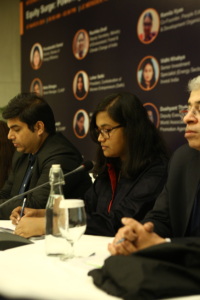
The first discussion, moderated by Neha Dhingra, Senior Manager at CLASP, shed light on the evolving landscape of India’s energy sector and the pivotal role women play within it. Speakers, including Ruchika Drall from Ministry of Environment, Forest and Climate Change, Ramila Vyas from People Education & Development Organization, Mandira Kalra Kalaan from Purpose, and Leher Sethi from the Confederation of Women Entrepreneurs, Delhi, provided valuable insights into women’s participation, their role as community leaders and decision-makers, and the need for gender-responsive policies.
The first discussion, moderated by Neha Dhingra, Senior Manager at CLASP, shed light on the evolving landscape of India’s energy sector and the pivotal role women play within it. Speakers, including Ruchika Drall from Ministry of Environment, Forest and Climate Change, Ramila Vyas from People Education & Development Organization, Mandira Kalra Kalaan from Purpose, and Leher Sethi from the Confederation of Women Entrepreneurs, Delhi, provided valuable insights into women’s participation, their role as community leaders and decision-makers, and the need for gender-responsive policies.
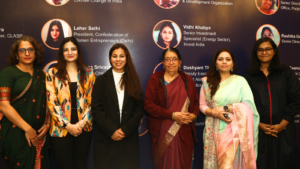
The speakers noted that women are not just underrepresented in the energy sector but also disproportionately affected by the impacts of climate change. The need for mainstreaming gender and fostering a gender-neutral framework was emphasized to break stereotypes and achieve gender balance in the workforce.
The solutions include enabling women’s access to finance and community engagement, as well as fostering leadership among women in the energy sector. The importance of monetizing unpaid household care work by women and communicating gender-responsive policies effectively were also underscored as critical steps toward achieving equity and inclusion.
According to India’s Council on Energy, Environment, and Water, if women’s participation in the energy sector is increased to 30%, it could create up to 3.2 million additional jobs by 2025. This CLASP event served as a crucial platform for fostering dialogue, learning and collaboration to encourage a more inclusive and equitable energy sector in India. CLASP continues to steer efforts and collective action globally with the vision of a just and inclusive energy transition for all.
0. International Energy Agency “World Energy Outlook 2019” https://iea.blob.core.windows.net/assets/98909c1b-aabc-4797-9926-35307b418cdb/WEO2019-free.pdf
1. International Energy Agency “World Energy Outlook 2019” https://iea.blob.core.windows.net/assets/98909c1b-aabc-4797-9926-35307b418cdb/WEO2019-free.pdf
2. International Energy Agency “World Energy Outlook 2023” https://iea.blob.core.windows.net/assets/86ede39e-4436-42d7-ba2a-edf61467e070/WorldEnergyOutlook2023.pdf
3. International Energy Agency “World Energy Outlook 2019” https://iea.blob.core.windows.net/assets/98909c1b-aabc-4797-9926-35307b418cdb/WEO2019-free.pdf
4. International Copper Association “ICA China Motor Program: 20 Years of Promoting Energy Efficiency” https://internationalcopper.org/resource/ica-china-motor-program-20-years-of-promoting-energy-efficiency/
5. International Copper Association India “Energy Efficient Motors” https://copperindia.org/energy-efficient-motors/
CLASP Supports India Deliver Two More Appliance Efficiency Policies
On 1 March 2024, India’s Bureau of Energy Efficiency (BEE) announced two new appliance efficiency policies set to reduce roughly 16 million tonnes of CO2 emissions by 2033. CLASP supported BEE with technical assistance in the development of these policies.
The two new appliance efficiency polices are set to enhance the energy performances of commercial beverage coolers and packaged boilers. This was announced by Shri R. K. Singh, India’s Minister of Power and New and Renewable Energy at the 22nd anniversary of the founding of Bureau of Energy Efficiency (BEE). In implementing these, India aims to achieve 16 million tonnes reduction in CO2 emissions, cumulatively by 2033, helping the country meet its climate targets, reduce pressure on the national power grid and lower the running costs for businesses.
BEE’s Standards & Labeling Program now covers 37 efficiency policies, including appliances and equipment across residential, commercial, and industrial sectors. CLASP has collaborated with BEE for many years, providing technical assistance, research expertise and policy advice.
Reflecting on the launch, Bishal Thapa, Senior Director at CLASP, commended BEE for its proactive approach to energy efficiency and expressed optimism about the impact of these policies. “Energy efficiency is paramount to tackle climate change, and India’s commitment is commendable,” Bishal remarked. “At CLASP, we are pleased to provide technical assistance to BEE in the development and implementation of appliance efficiency policies in India. CLASP stands ready to support BEE in implementing these policies effectively, ensuring that they deliver tangible benefits for both India and the global community.”
The two policies cover the following appliances:
Commercial Beverage Coolers
While domestic refrigeration is already regulated for energy consumption in India, the India Cooling Action Plan (ICAP) noted the opportunity to increase the energy efficiency and lower the running costs of various commercial refrigeration products. This is timely as the number of commercial refrigerators, including commercial beverage coolers, is poised to double in the next decade.
Packaged Boilers
Packaged boilers are small-sized boilers essential for meeting steam and hot water needs of process industries. These small capacity boilers consume a significant amount of energy in industrial and commercial settings. The introduction of a new efficiency labeling program will allow consumers to select more energy-efficient package boilers that are much cheaper to run.
For close to 25 years, CLASP has developed effective tactics for driving climate mitigation and adaptation and improving people’s lives through appliance efficiency. CLASP collaborates with policymakers, appliance manufactures, and leading experts to deliver leading research, sound policy recommendations, innovative tools, and clear pathways to a more sustainable world.
0. International Energy Agency “World Energy Outlook 2019” https://iea.blob.core.windows.net/assets/98909c1b-aabc-4797-9926-35307b418cdb/WEO2019-free.pdf
1. International Energy Agency “World Energy Outlook 2019” https://iea.blob.core.windows.net/assets/98909c1b-aabc-4797-9926-35307b418cdb/WEO2019-free.pdf
2. International Energy Agency “World Energy Outlook 2023” https://iea.blob.core.windows.net/assets/86ede39e-4436-42d7-ba2a-edf61467e070/WorldEnergyOutlook2023.pdf
3. International Energy Agency “World Energy Outlook 2019” https://iea.blob.core.windows.net/assets/98909c1b-aabc-4797-9926-35307b418cdb/WEO2019-free.pdf
4. International Copper Association “ICA China Motor Program: 20 Years of Promoting Energy Efficiency” https://internationalcopper.org/resource/ica-china-motor-program-20-years-of-promoting-energy-efficiency/
5. International Copper Association India “Energy Efficient Motors” https://copperindia.org/energy-efficient-motors/
Cooling India: Energy-Efficient Fans for a Greener Tomorrow
This article was originally published in Energy Efficiency Services Limited’s quarterly newsletter by Bishal Thapa, Senior Director – CLASP.
In India, nearly 41 million units of ceiling fans are sold every year, making them one of the largest-selling cooling appliances. However, only three in every 100 households use energy-efficient ceiling fans. As the nation grapples with sweltering summers, energy-efficient and affordable fans are essential for reducing energy consumption and greenhouse emissions; cutting energy costs; and promoting sustainability.
In a country that faces hot summers every year, cooling solutions are not a luxury but a necessity. Nearly 41 million ceiling fans sold every year in India, making it the second most commonly found service product in Indian households1. These fans account for a significant 20% of India’s residential electricity consumption. However, almost 97% of these fans are not energy-efficient and lead to high energy consumption, increased greenhouse emissions, and inflated energy bills.
India’s demand for cooling solutions is expected to increase ninefold between the years 2018 and 2037, contributing to a fivefold increase in energy consumption under a business-as-usual approach as per the India Cooling Action Plan (ICAP). This surge in demand will place considerable strain on existing electricity systems and require certain additions that will result in higher emissions.
The Opportunity Gap
There is a massive opportunity for making India’s ceiling fan market more energy-efficient. This will yield benefits for the environment, consumers, and ultimately the nation’s energy consumption. With this view, India’s Bureau of Energy Efficiency made it mandatory in 2022 for ceiling fans to be manufactured with star-rating labels. Fans with 5-star rating consume up to 50% less power as compared to unlabeled or lower-starred fans.
The Collaborative Symphony of Progress
Just like the blades of a fan run in unison to produce a cooling breeze, a similarly harmonious synergy of parts is required in the form of collaborations to cool India sustainably. The government, fan manufacturers, and other stakeholders are like the three blades of a fan, each with a crucial role to play in achieving energy efficiency.
Government: Setting the Pace
With the Bureau of Energy Efficiency’s integral policy on raising the efficiency of fans and enabling market transformation, EESL launched an initiative to encourage the adoption of ten million energy-efficient fans in India. This initiative aligns perfectly with ICAP’s mission, underlining a strong commitment to a greener future. India is projected to have a stock of 700 million ceiling fans by 2037-38. Ensuring that these units are energy-efficient will alone reduce the country’s energy consumption by almost 15%, helping the country achieve its climate ambitions.
Manufacturers: Crafting Innovation
Fan manufacturers are responsible for transforming policies into tangible solutions. Under the Bureau of Energy Efficiency’s mandatory star-label policy for ceiling fans, manufacturers are increasingly designing and producing energy-efficient fans that adhere to these standards without compromising performance. These fans not only reduce electricity consumption but also highlight the innovation potential of Indian manufacturing.
A Unified Movement led by Stakeholders
The stakeholders in this energy efficiency movement include consumers, retailers, and advocacy groups, among others. Their collective involvement is of paramount importance. By choosing energy-efficient appliances, spreading awareness, and advocating sustainable choices, these stakeholders can generate a groundswell of change, magnifying the impact of their efforts.
Collaborating for a Cooler Tomorrow
With various forces coming together to address the growing demand for cooling solutions, EESL has joined hands with CLASP and other civil society partners through a Memorandum of Understanding signed at the 14th Clean Energy Ministerial in July 2023, to bring about substantial change. EESL’s vision to deploy ten million energy-efficient fans across India, if realized, has potential to significantly bring down energy consumption. With technical expertise and market transformation strategies provided by CLASP, this collaboration is a beacon of hope for a sustainable cooling revolution.
As temperatures rise, so do the energy requirements of cooling appliances. The need for sustainable cooling is thus non-negotiable. EESL’s collaborative effort paves the way for other players in the ecosystem to unite in achieving India’s sustainable cooling goals. The government, manufacturers, and stakeholders – like the three blades of a fan – must collaborate and complement each other to enable a greener, cooler tomorrow for India. Through energy-efficient fans and unwavering commitment to sustainability, India can usher in an era of responsible cooling that benefits both its present and future generations.
0. International Energy Agency “World Energy Outlook 2019” https://iea.blob.core.windows.net/assets/98909c1b-aabc-4797-9926-35307b418cdb/WEO2019-free.pdf
1. International Energy Agency “World Energy Outlook 2019” https://iea.blob.core.windows.net/assets/98909c1b-aabc-4797-9926-35307b418cdb/WEO2019-free.pdf
2. International Energy Agency “World Energy Outlook 2023” https://iea.blob.core.windows.net/assets/86ede39e-4436-42d7-ba2a-edf61467e070/WorldEnergyOutlook2023.pdf
3. International Energy Agency “World Energy Outlook 2019” https://iea.blob.core.windows.net/assets/98909c1b-aabc-4797-9926-35307b418cdb/WEO2019-free.pdf
4. International Copper Association “ICA China Motor Program: 20 Years of Promoting Energy Efficiency” https://internationalcopper.org/resource/ica-china-motor-program-20-years-of-promoting-energy-efficiency/
5. International Copper Association India “Energy Efficient Motors” https://copperindia.org/energy-efficient-motors/
Advancing Distributed Renewable Energy in India
Last month, CLASP was at the 2023 South Asia Forum for Distributed Energy (SAFDE23), a GOGLA-organized event held in New Delhi, India. SAFDE23’s inaugural session opened with Shri Bhagwanth Khuba, Minister of State for New and Renewable Energy, Chemicals and Fertilizers who shared, “India has achieved household electrification across the country. We are on the right pathto achieving our ambitious national climate target of generating 500 GW through renewable energy by 2030”. The inaugural session was also addressed by Dr. Ajay Mathur, Director General – International Solar Alliance (ISA), Koen Peters, Executive Director – GOGLA, and Bishal Thapa, Senior Director – CLASP.
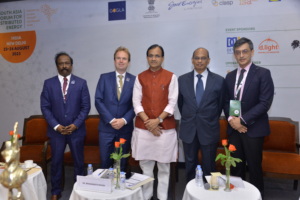
ISA’s Ajay Mathur highlighted the need for Distributed Renewable Energy (DRE) and rising demand, “Last year, 5.2 million solar energy kits sold during the second half of 2022, marking a 20% increase from the first half of the year.” He added, “the potential for DRE is very high but it is our responsibility to create an environment in which it thrives and the economic development of countries rises.”
CLASP’s Bishal Thapa expressed, “India is at the epicenter of a growing energy market and we are glad to join GOGLA in driving dialogue for integrated energy solutions. There is a big opportunity to mainstream distributed renewable energy through policy, market, and technology integration”.
On day 1, CLASP co-hosted a discussion with GOGLA on ‘Plugging the Gap: Partnerships and Innovations for the Weak Grid’, where the panel delved into challenges of a weak grid and the potential for the DRE industry, power distribution firms, financing, and technology to join forces.
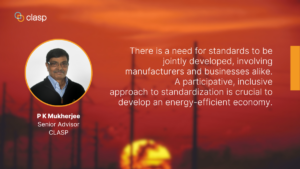 A key takeaway that emerged from the discussion was the need to de-risk financing provided for DRE and the necessity for adopting innovative financing solutions such as carbon financing. Additionally, CLASP’s PK Mukherjee also stressed on the need for participative policymaking.
On day 2, a discussion hosted by CLASP, in partnership with EESL, highlighted the investment possibilities within the cold chain sector for the future of India’s agriculture. Despite 2020-21’s record horticulture output, inadequate storage led to 30% food wastage the same year. FY 2021-22 saw 10 million metric tons of post-harvest fruit and vegetable losses, valued at INR 60,000 crores (USD 7.2 billion), impacting farmers’ incomes and emissions. Vishal Kapoor, CEO – EESL noted that the organization is commited towards transforming India’s cold chain and the role EESL will play in catalyzing investments through demand aggregation, financing, and policies.
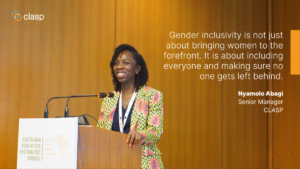
Finally, Nyamolo Abagi, CLASP’s Senior Manager for Kenya paneled a discussion on whether DRE is truly powering gender inclusion. Ensuring the inclusion of women and marginalized groups in a growing DRE market is pivotal to addressing the diverse needs of all individuals.
SAFDE23 stands as a testament to CLASP’s commitment to driving sustainable energy solutions through collaborative engagement. By addressing the challenges of weak grids, advocating for innovative financing, and promoting gender.
0. International Energy Agency “World Energy Outlook 2019” https://iea.blob.core.windows.net/assets/98909c1b-aabc-4797-9926-35307b418cdb/WEO2019-free.pdf
1. International Energy Agency “World Energy Outlook 2019” https://iea.blob.core.windows.net/assets/98909c1b-aabc-4797-9926-35307b418cdb/WEO2019-free.pdf
2. International Energy Agency “World Energy Outlook 2023” https://iea.blob.core.windows.net/assets/86ede39e-4436-42d7-ba2a-edf61467e070/WorldEnergyOutlook2023.pdf
3. International Energy Agency “World Energy Outlook 2019” https://iea.blob.core.windows.net/assets/98909c1b-aabc-4797-9926-35307b418cdb/WEO2019-free.pdf
4. International Copper Association “ICA China Motor Program: 20 Years of Promoting Energy Efficiency” https://internationalcopper.org/resource/ica-china-motor-program-20-years-of-promoting-energy-efficiency/
5. International Copper Association India “Energy Efficient Motors” https://copperindia.org/energy-efficient-motors/
CLASP: Advancing Energy-Efficient Cold Chains in India
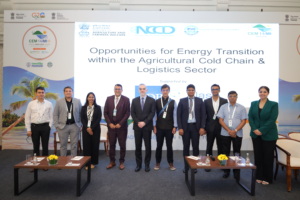
India’s agricultural sector faces two significant challenges: the impact of climate change and a rapidly growing population. As the demand for food increases, so will the need for efficient and robust cold chain and food logistics infrastructure. To bridge the gap between farmers and markets, the country needs substantial investments, a reliable power supply and an energy-efficient cold chain infrastructure.
In collaboration with Asian Development Bank (ADB), National Centre for Cold Chain Development, and Bureau of Energy Efficiency (BEE), CLASP co-hosted an event to explore the opportunities and challenges in transitioning towards low-carbon and energy-efficient cold chains.
BEE’s Director, Arijit Sengupta highlighted the importance of the energy sector for agriculture and livelihoods. Sengupta also shared that BEE is working to advance energy efficiency policy options for cold chain components such as compressors, walk in cold rooms and cold storage.
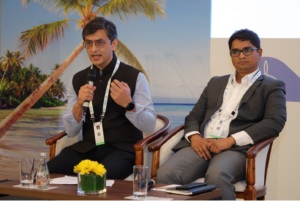
CLASP Senior Director, Bishal Thapa, moderated a discussion that emphasized the need to make the next wave of cold chain infrastructure energy efficient and sustainable. The consensus was that sustainable cold chain solutions and services must be accessible and affordable even to the smallest farms in India.
CLASP’s P. K. Mukherjee reinforced the need to have specific standards for cold chain equipment as a prerequisite to develop impactful energy efficiency policies for the sector. He also highlighted the existence of post-harvest horticulture guidelines and the need to ensure these are adopted by farmers.
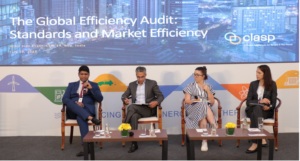 CLASP’s Kishore Kumar featured in a discussion on the Super-Efficient Appliance Deployment (SEAD) initiative of CEM. Kishore highlighted the progress being made towards doubling the efficiency of four priority products by 2030 – air conditioners, refrigerators, industrial motor systems, and lighting. This initiative is essential in the context of Nationally Determined Contributions (NDCs), where many countries are finding it challenging to meet their climate goals. By promoting super-efficient appliances, countries can significantly reduce their carbon footprint and contribute to global climate action.
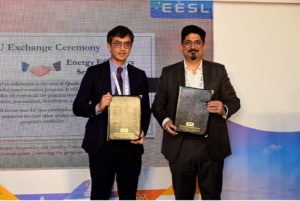
On the last day of CEM,, Energy Efficiency Services Limited (EESL) hosted a side event which included the signing of a Memorandum of Understanding with CLASP on adoption of 10 million energy-efficient fans in India. CLASP will provide technical assistance and capacity building support to EESL on Quality Assurance and Quality Control (QAQC) framework of fans program.
A key takeaway from CEM14 is that transitioning towards low-carbon and energy-efficient cold chain infrastructure is not just an opportunity but an imperative for India. Climate change poses significant challenges for India’s food storage and distribution, and it requires urgent action.
Watch all session recordings here.
0. International Energy Agency “World Energy Outlook 2019” https://iea.blob.core.windows.net/assets/98909c1b-aabc-4797-9926-35307b418cdb/WEO2019-free.pdf
1. International Energy Agency “World Energy Outlook 2019” https://iea.blob.core.windows.net/assets/98909c1b-aabc-4797-9926-35307b418cdb/WEO2019-free.pdf
2. International Energy Agency “World Energy Outlook 2023” https://iea.blob.core.windows.net/assets/86ede39e-4436-42d7-ba2a-edf61467e070/WorldEnergyOutlook2023.pdf
3. International Energy Agency “World Energy Outlook 2019” https://iea.blob.core.windows.net/assets/98909c1b-aabc-4797-9926-35307b418cdb/WEO2019-free.pdf
4. International Copper Association “ICA China Motor Program: 20 Years of Promoting Energy Efficiency” https://internationalcopper.org/resource/ica-china-motor-program-20-years-of-promoting-energy-efficiency/
5. International Copper Association India “Energy Efficient Motors” https://copperindia.org/energy-efficient-motors/
Financing for Impact: CLASP Collaborates to Accelerate India’s Net Zero Transition
GOA, 22 JULY 2023 – CLASP and Energy Efficiency Services Limited (EESL) signed a Memorandum of Understanding (MoU) at a side-event on “Accelerating India’s Net Zero Transition through Energy Efficiency, Sustainable Cooling & Mobility” at the 14th Clean Energy Ministerial (CEM14) to support EESL’s 10 million Energy-Efficient Fans programme, which will help support India’s transition to Net Zero Carbon Emissions. The event was by members of the Ministry of Power, Bureau of Energy Efficiency, State ministers from Andhra Pradesh and Orissa among others.
CEM14 brings together energy ministers, business leaders, policymakers, and experts from around the world to collaborate and take collective action through energy efficiency measures across sectors. During the event, Vishal Kapoor, CEO – EESL unveiled EESL’s 10 million Energy-Efficient Fan programme, which aims to transform India’s market towards energy-efficient ceiling fans. By raising the efficiency levels of the entire stock of residential ceiling fans, India could save 15% of its residential power consumption annually.
Under the partnership agreement, CLASP will support ceiling fans market transformation programme with technical assistance and capacity building to EESL on Quality Assurance and Quality Control (QAQC).
Vishal Kapoor, Chief Executive Officer, EESL, said, “These partnerships and collaborations reinforce EESL’s commitment to driving energy efficiency and sustainability in various sectors. By pooling our expertise and resources with experts, we will accelerate the pace of India’s transition towards clean energy solutions. EESL remains dedicated to promoting a clean, sustainable, and inclusive energy future, while addressing the challenges and opportunities associated with energy efficiency.”
Bishal Thapa, Senior Director, CLASP, said, “A programme of this scale and nature is a true representation of the collaboration needed to keep our planet cool amid rising temperatures. CLASP applauds EESL’s efforts in bringing together several organizations, who will bring their shared expertise to work towards a single goal of enabling efficient cooling in India.”
********
For media inquiries and more information, please contact:
Karishma Joseph
Communications – CLASP India
kjoseph@clasp.ngo
Established in 1999, CLASP is a leading international nonprofit organization at the epicenter of collaborative efforts to combat climate change and drive the transition towards a more energy-efficient future. With a primary focus on promoting appliance efficiency for the well-being of people and the planet, CLASP aims to ensure that no one is left behind due to inefficient appliances or limited access to energy sources. The organization actively supports the achievement of United Nations’ Sustainable Development Goal 7, which aims to provide affordable and sustainable energy for all. CLASP works closely with governments and partners to empower low-income communities and improve lives in a climate-friendly manner. Through its dedicated efforts, the organization remains steadfast in its commitment to expanding access to clean energy by implementing efficiency standards and labels for appliances, lighting, and equipment. With its global presence across Washington, DC; Nairobi, Kenya; New Delhi, India; Brussels, Belgium; and Jakarta, Indonesia, CLASP operates across continents to drive positive change on a global scale.
A joint venture of NTPC Limited, Power Finance Corporation, Rural Electrification Corporation and POWERGRID, Energy Efficiency Services Limited (EESL) was set up under the Ministry of Power to facilitate implementation of energy efficiency projects. EESL is a Super Energy Service Company (ESCO) that seeks to unlock energy efficiency market in India, estimated at Rs 74,000 crore that can potentially result in energy savings of up to 20 percent of current consumption, by way of innovative business and implementation models. It also acts as the resource centre for capacity building of State DISCOMs, ERCs, SDAs, upcoming ESCOs, financial institutions, etc.
0. International Energy Agency “World Energy Outlook 2019” https://iea.blob.core.windows.net/assets/98909c1b-aabc-4797-9926-35307b418cdb/WEO2019-free.pdf
1. International Energy Agency “World Energy Outlook 2019” https://iea.blob.core.windows.net/assets/98909c1b-aabc-4797-9926-35307b418cdb/WEO2019-free.pdf
2. International Energy Agency “World Energy Outlook 2023” https://iea.blob.core.windows.net/assets/86ede39e-4436-42d7-ba2a-edf61467e070/WorldEnergyOutlook2023.pdf
3. International Energy Agency “World Energy Outlook 2019” https://iea.blob.core.windows.net/assets/98909c1b-aabc-4797-9926-35307b418cdb/WEO2019-free.pdf
4. International Copper Association “ICA China Motor Program: 20 Years of Promoting Energy Efficiency” https://internationalcopper.org/resource/ica-china-motor-program-20-years-of-promoting-energy-efficiency/
5. International Copper Association India “Energy Efficient Motors” https://copperindia.org/energy-efficient-motors/