
LED Manufacturers Join Forces with the Clean Lighting Coalition
The Clean Lighting Coalition (CLiC) private sector partners are demonstrating market readiness for a global transition to clean, energy efficient LED lighting by supporting the end of exemptions for mercury-containing fluorescent lighting products under the United Nations Minamata Convention on Mercury.
“The technological advancements in LED lighting over the past decade have far surpassed even the most advanced mercury-containing fluorescent bulbs,” says Professor Shuji Nakamura, Nobel Prize for Physics (2014), Inventor of Blue Light LED. Today, LED retrofit bulbs are readily available across global markets, providing an efficient, safer and mercury-free lighting alternative to fluorescents in virtually all applications.
The Clean Lighting Coalition (CLiC), coordinated by CLASP, brings together LED manufacturers, distributors, associations, and other vital stakeholders to prove market readiness for the global transition to clean, cost-effective LED lighting. CLiC supports the proposed amendment by the Africa region to the Minamata Convention on Mercury to eliminate special exemptions for mercury in general illumination lighting products. Our industry partners provide the strong market push needed to drive the LED shift.
“With the proposed amendment to the Minamata Convention and implementation of national-level regulations to phase-out fluorescent lighting by 2025, countries can accelerate the transition to LED lighting technology to benefit people and the planet,” explains Professor Nakamura.
Spotlight on growing industry partners
“By joining the coalition, industry partners make a strong and unequivocal statement to policy makers that the global transition to clean lighting is possible today,” explains Nyamolo Abagi, the Coalition’s Industry Lead. “The lighting industry has invested heavily and is continuously innovating in the development of clean affordable lighting, making the exemption for mercury containing fluorescent lights under the Minamata Convention unnecessary.”
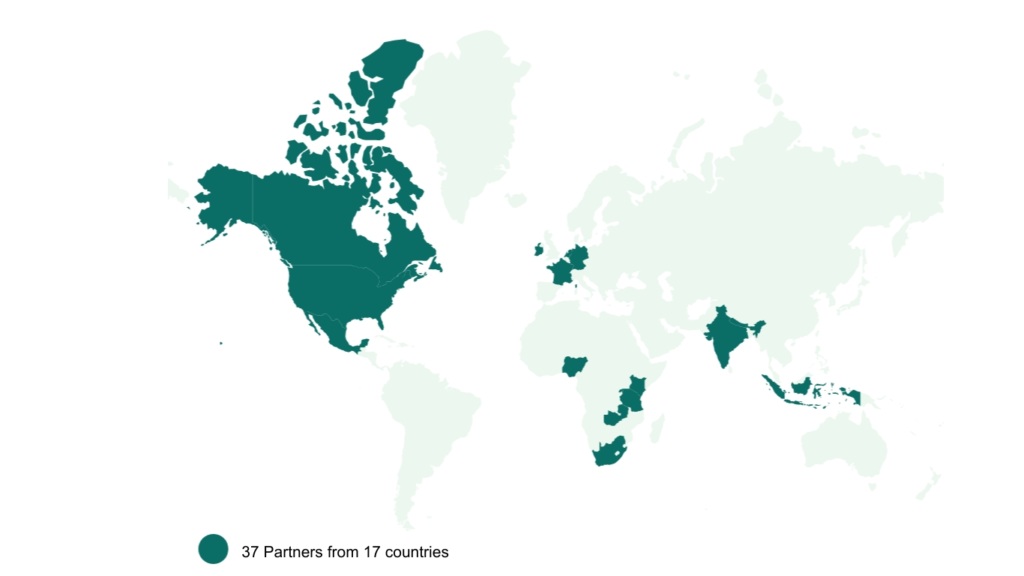
The Coalition’s growing list of private sector partners consists of 37 companies in 17 countries across Asia, Africa, Europe, and North America. This diverse list of partners includes Lumileds, a global lighting solutions company with research, development, and manufacturing facilities that employ approximately 7,000 team members in over 30 countries; Sahasra, an early innovator in local manufacturing of high-quality LEDs in Africa operating a subsidiary of its Indian headquarters in Rwanda; renowned manufacturer Panasonic’s India Anchorbrand, the DesignLights Consortium (DLC), a non-profit energy efficiency organization that evaluates commercial and industrial LED lighting products and maintains a list of over 500,000 products from over 1700 global suppliers for use in North America, and Golchha Group Nepal’s most prominent business conglomerate.
Clean Lighting Coalition industry partners lead the global lighting transition to LED
The Coalition provides an opportunity for the lighting community and private sector partners to publicly commit to supporting the global transition to clean, energy-efficient LED lighting to ensure the following benefits:
- Human Health – All fluorescent lamps contain mercury, a neurotoxin that is released whenever a bulb breaks. Lamp breakage can occur in homes, schools, child care settings, office and apartment buildings, retail stores, factories, health care, and other facilities. Mercury can cause harmful and long-term health effects; there is no “safe” level of mercury exposure.
- Diversity, Equity, and Inclusion – Without intervention, a global transition to clean LED lighting may take years due to the lobbying efforts of fluorescent lamp suppliers. Industry partners are bridging the gap between production and access to prevent under-regulated markets from becoming dumping grounds for outdated, mercury-laden fluorescents banned elsewhere.
- Climate and Environmental Health – A global transition to LED lighting is low-hanging fruit for climate change mitigation. Such a transition could support efforts to limit global warming to the UN target 1.5 Celsius. Transitioning to energy-efficient LEDs would eliminate 232 tonnes of mercury pollution from the environment, both from the bulbs themselves and avoided burning coal in power plants, and save 3.5 gigatons of CO₂ emissions from power plants (cumulatively between 2025-2050)
- Circular Economy – LEDs last 2-3 times longer than fluorescent alternatives and do not contain hazardous mercury, making them safer to dispose of at their end of life. Accelerating the adoption of LED products is estimated to reduce global energy consumption by 3%.
- Economics – LEDs are a cost-effective replacement for fluorescents. Consumers can find replacements for fluorescent bulbs in most countries for the same or slightly more expensive price. Where more expensive, LEDs pay for themselves in a few months from saved electricity costs due to the efficiency benefits.
LED companies and stakeholders can join the Clean Lighting Coalition by signing the CLiC Industry Pledge here or reach out to the CLiC Industry Engagement Lead Nyamolo Abagi (nabagi@cleanlightingcoalition.org).
Turn Out The Lights on Fluorescents
A new report released by the Clean Lighting Coalition highlights the environmental and health risks posed when fluorescent lamps break, especially to vulnerable populations. The report provides concrete steps government, industry, consumers, and others, like childcare providers, can take to accelerate the transition to LED lighting, which is mercury-free, more energy-efficient, more cost-effective, and widely available.
To mitigate the risks posed by mercury, the Coalition is calling on the Biden Administration to support the global phase-out of fluorescent lighting by 2025 at the upcoming meeting of the United Nation’s Minamata Convention on Mercury in March 2022. Furthermore, the Coalition notes that phasing out fluorescent lighting aligns with the Administration’s Executive Order on Tackling the Climate Crisis at Home and Abroad issued earlier this year.
“Fluorescent lamps have been tolerated for decades because they were considered the most energy-efficient option,” said Alicia Culver, Executive Director of the Responsible Purchasing Network and co-author of the report. “But this is no longer the case: LEDs are twice as energy efficient as fluorescent lamps, last 2-3 times longer, and they don’t contain mercury.”
The report details:
- Health risks to those exposed to mercury, especially populations that are more vulnerable, such as pregnant people and their unborn babies, infants and young children, communities of color, and those living in low-income neighborhoods
- Health risks to workers exposed to mercury when lamps break during the manufacturing, installation, recycling, and disposal of fluorescent lamps
- Environmental hazards posed by the release of mercury in fluorescent lighting
- Benefits of transitioning to LED lighting, now considered the most cost-effective and reliable lighting option in the U.S. marketplace
“We know that mercury exposure, especially in early life, can lead to irreversible deficits in verbal skills, reduced attention span and motor control, and lower IQ,” said Michael T. Bender, director of the Mercury Policy Project and one of the report authors. “However, these exposure risks are avoidable by replacing fluorescents with LEDs.”
The report recommends steps that government entities, businesses, and consumers can take to accelerate the transition to LEDs. For example, it recommends state and local governments:
- Adopt and enforce mercury reduction laws to phase out fluorescents. For example, Vermont law bans sales of mercury-containing lamps unless the manufacturer has demonstrated that no comparably performing alternative non-mercury energy-efficient lamp is available at a comparable cost.
- Update guidance, including on websites, to highlight the hazards of mercury in fluorescent lighting and the advantages of LEDs including reduced risk, better energy efficiency, longer product life, and significant cost savings.
- Adopt new lighting specifications that prohibit vendors from offering fluorescent lamps, fixtures and ballasts on their state supply contracts. Maryland and Minnesota are already using this approach to eliminate many fluorescent lighting products from their contracts.
- Develop contracts for environmentally preferable lighting equipment that offer a wide array of LED lighting products at discounted prices. New York State and the City of San Francisco have lighting contracts that feature LEDs.
The report also highlights guidelines from the US EPA regarding strict protocols that should be taken when cleaning up broken fluorescent lamps.
“There is no safe level of mercury exposure and following US EPA guidelines in cleaning up a broken lamp is not easy,” says Coalition Deputy Director and CLASP’s Senior Manager Ana Maria Carreño. “Most people, for example, either don’t know about or find it difficult to follow the proper procedures. Yet, with the tremendous advances in LED technology during the past decade, there’s no reason to continue using fluorescent lighting.”
Mercury is highly toxic to humans, which is why the World Health Organization lists it among the top 10 chemicals or groups of chemicals of major public health concern.
“The U.S. has been a global leader on many fronts,” said Michael Scholand of the Coalition and one of a worlds-leading experts on lighting policy and technology. “But when it comes to taking action on fluorescent lighting, the U.S. lags behind some African countries and the European Union, which have already taken steps to phase out mercury-based lighting.”
Mercury in Fluorescent Lighting: Unnecessary Health Risks and Actionable Solutions was published by the Clean Lighting Coalition in partnership with the Mercury Policy Project and the Responsible Purchasing Network. The report was co-published by CLASP, Vermont Public Interest Research Group, Healthy Babies Bright Futures, Eco-Healthy Child Care, the Children’s Environmental Health Network, Clean Water Action and Ecology Center.
The Coalition is encouraging consumers, businesses, and others to sign a pledge to support the global transition to clean and efficient lighting, and to end the manufacture, export and import of mercury-containing fluorescent lighting in the United States by 2025. To learn more, visit https://cleanlightingcoalition.org/advocates-pledge.
_____________
For more information about the transition away from mercury-based lighting, visit https://cleanlightingcoalition.org/benefits/
About the Clean Lighting Coalition
The Clean Lighting Coalition is a global partnership coordinated by CLASP to capture the health and environmental benefits of eliminating mercury-based lighting. To learn more, visit www.cleanlightingcoalition.org and follow the Coalition on Twitter, Facebook, and LinkedIn.
About the Mercury Policy Project
Founded in 1998, the Mercury Policy Project promotes policies to eliminate mercury use and reduce mercury exposure. To learn more, visit www.mercurypolicy.org
About the Responsible Purchasing Network
Responsible Purchasing Network is an international network of buyers dedicated to socially responsible and environmentally sustainable purchasing. To learn more, visit www.responsiblepurchasing.org
About Peter Maxson
Mr. Maxson is an environmental consultant who has long provided expert advice on mercury to multinational organizations, government agencies, nongovernmental organizations, and others.
Analysis Finds ROI of Appliance Efficiency Well Below Social Cost of Carbon
Appliance energy efficiency is a foundational component of effective climate policy, with well-documented social and economic benefits. A global transition to efficient appliances and equipment would cut more than 1 Gt of carbon emissions per year and save more than USD 200 billion annually on electricity bills.
CLASP’s new report, Pennies per Pound: The Return on Investment from Appliance Efficiency Technical Assistance, adds to the evidence base that appliance energy efficiency is a worthwhile investment, comparing the administrative costs of running such policies and climate impacts to the social cost of carbon.
We calculate the return on investment of appliance efficiency policies and technical assistance efforts. Our findings show appliance energy efficiency is a cost-effective climate mitigation tool.
Findings show appliance efficiency standards and labeling policies deliver major climate benefits for a minimal investment. When considering the benefits of different climate interventions, it is often helpful to compare their costs to the social cost of carbon. In the United States, the social cost of carbon, now USD 51 per ton, is used to determine whether a particular policy intervention is justified from a cost-benefit perspective. Any policy that reduces emissions for less than the social cost of carbon would be justified because the future economic benefits of mitigation outweigh the current costs.
For each of the 10 case studies assessed, the administrative costs required to achieve a one-ton reduction in CO₂e ranged from less than one cent per ton to USD 1 per ton.
Our analysis provides conclusive evidence that appliance energy efficiency policies are a smart investment for governments, enabling them to maximize climate impacts at a minimal cost.
Governments and implementing agencies are encouraged to read the full report and explore each case study in detail here.
Global Phase-Out of Fluorescents an Opportunity to Accelerate Adoption of LED Lighting
This piece was originally published by Edison Report on 11 August, 2021. Read the original article here.
Until a decade ago, fluorescent lights were viewed as the energy-efficient alternative to less-efficient incandescent and halogen lights. Fluorescent lighting however contains mercury, a known neurotoxin that is extremely hazardous to people and the environment. Mercury is on the World Health Organization’s top ten most dangerous chemicals to public health. Mercury and its compounds are released into the air, soil and water when the lamps break, and during various stages of their manufacture, use, transportation, recycling and disposal. Mercury exposure can affect the nervous, digestive and immune systems, as well as the lungs, kidney, skin and eyes. In Europe, roughly one-third of all births (1.8 million babies) are born with methylmercury levels above the safe limit.
At their end of life, the majority of fluorescent lamps are discarded into general waste streams where they go on to contaminate landfills, soil, streams, rivers, and ultimately the oceans with mercury. Typically, less than 10% of mercury [in fluorescents] is recovered. In the United States, recycling rates have been reported at 29% for industry recycled fluorescent lamps and CFLs, and at only 2% for consumers.
The case is similar in other wealthy countries that have systems in place for electrical and electronic waste management; recycling is still limited as the small size and weight of lamps makes them easier for consumers to dispose of in general waste. A 2016 report by the Danish Environment Protection Agency found that Denmark had achieved an overall lamp collection rate of only 36%. Note that Denmark has one of the highest collection rates in the EU.
Risks associated with mercury in fluorescents were however tolerated as a necessary trade-off for the efficiency benefits.
Availability of mercury-free direct retrofits
Today, thanks to major advances in LED technology, there are mercury-free LED replacement lamps available to replace all types of fluorescent lamps – different sizes, lengths, ballast types (i.e., magnetic/starter and high frequency electronic), colour temperatures, and regular, high output and ultra-high light output levels. Lamps are also available which are “universal” and can operate on a variety of ballasts and input power configurations. This approach to the design and marketing of the products removes barriers to upgrading to mercury-free LED lamps by enabling the end-users to continue to use the same luminaires, and simply change the lamp.
A review of published industry literature confirms the availability of easy-retrofit LED products designed as direct retrofits into existing fluorescent fixtures, avoiding the need to rewire. Philips/Signify states that there is “No need to change drivers or rewire”, noting that they offer a “plug and play solution that works straight out of the box” (Philips, 2016). OSRAM/LEDvance state that their “SubstiTUBE” product is a “Quick, simple and safe lamp replacement without rewiring.” (LEDvance, 2021) Tungsram reports that in addition to “the 2.5-3x longer life (compared to T8[1] fluorescent lamps operated on electro-magnetic gear) and lower wattages, Tungsram LED T8 tubes provide lower system loss while existing fixtures remain intact.” (Tungsram, 2021)
“The technological advancements in LED lighting over the past decade have far surpassed even the most advanced mercury-containing fluorescent lamps,” says Shuji Nakamura, Nobel Prize for Physics (2014) and Inventor of the blue light LED.
Market Leaders put Consumers at Risk for the sake of Profit
Over the last few years, retrofit LED light lamps have become significantly more affordable and accessible. In most countries, an LED lamp that replaces a compact fluorescent lamp (CFL) can often be found for the same price or sometimes slightly more expensive. In those situations, the small incremental cost of the LED lamp is quickly recovered through lower electricity bills.
Despite these benefits, sales of fluorescents continue to persist in markets globally due to the lobbying efforts of fluorescent lamp suppliers. Market leader Signify/Philips was recently flagged for continuing to make hundreds of millions on what they describe as a “last man standing strategy”. Their goal is to remain the last producer of highly profitable fluorescent lamps. LEDs are not only more expensive to make, but last 2-3 times longer than fluorescents, meaning consumers have to replace them less often. As such, Signify/Philips actively lobby the European Commission against a market ban of fluorescents to ensure they can continue to milk the golden tail of an outdated, but high margin, product.
Out With the Old, In With the LED
In Europe, policy-makers have been actively working to remove inefficient, toxic mercury-containing fluorescent lighting from the market, albeit years late for, by law, the European Commission should have removed inefficient and toxic fluorescent lamps from sale in 2018, when its own experts confirmed the legal conditions for a market ban were met. The Ecodesign Regulation set a schedule to eliminate integrally-ballasted compact fluorescent (CFLi) and T12 linear fluorescent (LFL) lamps in September 2021, and most T8 LFLs in September 2023. The European Commission is also reviewing exemptions for fluorescent lighting under the Restriction of Hazardous Substances (RoHS) Directive, with draft proposals to phase-out all CFLs (including pin-base), all T5 LFLs, the remainder of T8 LFLs and long-life LFLs over the next few years. The RoHS amendments have not yet been finalized, but they send a clear message that policy-makers recognize that LED technology has matured to the point that this transition can happen smoothly.
Global Ban on Toxic Lighting
This year, the world has a unique opportunity to phase out inefficient, outdated fluorescent lighting technologies and accelerate markets to clean, energy-efficient LEDs. LED companies and stakeholders can support this transition by endorsing a global campaign to remove exemptions for mercury in lighting under the Minamata Convention on Mercury.
In May 2021, the 36 parties (countries) to the Minamata Convention on Mercury from Africa, proposed an Amendment to the Convention to eliminate special exemptions for mercury in general illumination lighting products. The Minamata Convention on Mercury, named after the city of Minamata, Japan, which experienced widespread mercury poisoning after wastewater from a nearby chemical plant was discharged into the sea, was launched in 2013 with the goal to “Make Mercury History” by eliminating the use of mercury in products and processes worldwide. The Convention entered into force in 2017 following ratification by 50 countries and as of July 2021, there are 132 parties to the Convention.
Major highlights of the Minamata Convention include a ban on new mercury mines and phase-out of existing ones, the phase out and phase down of mercury use in a number of products and processes, control measures on emissions to air and on releases to land and water, and the regulation of the informal sector of artisanal and small-scale gold mining.
Despite this progress, the Convention includes special exemptions for mercury-based fluorescent lighting products, citing insufficient cost-effective alternatives across global markets. However, the rapid development and increasing accessibility and affordability of mercury-free LED lighting makes the exemption unnecessary.
“My work on blue LEDs enabled innovative bright and energy-saving lighting products to reach markets across the globe,” explains Nakamura. “With the proposed amendment to the Minamata Convention and implementation of national-level regulations to phase-out fluorescent lighting by 2025, countries can accelerate the transition to LED lighting technology to benefit people and the planet.”
The Clean Lighting Coalition Leads the Global Lighting Transition
The Clean Lighting Coalition (CLiC) is an independent campaign aiming to leverage expert knowledge and clean lighting stakeholders to transition global markets to safe, cost-effective, and energy-saving LED lighting by removing the exemption for fluorescents in the Minamata Convention. The Coalition is coordinated by CLASP.
The Coalition brings together LED companies, associations and stakeholders to prove market readiness for this global transition. The LED industry must signal its readiness and ability to manufacture and distribute enough high-quality products to meet the accelerated demand. If the African Lighting Amendment is adopted at the upcoming Convention of Parties (COP4), it would lead to a global phase out of toxic, mercury-laden fluorescents by 2025.
By supporting the amendment to transition the global markets to LED light lamps, LED industries will signal their readiness and ability to manufacture and distribute LEDs to meet the accelerated demand and grow the market share of LED lighting by penetrating markets currently dominated by fluorescents. The market size of LEDs was valued at $50.9 billion USD in 2020 and is estimated to grow by 12% in 2021 under a business-as-usual scenario.
LED Companies Signal Environmental Responsibility & Commitment to Equity
By joining CLiC and supporting the phase-out of fluorescents, LED companies will affirm their commitment to environmental protection. Eliminating exemptions for fluorescents under the Minamata Convention will remove 232 tonnes of mercury pollution from the environment, both from the lamps themselves and from avoiding burning of coal in power plants. It will also save 3.5 gigatonnes of CO₂ emissions from power plants (cumulatively between 2025-2050).
“The U.S. Department of Energy (DOE) Solid-State Lighting (SSL) Program was initiated over two decades ago on the premise that energy savings and quality lighting can be achieved together. Over that time period, LED lighting has made significant improvements and today, LEDs surpass fluorescent lighting in performance and efficiency at reasonable cost. It is now time to phase out mercury-containing fluorescent lamps to capture energy savings and reduce environmental pollution.” – James Brodrick, PhD, Program Manager, US DOE SSL Program 2000-2018
Take Real Action on Diversity, Equity, and Inclusion (DEI)
As wealthy countries and developed economies like North America and Europe lead the transition to LEDs, the rest of the world must not be treated as a dumping ground for outdated, mercury-laden fluorescents. In unregulated markets, particularly in emerging economies, fluorescent lamps are still the market leaders. Without intervention, a global transition to clean super-efficient LED lighting may take years due to lobbying efforts of fluorescent lamp suppliers. CLiC is asking LED companies to go on the record and pledge commitment to equity.
To support the global transition to clean, energy-efficient LED lighting, Sign the CLiC Industry Pledge here or reach out to the CLiC Industry Engagement Lead Nyamolo Abagi at nabagi@cleanlightingcoalition.org.
[1] T8 is industry nomenclature for describing a certain type of fluorescent lamp. The T stands for tubular and the 8 refers to the number of eights of an inch diameter of the tube. Thus a T8 lamp is one inch in diameter.
Appliance Efficiency: An Underutilized Opportunity on the Path to Net-Zero Emissions
This article uses an up-to-date analysis from CLASP’s new tool, Mepsy, to showcase the value of appliance efficiency policies and estimates the avoided CO₂ emissions that could be achieved if stringent minimum energy performance standards (MEPS) were adopted worldwide in 2021.
Energy efficiency plays a critical role in the race to a net-zero carbon economy. Investments in efficiency can reduce total demand for electricity, alleviate strain on the grid during periods of peak demand, and enable the early decommissioning of coal and other fossil-fuel power plants. Together these benefits can lower emissions while saving customers money on their electric bills. Efficiency improvements can contribute about half of the reduction in energy-related greenhouse gas emissions required over the next two decades to put the world on a path to meeting international energy and climate goals.
Energy efficiency is often touted as the “first fuel” of a sustainable energy system, but progress has often lagged behind development and investment in the power sector. According to the IEA, urgent action is needed: global efficiency improvements have been declining since 2015. Around the world, governments have incorporated energy efficiency measures into their energy and climate policies. In 2017, it was estimated that 68% of global energy use was not covered by efficiency codes or standards, still many opportunities remain untapped.
Of this untapped potential, appliance efficiency policies remain a bright spot for technical efficiency gains and climate action. 53 countries mention building energy efficiency in their Nationally-Determined Contributions (NDCs) to the Paris Climate Agreement. Of these, a smaller portion directly mention appliance standards. As countries continue to update and revise their NDCs, policies like minimum energy performance standards (MEPS), which aim to eliminate inefficient products, could have a large impact on global emissions. A forthcoming report from the IEA Technology Collaboration Programme on Energy Efficient End-Use Equipment (4E TCP) assesses the energy and climate achievements of standards and labeling programs in the commercial, residential and industrial sectors. It finds the electricity savings recorded from mature programs with the largest product coverage are encompass roughly 15% of total economy-wide electricity consumption.
Mepsy: CLASP’s Appliance & Equipment Impact Calculator
In February 2021, CLASP launched Mepsy, the appliance and equipment climate impact calculator. Mepsy is designed to help practitioners compare and prioritize appliance and equipment policy options. The free online tool displays the energy and climate impacts of appliance efficiency standards for key energy-using products and supports national, regional, and global analysis. Mepsy includes data for 162 countries and six products, and will soon be extended to include 10 product types, covering more than 75% of global residential and commercial energy use and more than 50% of global electricity use by industry.
Moving Beyond Business-As-Usual
Mepsy clearly communicates the value of appliance energy efficiency. In Figure 1 we plot annual emissions, energy consumption, and the total stock of appliances for five product classes (air conditioning, ceiling & portable fans, refrigerator-freezers, space heating, and televisions) by region (according to the World Bank’s regional classifications). The animation depicts changes in these variables over a 2005 to 2030 time frame under a business-as-usual scenario. The x-axis shows total energy consumption in terawatt-hours (TWh) on a logarithmic scale, and the y-axis shows CO₂ emissions in metric megatons (Mt) on a logarithmic scale. The area of each data point (shown as a bubble) corresponds to the total number of units in each region for that year.
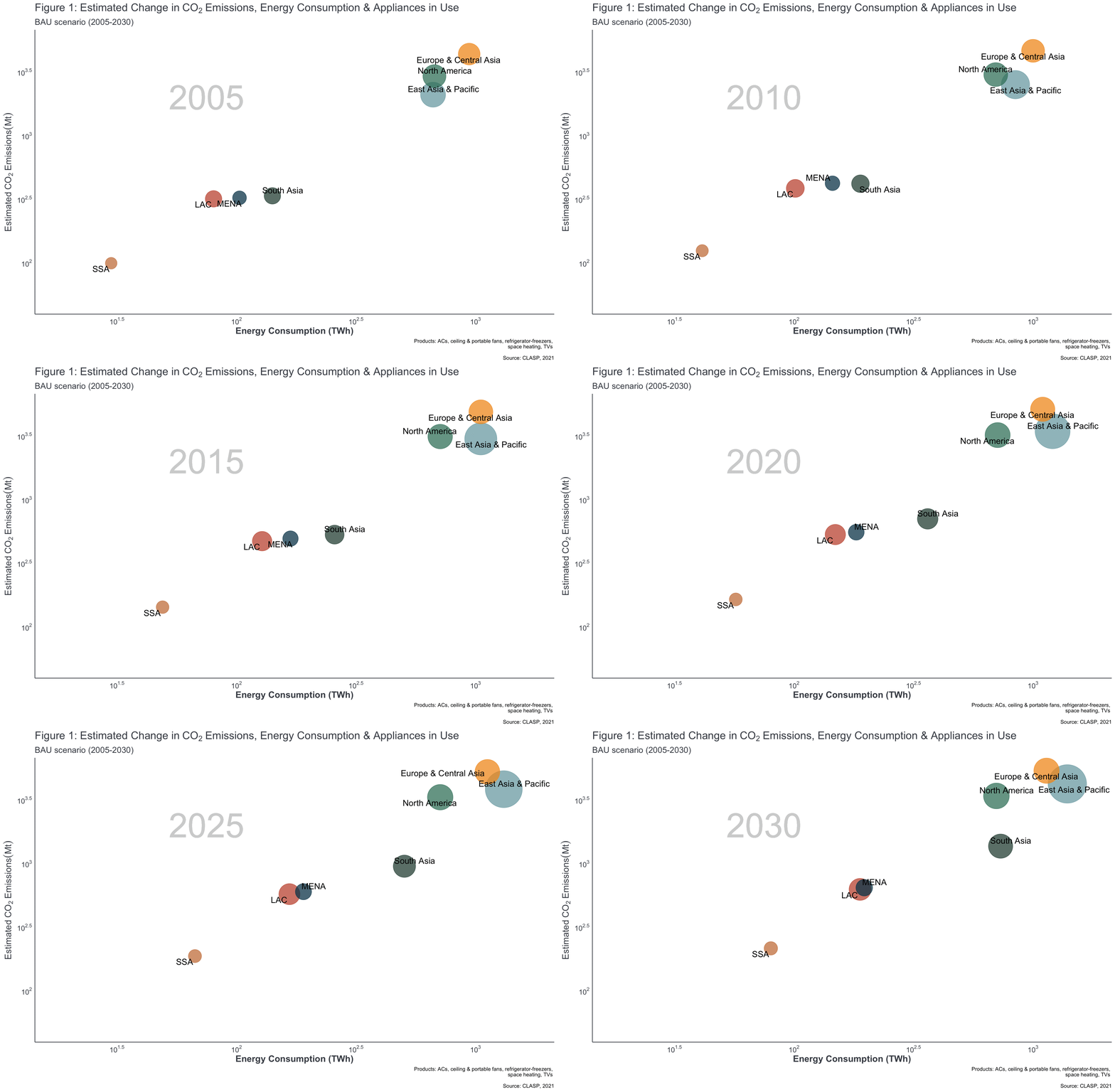
The data reveal three important trends:
- Appliance markets in North America, Europe, Central Asia, and parts of East Asia are saturated, but efficiency opportunities remain as relevant as ever. The total number of appliance units in use grows only slightly from 2005 to 2030, suggesting that markets in North America and Europe & Central Asia are saturated. The total number of appliances in use in East Asia & the Pacific is projected to continue to grow through 2030, largely due to sustained economic growth in China. Mepsy data show the number of appliances in use for other countries in the region (e.g., Japan and South Korea) has remained relatively constant and similar to trends in Europe, Central Asia, and North America. A typical household in a high-income country owns between 15 and 40 different appliances with the market penetration of some appliances, like refrigerators and TVs, estimated at 100%. High levels of appliance ownership correlate with high energy consumption. Household energy consumption in the United States and Europe is 5-10 times greater than in India and 10-20 times greater than in Nigeria. High market penetration of appliances, coupled with high energy consumption creates significant opportunities for MEPS to deliver large climate impacts.
- South Asia and Latin America and the Caribbean (LAC) are high-value opportunities for timely efficiency policies. Penetration of appliances in middle-income countries varies by region and appliance type. In India, residential air conditioner ownership in cities exceeds 30%, while nationwide penetration is estimated at 4%. In Brazil, appliance sales and energy consumption are predicted to increase as these economies grow and disposable incomes rise. In the absence of strong efficiency policies and a push for low-carbon energy generation, this transition will lead to higher emissions. By adopting standards now, nations could alleviate stress on the electrical grid, while changing the trajectory of household energy consumption and CO₂
- Sub-Saharan Africa (SSA) has the potential to “leapfrog” inefficient and outdated technologies. Compared to other regions, energy consumption and CO₂ emissions from appliances in Sub-Saharan Africa are relatively low, largely due to low rates of electricity access and appliance ownership in rural areas. 580 million Africans lack access to electricity and rural households typically own between 2 to 5 appliances. Ensuring a balance of policies that expand energy access and increase energy efficiency will be critical to ensuring all households can harness the benefits of clean, affordable, and reliable power. For example, improving the efficiency of off-grid appliances enables households frees up additional capacity to run additional appliances on a solar home system. Quality standards can further help to ensure the benefits of energy access translate into social and economic gains by advancing consumer protection and facilitating the growth of clean energy.
Quantifying the Potential Climate Impacts
If minimum energy performance standards for air conditioning, ceiling and portable fans, refrigerator-freezers, space heating, and televisions are adopted globally in 2021, we could cumulatively avoid 3,184 Mt of CO₂ emissions from 2021 to 2030 (Figure 2). These cumulative savings are equivalent to the emissions produced by 803 coal plants in one year. Further, these gains could be achieved without requiring customers to radically alter their behavior, e.g., Mepsy does not include efforts that nudge consumers to use their appliances and equipment less. The largest reductions are predicted to occur in high-emitting, high-income regions (e.g., North America) and middle-income countries with growing economies and populations (e.g., South Asia and Latin America and the Caribbean).
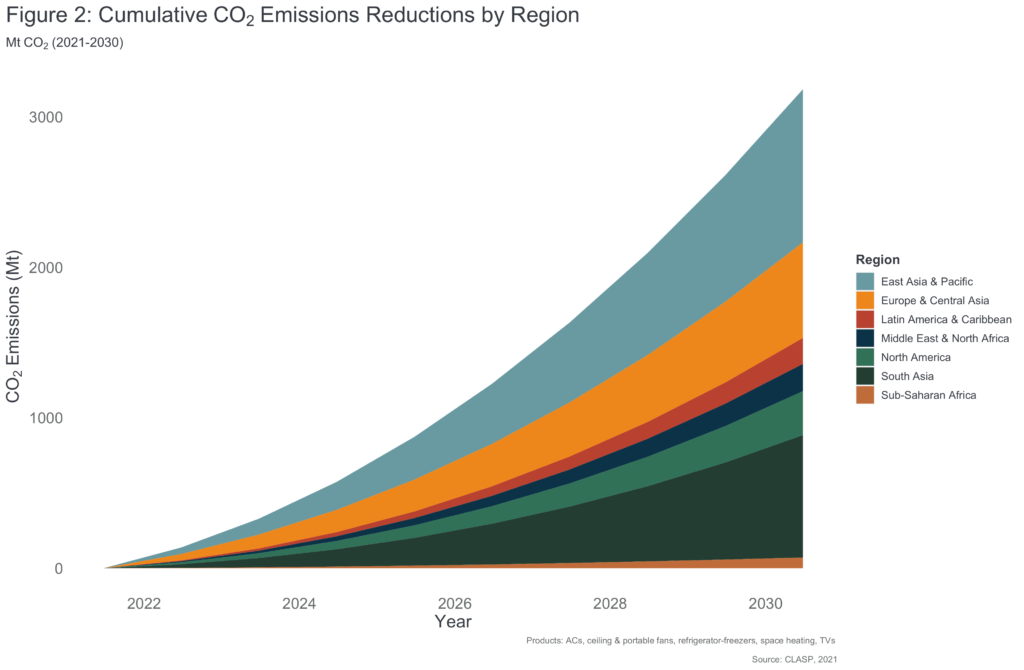
Figure 3 further illustrates the emissions that could be avoided with the widespread adoption of MEPS worldwide. It depicts the estimated CO₂ emissions from five appliance classes under Mepsy’s BAU and efficient policies scenarios. 2030 CO₂ emissions from the BAU scenario are shown in orange, while emissions from the efficient policies scenario are shown in blue. The reduction in emissions (expressed as a percentage) from the BAU scenario is shown on the right.
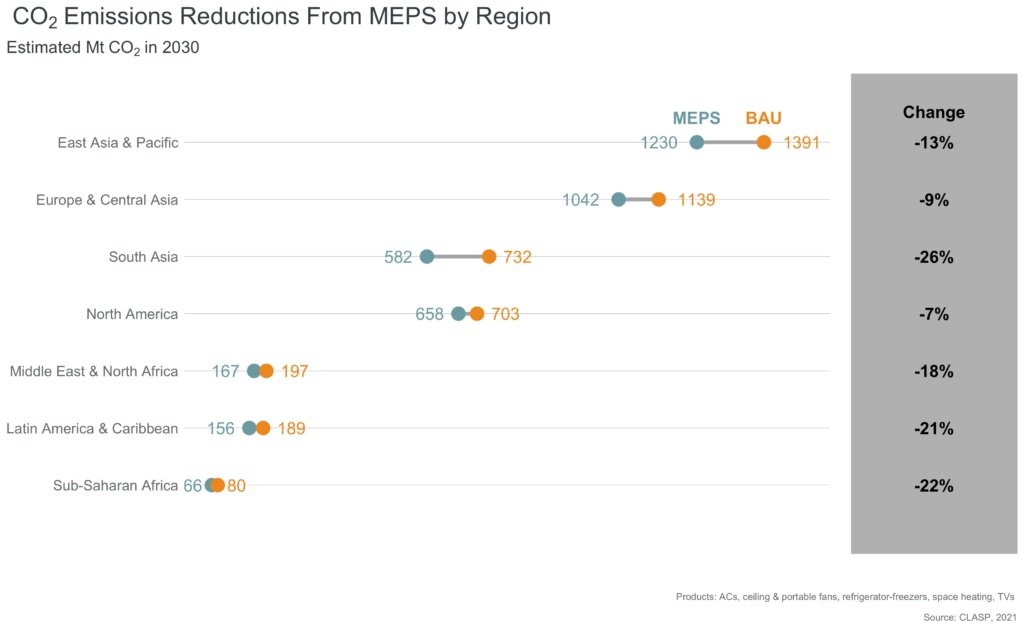
Mepsy estimates that CO₂ emissions from appliances in North America and parts of Europe and East Asia will decline or slow in both the BAU and MEPS scenario. This reflects minimal changes in electricity consumption (i.e., terawatt-hours consumed vary little from year to year) and a declining grid emissions factor due to decarbonization in the power sector. As inefficient products reach their end of life and more efficient products take their place, both the energy consumed by these products and the CO₂ emissions associated with that consumption will decrease. While high energy consumption is projected to persist in North America, we estimate that 293 Mt in emissions savings (7% reduction from BAU scenario) can be achieved by adopting stringent MEPS. Countries in Europe and Central Asia can similarly reduce their collective emissions by 636 Mt by 2030 (a 9% reduction from BAU).
Emissions from appliance use in Latin America and the Caribbean and South Asia are all projected to rise through 2030. By adopting efficient policies now governments can significantly lower their CO₂ emissions by 2030. We estimate that if MEPS were adopted this year, emissions in Latin America and the Caribbean could cut 173 Mt and South Asia 813 Mt, a 21% and 26% decrease from BAU, respectively. These cumulative savings translate to the equivalent of taking over 214 million cars off of the road for one year or the emissions from nearly 250 coal power plants in one year.
Finally, if countries in Sub-Saharan Africa were to adopt MEPS for air conditioners, ceiling & portable fans, refrigerator-freezers, space heating, and televisions, they could prevent 71 Mt of CO₂ emissions between 2021 and 2030. While this number is small in comparison to other regions, adoption of MEPS would place the region on a sustainable trajectory by ensuring efficiency policies are in place as the region develops and more people are able to afford appliances.
Conclusion
The need to address the global climate crisis is becoming increasingly more urgent. New analysis of countries’ updated NDCs finds they must “re-double” their climate efforts to achieve Paris Agreement’s goal of limiting global temperature rise by 2°C, ideally 1.5°C, by the end of the century. As we look to COP26 later this year, appliance MEPS stand to play a large role in the global effort to increase ambition on collective climate contributions and turn far-away targets into immediate action.
About This Analysis
This analysis was performed using the pre-loaded data freely available in Mepsy, with a linear projection of grid emission factors and transmission and distribution losses (between the data in Mepsy, applicable today, and historical data from 2000 and 2002 from CLASP’s Policy and Analysis Modeling System (PAMS). Mepsy uses a bottom-up accounting method that accumulates unit sales and retirements to estimate the number of appliances in use in each country (the stock) and multiplies it by the average unit energy consumption (UEC) under two different policy scenarios: business-as-usual and efficiency policies (CLASP’s recommended worldwide MEPS, often harmonized with global initiatives such as UN Environment Programme’s United for Efficiency). CLASP regularly updates Mepsy’s underlying data to reflect the latest product shipments and efficiency.
Mepsy also enables users to run their own analysis for a given date range using their own shipment (sales), equipment (e.g., lifetime, price, energy consumption), economic (consumer discount rate), and energy sector data (e.g., electricity price, transmission losses, etc.). These custom features allow policymakers, researchers, and others to generate more precise estimates for a specific policy in a specific country. To leverage these features, please select “Run Detailed Analysis” or read our Quick Start Guide.
If you have any questions about Mepsy or its underlying methodology and assumptions, please contact us. CLASP offers custom workshops for practitioners, to request a training please send us an email with your name, organization name, organization size, and a short description of the product classes and/or policies of interest.
Proposed Heat Pump Incentive Program Could Rapidly Transform the US Residential Market and Deliver $27 Billion in Consumer Energy Bill Savings
A new proposal from CLASP, supported by researchers at HVAC 2.0 and Harvard University, presents a low-barrier, least-cost policy package to rapidly deploy efficient space heating and cooling solutions in the United States. The study finds that a temporary Federal subsidy for residential electric heat pumps could save Americans more than $27 billion on their energy bills and deliver $80 billion in additional societal benefits over a ten-year period.
Residential heating and cooling account for 51% of household energy use and 40% of household energy bills in the US. Inefficient gas and electric resistance furnaces and air conditioners (ACs) account for more than 80% of all products currently in use. Heat pumps, which can provide both cooling and heating services, are up to four times more efficient than traditional equipment and have the potential to save consumers money on their energy bills and reduce greenhouse gas emissions.
Heat pumps are a critical technology on the path to net-zero emissions, but their deployment to date has been slow. Without intervention, heat pumps are unlikely to achieve 100% of the US market share on their own. Three million heat pumps are sold each year, compared to more than five million conventional unitary ACs. This imbalance can “lock-in” outdated infrastructure for 15 years or more.
The proposed ‘3H’ Hybrid Heat Homes program outlines an incentive program for residential electric heat pumps. While the program does not aim to achieve full heating electrification, it offers a pragmatic and cost-effective pathway to convert the entire US supply chain of unitary ACs into heat pumps. It aims to “raise the floor” for electric space heating in the residential HVAC market, delivering 45 million new installations over 10 years and paving the way for more ambitious decarbonization efforts.
The 3H program centers on a comprehensive Federal subsidy beginning in 2022 with a regulatory backstop to take effect in 2029. By ensuring that heat pumps are available and installed at the time of every future AC replacement, the market share of heat pumps in the US can increase from 10% to 44% by 2032.
Program benefits are substantial and will touch every corner of the country. On average, participating household energy bills will decrease by $169 each year, with cumulative energy bill savings totaling $27 billion over a 10-year period. Additional program benefits, estimated at $80 billion over the same 10-year period, include reduced climate impacts, cleaner air, and healthier communities. In 2032 alone, greenhouse gas emissions will be reduced by up to 49 million tons of CO₂e. Cleaner air will result in 888 fewer premature deaths, 920 fewer emergency room visits, 1,029 fewer nonfatal heart attacks, 24,476 fewer asthma exacerbations, 36,953 fewer respiratory and acute bronchitis incidents, 571,034 fewer minor restricted activity days, and 97,906 fewer lost workdays.
3H Hybrid Heat Homes: An Incentive Program to Electrify Space Heating and Reduce Energy Bills in American Homes

A temporary incentive program for residential electric heat pumps could save Americans more than $27 billion on their energy bills and deliver $80 billion in additional societal benefits over a ten-year period.
Heat pumps are a critical technology on the path to net-zero emissions, but their deployment to date has been slow. This document proposes a low-barrier, least-cost policy package to rapidly deploy efficient space heating and cooling solutions in the United States. It aims to “raise the floor” for electric space heating in the residential HVAC market, delivering 45 million new installations over 10 years and paving the way for more ambitious decarbonization efforts.
Residential heating and cooling account for 51% of household energy use and 40% of household energy bills in the US. Inefficient gas and electric resistance furnaces and air conditioners (ACs) account for more than 80% of all products currently in use. Heat pumps, which can provide both cooling and heating services, are up to four times more efficient than traditional equipment and have the potential to save consumers money on their energy bills and reduce greenhouse gas emissions.
The 3H Hybrid Heat Homes program centers on a comprehensive Federal subsidy beginning in 2022 with a regulatory backstop to take effect in 2029. By ensuring that heat pumps are available and installed at the time of every future AC replacement, the market share of heat pumps in the US can increase from 10% to 44% by 2032. Over a ten-year period, the program will save Americans more than $27 billion on their energy bills and deliver $80 billion in additional societal benefits.
Ending Toxic Lighting Together – CLASP Coordinates the Clean Lighting Coalition
The Clean Lighting Coalition (CLiC) is a global partnership to capture the health and environmental benefits of eliminating mercury-based lighting under the Minamata Convention on Mercury.
The Convention
The Minamata Convention aims to ‘Make Mercury History’ by eliminating the use of mercury in products and processes worldwide. Major highlights of the Convention include a ban on new mercury mines and phase-out of existing mines, the phase out and phase down of mercury use in a number of products and processes, control measures on emissions to air and on releases to land and water, and the regulation of the informal sector of artisanal and small-scale gold mining.
Despite this progress, the Convention currently includes special exemptions for fluorescent lighting, citing insufficient cost-effective alternatives across global markets. However, the rapid development and increasing accessibility and affordability of mercury-free LED lighting in recent years makes the exemption unnecessary. Eliminating special exemptions for fluorescent lighting at the next Conference of Parties (COP4) would lead to a global phase-out by 2025 and accelerate a transition to super-efficient LED lighting.
Clean Lighting is a Global Equity Issue
As larger countries regulate their markets, there is a growing risk that lower-income countries will become dumping grounds for toxic, outdated lighting products like fluorescent bulbs. Poor waste management infrastructure for mercury in lightbulbsleads to widespread dispersion into the environment and ecosystems. The majority of fluorescent bulbs are discarded into general waste streams where, due to their fragility, they break, releasing mercury and contaminating landfills, soil and water bodies. Only an estimated 10% of mercury in fluorescents is recovered. No country has adequate disposal or recycling facilities.
Considered by WHO as one of the top ten chemicals of major public health concern, mercury poses a threat to human health, particularly during the development of the child in utero and early in life. Broken or discarded fluorescent bulbs haphazardly release this toxic substance mainly into the air, where it can bioaccumulate up the food chain, posing a risk to human health, wildlife and the environment. Eliminating exceptions for mercury lighting under the Minamata Convention and transitioning to clean LED lighting would protect people from the dangerous risks of mercury.
Mitigating Climate Change
LEDs are the most efficient light source on the market, offering people, businesses and governments long-term cost savings, consuming up to 60% less energy than fluorescents and lasting 2-3 times longer. A phase out of fluorescent light bulbs by 2025 could conservatively reduce CO₂ emissions equivalent to getting all passenger cars (globally) off the road for a whole year.
Lead Up to COP4
CLiC and our partners are celebrating a proposed amendment by representatives from the Africa region to phase out most fluorescent lamps at the next meeting of the Conference of the Parties (COP4) of the Minamata Convention on Mercury. Read the full press release.
In the lead-up to COP4, the Coalition is coordinating experts, governments, advocates and the private sector to support a global transition to clean lighting.
____
Further Reading:
- Quantifying Lighting Benefits under the RoHS Directive: Calculating the Cost of Lost Time
- Mapping the Lighting Market in Tanzania and Zanzibar
- Report Shows Market Readiness to Eliminate Mercury-Based Lighting
- Phasing Out Mercury-Based Lighting Offers Environmental and Consumer Benefits, Report Finds
Webinar Materials | How to Evaluate and Prioritize Efficiency Policies with Mepsy
Improving the energy efficiency of household appliances and commercial equipment is a fast, cost-effective, and reliable means of mitigating carbon emissions. Efficiency standards are a key building block in most national plans to meet the climate challenge, but the analytical tools used to support policy design have long been too difficult or expensive to use and customize.
In February, CLASP launched Mepsy, a new planning tool designed to help policymakers, researchers, and others assess, compare, and prioritize energy efficiency policy scenarios. Mepsy displays the energy and climate impacts of appliance efficiency standards for key energy-using products, and supports national, regional, and global analysis.
These webinar resources introduce viewers to Mepsy, its underlying data, methodology, and use cases, with a real-world example of how CLASP is deploying the tool in Botswana. Users will understand how they can use Mepsy to understand the climate and energy impacts of efficiency standards, as well as how they can model specific policy scenarios using their own data.
A transcript of the audience Q&A session is also available.
Revising the Brazilian Labeling Program for Refrigerators: Lessons from the European Union and Thailand
Brazil’s INMETRO is currently considering modifications to the National Label for Energy Conservation (ENCE) for refrigerators to better differentiate more efficient products that will lower electricity consumption, save consumers money, and reduce carbon dioxide emissions. The modifications being considered include the addition of “A+,” “A++,” and “A+++,” to the current A to G scale, since all refrigerators currently found in the market are already “A” class. These modifications are similar to the additional categories that were added to the European Union’s energy efficiency label in 2010, and then removed beginning in 2017. The Electricity Generation Authority of Thailand (EGAT) has also experimented with the creation of additional categories on their EGAT No. 5 label, which previously categorized products on a scale from level 1 to level 5. They did this by adding three stars to their label, so that the top labeling class changed from “level 5” to “level 5 with three stars.” The experiences from both the European Union (EU) and Thailand demonstrate that, while creating such additional categories can help to differentiate products, it can also decrease the effectiveness of the label and confuse consumers.
Key Findings and Recommendations:
- Creating additional label categories is not as effective at motivating consumer choice as a full revision of the energy efficiency criteria for the existing label. In the EU, consumers were less likely to pay more for an “A+++” product over an “A” product than for an “A” product over a “D” product. In Thailand, 94% of consumers would not purchase a product that does not achieve the level 5, but only 11% of consumers would pay 20% more for a No. 5 product with three stars over a No. 5 product with no stars.
- Additional label categories can confuse consumers. In Thailand, 57% of retailers reported that consumers asked for clarifications about the meaning of the additional stars on the existing No.5 label. In the EU, Electrolux, a major appliance manufacturer, publicly criticized the European Commission for the additional categories as “increasingly confusing to consumers,” creating additional momentum for the elimination of the categories starting in 2017.
- INMETRO should implement a full rescaling instead of creating additional labeling categories. This would achieve the objective of differentiating products, maintain the motivating power of the top labeling class, and avoid confusing consumers.
- If additional categories are created, a comprehensive consumer awareness campaign should be launched to educate consumers on the value of the new categories, and that the “A” class represents the least efficient refrigerator class currently allowed on the market. Displaying the “A” class as the lowest efficiency class on the label would help to make this clear. In addition, a consumer awareness campaign, including materials for retailers illustrating how to explain the new classes to consumers, would reduce confusion.