
New report finds US hybrid heating could cut national heating costs by $13.6 billion
Read the full press release here.
A new report from CLASP and the Regulatory Assistance Project (RAP) finds that the US could reduce national heating bills by $13.6 billion and cut annual CO2 emissions by 67 Mt, the equivalent of removing 14.4 million passenger cars for an entire year, by swapping air conditioners for heat pumps.
The report, “Combating High Fuel Prices with Hybrid Heating: The Case for Swapping Air Conditioners for Heat Pumps”, advocates for households to replace existing air conditioning units at the end of their useful life with look-alike electric heat pumps – a technology that can both heat and cool indoor spaces. In this proposal, households would keep their legacy heat systems in place, using them to supplement the heat pump at lower temperatures.
“AC retirements are a low-cost opportunity to bring super-efficient heat pumps into US homes,” said Matt Malinowski, report author and Director of Climate Research at CLASP. “Our report offers a robust argument in favor of making the swap, including huge cost savings for households and meaningful mitigation impacts.”
Every six seconds a new residential furnace or air conditioner starts up in the US, meaning these households miss out on the opportunity to begin home decarbonization until that equipment is retired in 2035-2040. In contrast, 1.7 million oil, 3.1 million propane, 16 million electric resistance, and 33 million methane gas households across the country can benefit right now from swapping one-way ACs for hybrid heat pumps. Households will also reduce their heating bills by $77-$555 per year, while reducing CO2 emissions by 11%-20%, depending on fuel.
“The transition away from fossil heating in the US requires millions of new electric heat pumps to be installed in the next few decades,” said Steve Pantano, Chief of Research at Rewiring America. “But the opportunity is clear. We can tackle a big part of this challenge at a very low cost, save consumers money on their energy bills, and accelerate progress toward our nation’s climate goals.”
The report, which extends the research in CLASP’s 2021 3H report, offers an analysis of the feasibility and benefits of household transition from oil, propane, methane gas, and electric resistance heating to hybrid heating systems in light of rising fuel costs and a desire to reduce fossil fuel dependence. The authors also recommend proven state and local policy tools to accelerate the adoption and overall availability of heat pumps.
“Rerunning the numbers, the Hybrid Heat Homes idea makes even more sense this year than last,” said Nate Adams, founder of HVAC 2.0 and co-author of the 3H paper. “All fuel prices are up substantially, so savings amounts got higher. Particularly for rural areas with expensive fuels and lower income, it’s a boon for equity. And, of course, being able to run on renewables helps deliver true energy independence so we’re less prone to price shocks like those caused by events like Russia invading Ukraine.”
Pushing for a swap from air conditioners to heat pumps over the next 5-10 years will smooth the way for full-building electrification and advance the United States towards its ambitious goal of achieving net zero by 2050.
“Electrification of the existing housing stock is a big mountain to climb,” said Max Dupuy, coauthor of the report and Principal at RAP. “Every home is different. Our proposal to swap AC to heat pumps opens a clear path to get rolling.”
Forecast Climate Impacts up to 2050 with Mepsy
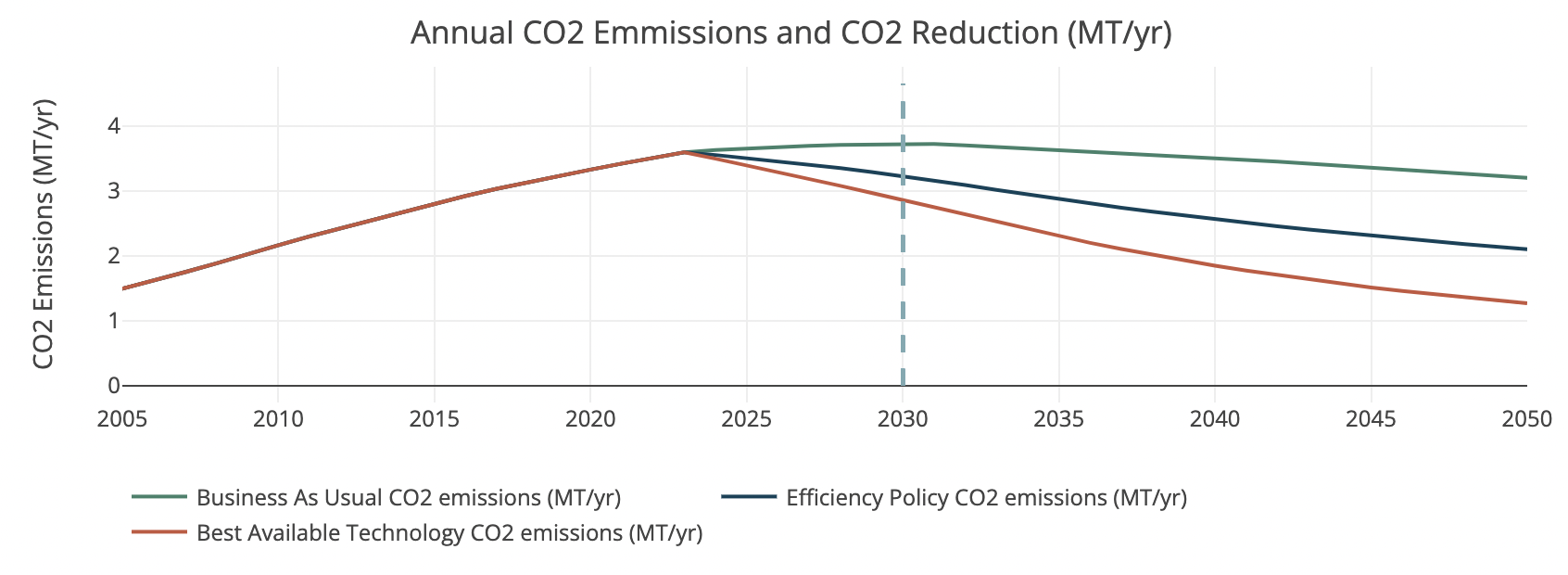
As the target date for critical 2030 climate mitigation goals looms just eight years away, policymakers and researchers need the tools to accurately forecast climate impacts into the next several decades. Many countries have set additional goals for years after 2030, often using 2050 as the goalpost. To match the expanding needs of our users, Mepsy, CLASP’s Appliance & Equipment Climate Impact Calculator, is evolving to include more relevant data and improve the user experience.
In mid-May, CLASP unveiled the new 2050 extension model for Mepsy. This update allows users to forecast climate impacts for all seven of Mepsy’s current appliances up until the year 2050. Mepsy contains the most of-the-moment data to provide efficiency professionals with the insights needed to inform the highest impact policies for people and the planet.
In addition to longer modeling capabilities, this month’s update also includes backend revisions and newly released methodologies to dive deeper into the data.
Operation Updates:
In anticipation of this important update, Mepsy’s team fine-tuned the tool’s code for an improved user experience. We also integrated additional options that allow users to account for improvements related to pricing, efficiency and emissions over time, more closely resembling real-world conditions.
Methodology Updates:
The Mepsy team used data from updated versions of previously cited sources, like USAID, the World Bank and the UN. To address gaps in data, CLASP used linear interpolation and extrapolation to complete the set. The current modeling is based on a beta regression model, improving the accuracy of the original model built in 2007.
For a more detailed description of our methodology, please see our Extension Model Methodology, also available on the Mepsy page.
Looking Forward: Noting high-GWP refrigerants
The majority of refrigerants used today have high GWP when released into the atmosphere, especially during leakage. Because of their ubiquity in AC and refrigeration (residential and commercial), CLASP calculated the outsized climate effects of refrigerant leakage, which we will later integrate into existing Mepsy appliances. We hope these data further support the implementation of policies that prioritize high-efficiency AC and refrigeration appliances.
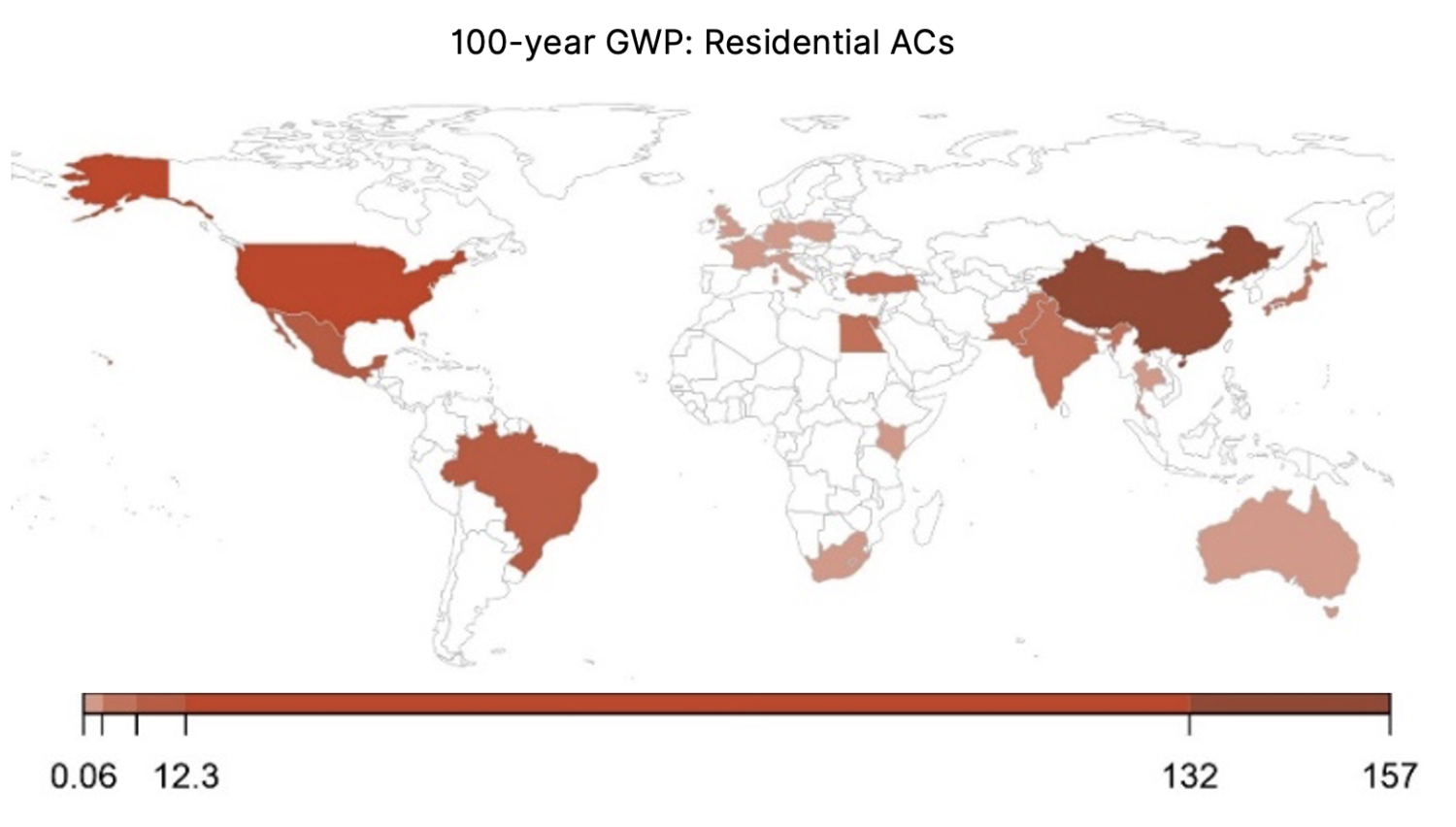
These emissions are 13 to 29% of the CO₂ emitted while powering seven common appliances in the 22 countries.
In anticipation of the launch, we are releasing our refrigerant methodology that explains how the data were gathered and will be integrated into existing cooling and cooling/heating appliances on Mepsy.
To keep up to date with Mepsy, reach out to mepsy@clasp.ngo to sign up for email updates.
HEATR Act Introduced in US Senate
Heat pumps, which can both cool and heat indoor spaces, are up to four times more efficient than traditional equipment, providing a significant opportunity to save people money on energy bills, cut greenhouse gas emissions, and decrease our reliance on oil and gas. With the rapid increase in fossil fuel prices and an accelerating climate crisis at hand, US policymakers are scoping out effective and affordable climate solutions.
In early May, Senator Amy Klobuchar introduced the Heating Efficiency and Affordability Tax Relief (HEATR) Act. Drawing directly from recommendations in CLASP’s 3H Hybrid Heat Homes report, the bill aims to establish upstream incentives for manufacturers to transition production to heat pumps, resulting in lower upfront costs to consumers and accelerated deployment of the super-efficient technology.
Supplementing traditional home heating with heat pumps offers noteworthy climate and economic benefits. The average household can cut fossil fuel use by 39% when running a heat pump above 41°F/5°C and save $154 per year in operating costs.
Support the HEATR Act
Underscored by the Russian invasion of Ukraine and skyrocketing oil and gas prices globally, CLASP and our partners are urging other NGOs and civil society organizations to voice their support for the bill.
To endorse the HEATR Act, please fill out this form.
Thus far, the legislation is endorsed by CLASP, the Appliance Standards Awareness Project (ASAP), the American Council for an Energy-Efficient Economy (ACEEE), the Natural Resource Defense Council (NRDC), RMI, AFL-CIO and 21 additional organizations.
More About the Bill
The HEATR Act was introduced by Senator Klobuchar and co-sponsored by Senators Hickenlooper, Whitehouse, Leahy, Merkley, and Booker.
Targeted manufacturer incentives can help keep the purchase cost of the equipment low by avoiding markups along the manufacturing and distribution process. This strategy helps to reduce the high upfront costs to consumers, lowering the barrier for mass heat pump deployment across the US, and complements the consumer-facing incentive currently proposed in Build Back Better.
The bill is currently awaiting approval from the Senate Finance Committee.
To learn more about the bill and heat pump technology, explore the following resources:
- Bill Text and Bill Status
- CLASP 3H Hybrid Heat Homes Report
- Replacing Residential Heating Oil with Heat Pumps in the US
Press
- Senator Klobuchar’s Press Release.
- Senator Smith’s Press Release.
- A new bill could speed up American electrification by 20 years, Canary Media.
- New Senate Bills Encourage U.S. Heat Pump Manufacturing Jobs, NRDC.
- The U.S. Is Addicted To Gas Heating. A New Bill May Make Going Electric The Easy Choice, Huffington Post.
- Two new bills could help pump up a climate-friendly system for heating and cooling homes, Popular Science.
First-of-its-kind Campaign Raises Awareness on Solar Water Pumps in Kenya
Through Efficiency for Access, CLASP ran an awareness-raising campaign across five sub-counties in Machakos, Kenya. The campaign sought to stimulate consumer awareness of the benefits of solar water pumps (SWPs) for improved agricultural productivity and potentially increase the demand for SWPs among rural households.
The campaign engagement strategy included a variety of mass communication and tailored direct-to-consumer activities, including community education forums, farm-to-farm visits, product demonstrations, and radio advertisements. By the end of December, we reached over 30,000 people through direct in-person engagement, and we estimate that the local radio ads reached 3,000,000 people, exceeding our target audience of 770 households.
We partnered with Shamba Shape Up to film an episode on a solar water pump installation for Ted, a Kenyan farmer who previously relied on an electric pump for irrigation.
Here are some insights from the campaign:
- Between the baseline and the end-line surveys, awareness levels increased by 46%, indicating that more people were knowledgeable about the benefits of SWPs.
- Almost 80% of the farmers interviewed indicated they would like to adopt solar irrigation within one year; but we have not yet seen any conversion into sales. A lack of financing options was cited as the main reason.
- Community members identified water source challenges, inadequate knowledge and lack of capital as the most significant barriers to solar irrigation adoption.
- Despite increased awareness of the benefits of solar water pumping, there is a massive gap in local supply and brand-specific technical awareness among the farmers.
Download the campaign readout or watch our YouTube video to learn about the campaign’s outcomes and Efficiency for Access’ recommendations for increasing demand among rural households.
You can also watch a recording of the live Q&A session Efficiency for Access hosted with Kilian Blumenthal from Water and Energy for Food and Kavita Ndolo, an agribusiness owner from Machakos, Kenya for insights on the awareness-raising campaign.
Replacing Residential Heating Oil with Heat Pumps in the US
Heating oil is one of the most expensive heating fuels in the US, requiring millions of households to spend more than $2,000 annually for heat. Replacing all or some oil-powered heating equipment with modern two-way heat pumps can cut greenhouse gas emissions, reduce household heating and cooling costs, and increase comfort.
This paper explores two opportunities for heat pump retrofits for oil heating equipment in the US and the costs and benefits of each based on a 2021 CLASP analysis, with updates to reflect December 2021 prices.
Webinar Materials | How Mepsy Can Transform Your Energy Efficiency Policy Development
Effective energy efficiency policy is more important than ever for mitigating carbon emissions and improving energy access globally. Policymakers and researchers can take advantage of Mepsy, CLASP’s free policy analysis tool, to make data-driven decisions about managing the top energy-consuming appliances, now including lighting and considerations for varying compliance levels.
This webinar, held on 16 March 2022, informed participants of two major additions to Mepsy’s toolkit: lighting and compliance. In addition, CLASP demonstrated how to use Mepsy to perform custom analyses and multiple tier policy analyses, in response to high demand for the feature.
A PDF version of the slides is available above, but to view the videos presented during the slideshow, please see the link below. Other related materials can also be downloaded below.
- Download Presentation (Read Only)
- 2022 Mepsy Webinar Q&A
- Analyzing Multiple Policy Tiers Guide
- Multiple Tiers Tool (Excel sheet)
- Transcript
For more information on Mepsy, see the Mepsy tool page and watch our launch webinar.
CLASP Supports Water Solutions in Increasingly Dry South Africa
In 2021, CLASP found that South Africa will require 17% more water by 2030 to meet growing demand; efficiency policies for taps and shower-heads could reduce demand for water and electricity. In a new study, the South African Energy Development Institute (SANEDI) and CLASP found that South Africa can reduce water wastage and mitigate a water crisis by implementing a labelling scheme.
Aligning Domestic with International Water Policies
The new study outlines the path to a South African water efficiency labeling program, in line with the country’s Water and Sanitation Master Plan. To ensure the program is effective, the report indicates that local policies must align with international standards.
“The report aims to advance water and in turn, energy efficiency, in South Africa by making recommendations for alignment to international standards which have improved efficiency globally,” says Ashanti Mogosetsi, Project Manager for Appliance Standards and Labelling at SANEDI. “We encourage South Africans to engage with the report and take steps to align their plumbing needs with the country’s evolving regulatory framework. Conserving water also conserves energy, which reduces your annual water and electricity bills.”
User experience should not be compromised
The report analyses flow rate requirements and test conditions for all products submitted to the South African regulatory body. It suggests the best minimum and maximum flow rates that would not compromise user experience, while still conserving water. CLASP recommends analyzing the application of the tap (domestic, public or commercial) as well as the function (continuous/running flow or to fill a measured volume) before developing a standard.
“We took into consideration all the different uses for taps,” explains Monica Wambui, Senior Associate at CLASP. “We analyzed which flow rate would provide the best experience for South Africans.”
Limiting the flow rate for taps that are intended to fill a measured volume – like a bath – will likely not save water. Low flow rates instead may lead to user dissatisfaction. However, for taps like kitchen sinks, the report recommends maximum flow rate restrictions, while still allowing enough flow to not frustrate the user.
“The findings in this report will guide the alignment in policies for taps. Developing these water efficiency policies and labels will benefit everyone – from the household to the national level,” says Wambui.
Efficiency for Access Launches New Efficiency for AgTech Campaign
In an effort to form a bridge between the historically siloed energy and agriculture sectors, Efficiency for Access is launching a campaign entitled Efficiency for AgTech that will spotlight the inextricable link between energy and agriculture. From January to April 2022, the campaign will promote and highlight the latest trends and innovations in energy-efficient, sustainable and climate-smart agricultural solutions that can enhance global food security and build climate resilience. As an evolution of the Low-Energy Inclusive Appliances (LEIA) programme’s first-ever communications campaign in 2017, also entitled Efficiency for AgTech, this campaign brings the five-year LEIA programme full circle.
The United Nations Food and Agriculture Organization (FAO) estimates that by 2050, 70% more food will need to be produced in order to feed the growing global population. Yet as climate change destablises weather patterns and predictable growing seasons, this effort to expand global food production becomes increasingly threatened. The ecological crisis thus compounds the problem by exacerbating already existing inefficient and polluting food production and storage processes.
Energy-efficient, solar-powered, off-grid appropriate agricultural appliances and equipment have the potential to help meet the growing food demand in a way that mitigates climate impacts and builds resilience. These technologies are particularly impactful for the smallholder farmers who help feed a third of the world’s population.
“Solar-powered productive use agricultural equipment has gained an increasingly important role in the face of our changing planet,” says Jenny Corry, Director at CLASP. “Using polluting and inefficient systems or technologies is no longer viable. We need clean agtech to empower smallholder farmers to sustainably feed our growing global population, while also enhancing the infrastructure and processes that build climate resilience.”
“This 2022 Efficiency for AgTech communications campaign is an evolution from our first campaign in 2017, also entitled Efficiency for AgTech. This campaign will serve as a crucial link between the energy and ag sectors, highlighting the need to form partnerships that accelerate the uptake of these technologies–at a pace that acknowledges the urgency of the climate crisis.”
Over the course of this three-month campaign, Efficiency for AgTech will highlight what Efficiency for Access and its partners have accomplished so far in accelerating the uptake of solar-powered agricultural appliances. It will also forecast the future direction of the ag-related productive use equipment sector by shining a light on emerging trends and challenges. The campaign will use Efficiency for Access social media channels and newsletter outlets to amplify blog articles, publications and events. All campaign-related materials and collateral will use the hashtag #EfficiencyforAgTech. Visit the campaign webpage for more.
Throughout the campaign, Efficiency for Access will collaborate with organisations working in the energy and agriculture nexus to disseminate information, co-host events and develop new content. To get involved, please contact Marion Kudla (mkudla@clasp.ngo) and Lisa Kahuthu (lkahuthu@clasp.ngo).
—
About Efficiency for Access
Efficiency for Access is a global coalition working to promote high performing appliances that enable access to clean energy for the world’s poorest people. It is a catalyst for change, accelerating the growth of off-grid appliance markets to boost incomes, reduce carbon emissions, improve quality of life and support sustainable development. Efficiency for Access consists of 15 Donor Roundtable Members, 17 Programme Partners, and more than 30 Investor Network members. Current Efficiency for Access Coalition members have programmes and initiatives spanning 47 countries and 25 key technologies.
The Efficiency for Access Coalition is coordinated jointly by CLASP, an international appliance energy efficiency and market development specialist not-for-profit organisation, and Energy Saving Trust, which specialises in energy efficiency product verification, data and insight, advice and research. Visit https://efficiencyforaccess.org/ for more information.
If you would like more information about this topic, please email Marion Kudla at mkudla@clasp.ngo
CLASP Supports Policies to Improve Water Efficiency in South Africa
South African Drought Leads to Water Crisis
South Africa, considered the 30th driest country, relies on increasingly unpredictable rainfall. Between 2015 and 2017, the country experienced a crippling drought, culminating in a severe water shortage. In 2018, the Cape Town local government announced that the city was within 90 days of running out of water, inching closer to a Day Zero scenario. On Day Zero, the government would shut down all water sources and require residents to source daily water from designated collection points.
Through strict water saving restrictions, including banning all forms of outdoor water use, such as washing cars, the local government averted Day Zero. In addition, the city increased tariffs and reduced water pressure, limiting household consumption to just 50 liters per day for all daily activities. The country still requires 17% more water by 2030 to meet growing demand. Without policies to improve water use and efficiency, the Day Zero scenario remains a stark possibility for South Africa.
Water Efficiency Policies Mitigate Day Zero Scenario
In order to reduce future water demand, South Africa is implementing a National Water and Sanitation Master Plan. CLASP is supporting the South African government to introduce water efficiency policies that will mitigate the risk of water shortages throughout the country by identifying more efficient technologies for taps and showerheads.
Implementing efficiency policies will reduce South African water use by over 1 trillion liters per year and cut energy consumption across the country. Heated water accounts for 40-50% of residential electricity use; by developing and implementing efficiency policies for taps and showerheads, South Africa will reduce energy consumption by 18 TWh per year, equivalent to 9% of national electricity use. In addition, reduced heating electricity consumption will avoid 16 MT in C02 emissions per year.
CLASP Analyzes Current Water Policies
“CLASP is conducting a gap analysis to better understand how domestic water appliances and policies compare to global best practices. The analysis includes a review and comparison of South Africa National Standards (SANS) products, installation and international standards, as well as recommendations for improved policy alignment”, said Monica Wambui, Senior Associate at CLASP.
Our team is working with a partner to test and establish a baseline of flow rates of commonly available showerheads. The team will guide the development of policies, as well as strengthen existing efficiency policies and regulations in the future. Among the considerations in the analysis is the use of the taps. The considerations will guide the best flow rate to reduce water wastage and energy consumption.
Our findings will provide government agencies and stakeholders with recommendations to make informed decisions to align and better integrate water efficiency into water appliance standards, mitigating potential future water shortages.
Off- and Weak-Grid Appliance Market: Uganda
Uganda’s electrification rate is growing rapidly, but 59% of people still do not have access to electricity. This large off- and weak-grid population, a sharp increase in mobile money operations, and the established markets for component-based solar energy systems all provide a strong foundation for appliance sales in Uganda.
While the solar market in Uganda is growing fast, ownership of appliances such as TVs and refrigerators remain extremely low. There is also insufficient data about off-grid appropriate appliances that can help manufacturers, policymakers, distributors, mini-grid operators, investors, and other market actors to make informed decisions and identify high quality, efficient products sold in their region.
To help address this challenge, Efficiency for Access has worked to gather data on the availability of off-grid appropriate appliances in key countries, including Uganda. The Off- and Weak-Grid Appliance Market Country Profile for Uganda analyses four types of off-grid appliances surveyed in 2018 and 2020—TVs, fans, refrigerators and SWPs.
The profile explores the overall market landscape in Uganda, the common power type, size, price and warranty of off-grid appliances sold in retail markets, and other findings. The market insights can help inform sector stakeholders, such as development programmes, distributors, manufacturers, mini-grid developers, policymakers, and others, on the state of the market. In addition, we hope that the publication can help its readers identify opportunities to encourage higher market penetration for high-quality off- and weak-grid appropriate appliances.
Download the Off- and Weak-Grid Appliance Market: Uganda report here.
About Efficiency for Access
Efficiency for Access is a global coalition working to promote renewable and energy efficient appliances to deliver clean energy to the world’s poorest people. It is coordinated jointly by CLASP and the UK’s Energy Saving Trust.