Just How Bad Is Air Conditioning for the Climate—and What Can We Do About It?
AC policy expert Ana Maria Carreño offers a primer for climate advocates.
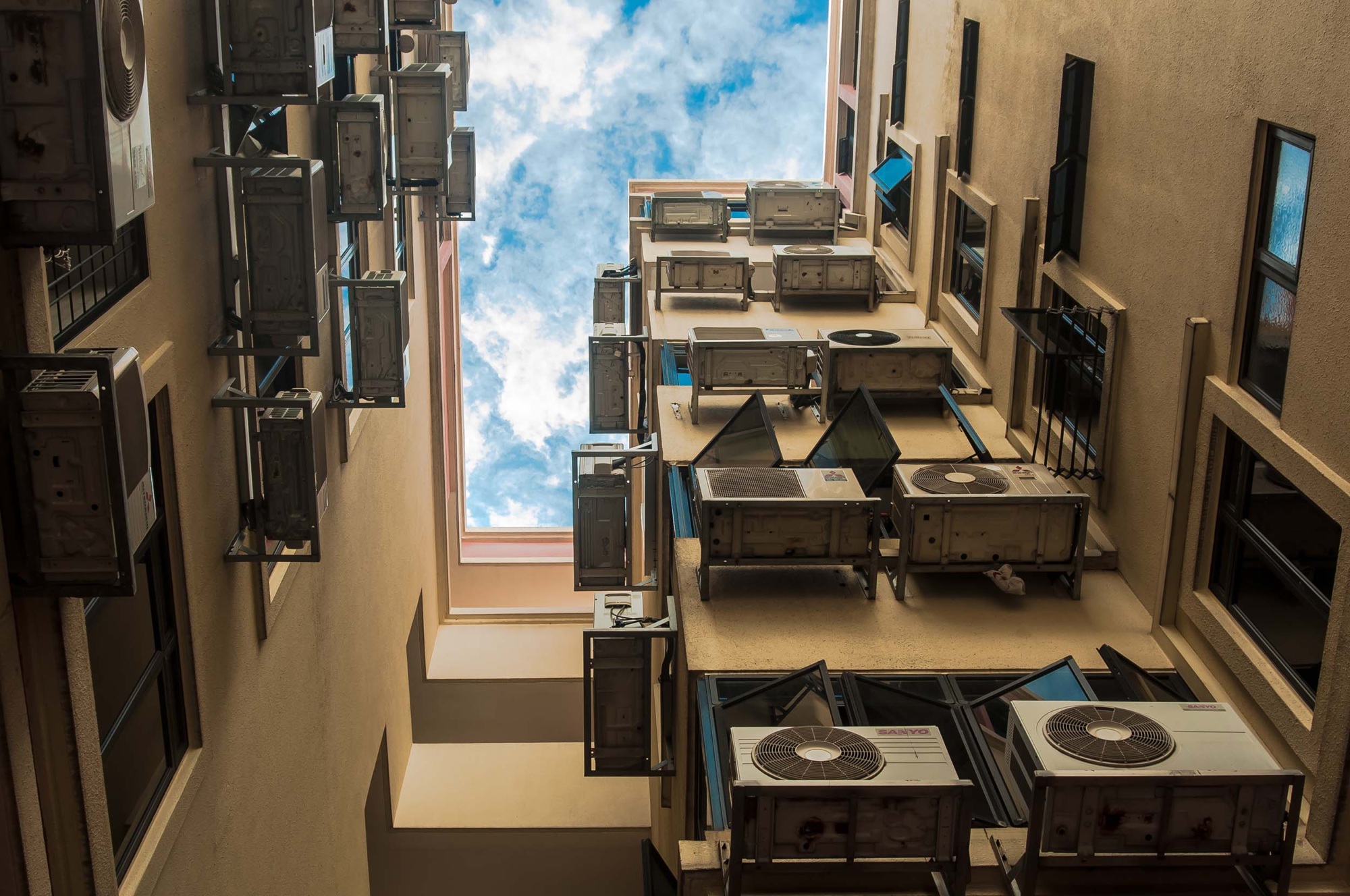
As the planet warms, air conditioning is becoming a critical necessity in much of the world. But common AC technologies have an outsized climate impact, driving temperatures even higher.
Ana Maria Carreño has spent years working to disrupt this cycle. As CLASP’s senior director of climate, she identifies and implements solutions for keeping people cool without heating up the planet.
In this interview with CLASP’s Sarah Wesseler, she discusses AC’s mitigation challenges and what it would take to solve them.
*
Sarah Wesseler: The links between climate change and air conditioning have been widely covered in the media. It’s a complex problem, though, and I suspect most climate advocates don’t have a nuanced understanding of it, let alone a sense of how to solve it. What do you see as the most important things to understand about reducing emissions from ACs?
Ana Maria Carreño: Well, first of all, you have to reduce the demand for artificial cooling. But that doesn’t mean asking people to live with excess heat. Instead, it means changing the way we design cities and buildings.
If you look at places built before modern HVAC [heating, ventilation, and air conditioning] equipment was invented, they’re highly responsive to their local climates. In hot places, design solutions like shade and natural ventilation kept people comfortable even during the summer. Things like large porches, internal courtyards, and trees kept direct sunlight out of building interiors, for example. Even something as simple as light-colored roofs that reflect heat away from buildings can make a huge difference.
Today, a lot of this nuance has been lost. You can find essentially the same types of buildings and neighborhoods being built in very different climates, which leads to unnecessarily huge air conditioning loads. It also means more heating is needed in the winter, but that’s another story.
So we need to go back to this older model of working with local environmental conditions to create places that are comfortable in hot weather even without air conditioning.
There’s a lot of really interesting work happening on this front. For example, in Colombia, where I’m from, the city of Medellín has had a lot of success in reducing heat by planting trees on busy streets to create shade. The program has really made a difference, lowering local temperatures by 2º degrees Celsius (3.6º Fahrenheit).

So reducing the demand for mechanical cooling is the first step. And then once we get that as low as it can go, we need to meet the remaining demand in a way that’s as climate-friendly as possible. That means paying close attention to electricity and refrigerants, which are the two main sources of emissions.
The electricity emissions come from burning fossil fuels in places where the electricity used by ACs is produced with oil, gas, or coal. Because a lot of electricity is produced this way, ACs are indirectly responsible for a large volume of emissions. That’s why it’s important to use efficient equipment. As we reduce the amount of energy needed to run ACs, we can reduce the amount of fossil fuels burned.
Refrigerants are also really important. They’re classified in terms of their global warming potential, which is extremely high for some refrigerants. One of the most common ones used in air conditioners, R-410A, is 2,000 times more potent than carbon dioxide.
The world is moving away from refrigerants that have high global warming potential, but that transition is not happening as fast as it should. The transition is being driven by commitments many countries made under the Kigali Amendment of the Montreal Protocol to phase down and phase out these refrigerants. But national regulations are needed to speed the process, and in many countries there is no regulation.
Wesseler: OK, so electricity use and refrigerants make ACs problematic from a climate perspective. How problematic, specifically? How much of a climate risk does AC pose?
Carreño: Well, data from CLASP’s appliance efficiency policy model, Mepsy, show that the projected emissions in 2030 from room air conditioners alone—so not counting any other type of space cooling, like fans—are about 800 megatons, which is almost a gigaton. That’s roughly equivalent to driving 186 million gasoline-powered cars for a year.
We’ve also found that, to achieve net zero scenarios by 2050, emissions from the entire appliance sector need to fall by nine gigatons by 2050. So when you consider that room air conditioners will reach one gigaton of emissions in 2030, that tells you the magnitude of the challenge AC poses for the climate community.

Credit: Shutterstock
What makes this even more difficult is that, at the same time that we need to reduce emissions from AC, we need to help more people get access to air conditioners.
For many years, the efficiency community talked about air conditioners being a luxury—something that was only for households with the capacity to purchase the equipment and pay high electricity bills. But now summers are becoming so hot in many places that it’s almost impossible to stay healthy, to work, to study without AC. But there’s still very low access to air conditioning in Southeast Asia, Latin America, and Africa.
Brazil is a good example. Only 20% of households there own an air conditioner—most people use fans for cooling since they’re cheaper than AC. But the summers are becoming hotter and hotter. This year, the temperature reached 44° Celsius (111° Fahrenheit) in Rio de Janeiro. In heat like that, fans are no longer enough to keep people cool.
Brazil actually set a new record for air conditioner sales in 2024 because of the growing heat. There were six million new ACs sold, which is a 38% increase from 2023.

Air conditioners above a Rio de Janeiro street. Credit: CLASP
This same kind of growth is happening in other countries as well. The IEA (International Energy Agency) has forecast that demand for cooling will triple by 2050.
Wesseler: You mentioned that regulations are critical to reducing the climate impact of ACs. What kinds of regulations are most effective?
Carreño: National governments have various policy options. The most popular, and the most effective, are energy efficiency standards. With standards, governments essentially say, “All ACs sold in this country have to operate above this specific level of efficiency.”
Of course, there’s more to it than simply setting the efficiency level. The policy has to be widely communicated to industry—manufacturers, importers, and others—and there have to be mechanisms for testing and certifying products for compliance. But in general, standards are a relatively simple and very effective tool for removing the least-efficient products from the market.
Another important policy is labeling. Labels are a consumer-facing tool; you use them to inform consumers about the different levels of performance of the equipment available on the market. So if you’re interested in purchasing an appliance that uses less energy, that has less impact on the climate, you can easily identify those products using this simple label system.

Brazilian air conditioner energy efficiency label. Credit: CLASP
Some governments also use incentives to promote the purchase of more efficient appliances. Public procurement is a very good incentive. Many governments purchase massive amounts of equipment for official buildings, for municipalities. When policymakers require high efficiency and low climate impact as part of this process, that incentivizes manufacturers and importers to bring in more equipment that meets those criteria. It’s an important lever.
Governments can also provide incentives to help consumers replace obsolete appliances they already own. There are a lot of examples of replacement programs for refrigerators, for instance.
Governments can also support local industry in upgrading appliance production lines. This is something CLASP is looking into in Brazil and India. Brazil produces about 90% of the air conditioners used in the country, and it already has good efficiency standards, but the idea is to support the domestic production of high-efficiency equipment and continue raising the level of ambition. We’re working with the Brazilian Agency for Industrial Development to incorporate energy efficiency into its programs. That’s turning out to be a very, very interesting program.
Wesseler: So it sounds like AC policy can be a win/win for the public and private sectors—it’s not necessarily punitive for manufacturers.
Carreño: Yeah, and this is a really important point. In general, countries’ AC policies are led by countries’ ministries of energy. Reducing energy demand and improving energy security is front and center for these ministries, of course, but they also assess the impacts of these policies on industry and consumers. And that means that policies cannot increase the price of the equipment for consumers or impact local manufacturing. That’s a challenge, because when you improve AC policies, sometimes local manufacturing is going to be impacted. So it’s important to work with local industries so they can continue to be competitive. In some cases, these upgrades can improve their competitiveness in export markets, too.
But this is the main challenge for AC policy in many of these countries. For many years, it’s the reason why policy progress has been slow.
Wesseler: Which countries are doing the most interesting things on AC policy today?
Carreño: China has the current world-leading standard for air conditioners, and the government is looking to go even farther. It’s trying to improve the technology itself, investing in research and development with the goal of doubling the efficiency of cooling equipment. The idea is that when that technology is available, that higher level of efficiency will become the new policy standard. So China is really pushing the envelope.
Brazil is another good example of where policy has really shifted the market to efficient products. For many years, Brazil didn’t revise its AC policies, but this has changed, partly because of efforts by the advocacy community in Brazil. So when the new AC label was published five years ago, followed by a new standard two years later, it really shifted the market to very efficient products.
India is also interesting. The government essentially sets up a schedule that gives manufacturers notice on what efficiency levels they need to reach in future years, helping them understand how policies will change over time. I think that’s a very good practice.

Residential buildings in Kolkata, India. Credit: Shutterstock
Wesseler: We’ve talked about national-level policymakers and manufacturers. Are those the main actors determining the future of air conditioning? Or are there other important nodes of influence?
Carreño: Well, policymakers are critical for advancing cooling efficiency, and in CLASP’s work they are an important stakeholder. Industry has the capacity to invest in innovation and producing the next generation of ACs, so it’s critical. And some of the interventions CLASP is working on focus on creating a policy environment that enables this kind of investment. We’re also looking at how global supply chains affect the cost of producing efficient AC units and their components, understanding that manufacturers need to keep prices down in order to stay competitive.
Things work differently on the refrigerants side. Ideally, air conditioner standards would also set requirements for refrigerant global warming potential, but ministries of energy are usually the ones that set those standards, and they don’t deal with refrigerants. That falls under the implementation of the Montreal Protocol, which is under the ministry of environment’s remit. But there are efforts to bring these issues together and help agencies collaborate.
Wesseler: You mentioned CLASP’s efforts. It sounds like, in addition to governments and industry, the nonprofit sector is also an important node of influence on this issue.
Carreño: Yeah. There’s a large community of organizations working in this space, striving to provide governments with the best research and technical evidence so that they can advance cooling policy, and identifying solutions for manufacturers and consumers as well.
Wesseler: What about people who don’t work in this space but want to do something about global warming? Let’s say somebody volunteers with a climate group like 350.org or the Sunrise Movement. What are some ways individual climate activists can influence what happens on this massive global issue?
Carreño: Participating in public consultations—for example, attending a meeting about building code standards or government incentive programs—can make a real difference. It can also help people understand the impacts of policies like these on their own communities.
This kind of advocacy is critical, because governments need to get feedback that this is an issue that’s important to their constituents. The more voices at the table the better.
Interview edited and condensed.