
BRICS Meets to Discuss Global Efficiency Standards
On 28 June, CLASP participated in an international workshop hosted by The China National Institute of Standardization (CNIS) with representatives from the BRICS nations. The “BRICS Workshop on Carbon Peaking and Carbon Neutrality Standards” built on the alliance’s desire to transition to a greener, lower-carbon, and circular economy, in alignment with the Paris Agreement. CNIS led the session, focusing on how to support other BRICS countries to take maximum advantage of energy efficiency standards in their own climate agendas.
This type of knowledge exchange is critical for influencing world economies and allow countries with different experiences share lessons for effective mobilization. BRICS consists of highly populous countries (Brazil, Russia, India, China, and South Africa) with rapidly increasing appliance markets. This shift in energy demand will continue to have an enormous global impact on energy usage and subsequent energy-related emissions. Facilitating the expansion of energy efficiency programs through international partnerships is a key component of quickly reaching our collective climate goals.
CNIS shared their experience with efficiency standards and their role in dramatically reducing energy consumption and associated GHG emissions. They presented their legal and technical framework as an example for further strengthening the existing programs of the other four member countries.
Policymakers from Brazil and South Africa emphasized the importance of CLASP’s role in improving national energy efficiency policy for several priority products. The Research Institute at the Environmental Industrial Policy Centre in Russia also expressed interest in future collaboration on efficiency regulations beyond appliances, like agriculture and industry. Our team will continue to participate in international knowledge sharing among BRICS entities, working together toward a more efficient future.
Brazil’s Elucidative Case of AC Efficiency Testing Circumvention
One of CLASP’s top priorities in our climate and appliance efficiency policy work is to ensure that new policies and standards will maximize CO₂ emissions reductions. That goal is jeopardized when supply chain actors inflate the efficiency performance of their products, compromising the integrity of the test and subsequent labeling. If gone unnoticed, the products’ persistence on the market will lead to higher emissions and costs, harming consumers.
Underperforming ACs Score High on Efficiency Testing
In 2021, CLASP’s close collaborator, the National Institute of Metrology Standardization and Industrial Quality (INMETRO) in Brazil, were informed that some manufacturers were circumventing efficiency testing for air conditioners. This meant that during efficiency tests, the manufacturer was able to manipulate the unit in a way that would produce an unduly higher efficiency rating and thus bear an inaccurate label.
INMETRO uses the Cooling Season Performance Factor (CSPF) to help consumers better understand their appliance’s performance. After publishing the data that informed CSPF ratings, some industry actors noticed that more energy-intensive products received higher CSPF ratings. After considering several possible causes, INMETRO determined that these suppliers manipulated the use of a third, optional test to artificially inflate energy use and influence the final CSPF calculation.
INMETRO executive analyst Danielle Assafin, author of the paper, concluded that the current test method needed to be updated. Her team considered multiple approaches, but changing the test process would increase costs and delay the implementation of updated AC efficiency policies.
Ultimately, they decided that the best option would be to only allow appliances with reasonable results in the first two tests to utilize the third and earn a higher CSPF. Though not a perfect solution, this would eliminate the possibility of this type of circumvention. The International Organization for Standardization was alerted and are now undergoing a test revision process.
Further Investigation to Track and Prevent Circumvention
Brazil offers a case study on the threat of circumvention in appliances testing procedures that is likely replicated around the world. In fact, the EU-based program Anti-Circumvention of Standards for better market Surveillance (ANTICCS) found that the known acts of circumvention within the EU resulted in 201,800 tons of CO₂e emissions per year. Extrapolating that to cases of unknown circumvention, it is clear that these unfair practices are costly to people and the planet.
Moving forward, CLASP hopes to highlight the risks and opportunities to mitigate circumvention through research into overall CO₂ emissions and energy waste. Knowing about these instances can support more airtight policies that are thus more difficult to circumvent. This research could lead to generally improved testing procedures that reward high-performing appliances, saving consumers money and sparing climate-changing emissions.
The specifics of the calculations used during testing and how the circumvention exploited the calculations used can be found in the original paper, which will be published later this year.
Hospital LED Retrofit in São Paolo Will Cut Lighting Costs by 40%
Surrounded by lush rolling hills in the heart of the state of São Paulo, Hospital das Clínicas da Faculdade de Medicina de Botucatu (Teaching Hospital of Botucatu) prides itself on sixty years of educating the future healthcare professionals of Brazil. One of the largest hospitals in the region, thousands of patients visit daily to meet with some of the country’s best specialists.
Dr. Karina Pavão, faculty member and Coordinator of the Special Unit for Sustainable Health at the hospital, has spearheaded initiatives to increase sustainability and improve energy efficiency at the hospital over the past decade. As she walks through the corridors of the massive complex greeting staff members and students, some overhead lights flicker or are noticeably off.
The public hospital has faced increasing financial strains over the past two years of the pandemic. Despite an urgent need for better lighting, budget constraints have stalled progress. The hospital started a LED retrofit in 2017 but the projected ended without retrofitting the entire hospital. The hospital now organizes a yearly campaign where staff and patients donate to purchase LED bulbs.
When Healthy Hospital Project (PHS) reached out to Dr. Pavão earlier this year proposing an LED retrofit, she was eager to participate. In partnership with PHS and CLASP, the Faculdade will replace over 3,000 fluorescent bulbs covering 3,000 square meters of facilities with energy-efficient LED alternatives. The retrofit is expected to reduce lighting electricity costs by 40%.
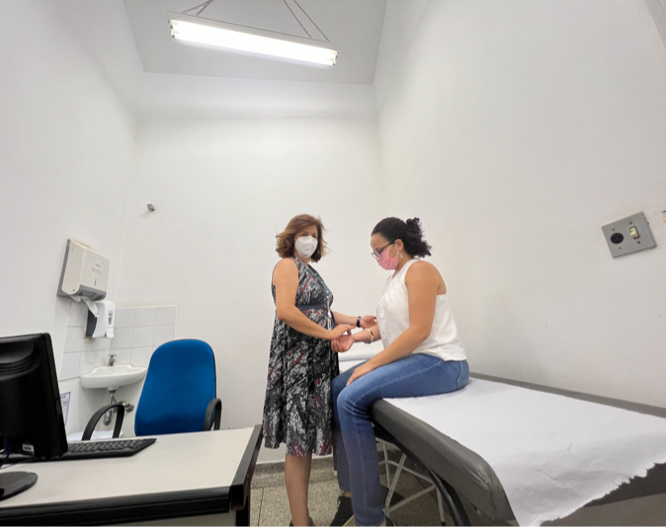
Dr. Karina Pavão in a hospital room retrofitted with LED lights.
The Botucatu lighting retrofit is one of three pilots projects CLASP is leading – the other two are at Mary Johnston Hospital in Manila, Philippines and the Lagos State Civil Servant Clinic in Lagos, Nigeria.
“Our hospitals have been particularly stretched during the pandemic and could greatly benefit from cost saving solutions. Our partner hospitals are currently operating with fluorescent lamps which consume 50-60% more energy than LEDs, and contain mercury, a neurotoxin that can have harmful and long-term health effects,” explains Nyamolo Abagi, a lighting expert at CLASP. “By replacing fluorescents with LEDs, we also improve working conditions for hospital staff as LEDS provide a higher quality lighting experience.”
“The LED retrofit will protect our staff and patients from the risk of mercury exposure if a fluorescent bulb breaks. We will also lower our monthly electricity costs and improve working conditions,” Dr. Pavão says.
Dr. Pavão hopes the Botucatu retrofit will demonstrate to other hospitals, as well as the Brazilian government, that it is time for a transition to LEDs. “Our mission is to train future leaders and build awareness that sustainability should be integrated into our day-to-day operations and healthcare processes. We have an obligation to protect our communities and the planet from further damage because climate change is the biggest challenge facing Brazil and the world. Improving energy efficiency and mitigating further damage is as easy as changing a lightbulb.”
Brazil’s Latest AC Policy to Dramatically Cut Costs and Emissions
On 27 April, the Brazilian Ministry of Mines and Energy implemented new standards that will accelerate market dominance of high-efficiency inverter air conditioning. This is the first mandatory minimum energy performance standard (MEPS) in Brazil to be based on the Cooling Seasonal Performance Factor metric, which captures the efficiency benefits of inverter air conditioners. These stricter requirements will eliminate most fixed-speed AC units from the market by 2026.
Air Conditioning in Brazil
In Brazil, air conditioners are among the highest consumers of residential electricity. More frequent heat waves have led to increased sales, leading to higher household energy consumption long term. Household AC demand is projected to grow from 17% today to 80% by 2035.
Inverter ACs, which are able to automatically adjust energy usage based on temperature, are benefiting from a rapid market transformation, accounting for 50% of residential AC sales in 2018 (Eletrobras 2021). Continuously updated standards for these appliances will help ensure sustainable growth without unsustainable energy use, delivering R$ 30 billion BRL ($6.2 billion USD) in savings by 2040. The related energy savings, 119 TWh, is equivalent to one fifth of Brazil’s annual energy consumption.
Ongoing Policy Support
CLASP has been supporting the development of this policy since 2018, providing technical analysis and coordinating stakeholders. With experience and knowledge of best practice in other countries, we supported the Ministry’s more rigorous standards in the face of industry pushback. CLASP also reviewed the Regulatory Impact Assessment produced by utility company Eletrobras, demonstrating projected economic, social and environmental benefits of the proposed AC standards.
This policy follows a robust revision of Brazil’s air conditioning energy labeling scheme and the ensuing alignment of National Electric Energy Conservation Program’s (Procel) endorsement label in 2020. Combined with these updates, people purchasing AC units will have a clearer understanding of which appliances perform the most efficiently and ultimately save money on energy-related costs. The new standards are expected to mitigate 72 Mt of CO₂ by 2040, on top of the 21.5 Mt by 2030 expected from the initial label rescaling.
The first step of the policy’s implementation will ban the manufacture and import of non-compliant units starting 1 January 2023. Marketing of these appliances (by manufacturers, importers, wholesalers, and retailers) will be completely banned by 1 January 2025. The second step will increase the minimum energy performance requirements, effective 1 January 2026, and will follow a similar 3-year timeline.
|
|
Step 1 |
Step 2 |
|
Manufacturing and Importing |
31/12/2022 |
31/12/2025 |
|
Marketing by Manufacturers and Importers |
31/12/2023 |
31/12/2026 |
|
Marketing by Wholesalers and Retailers |
31/12/2024 |
31/12/2027 |
CLASP will continue to work closely with its local partners to provide technical assistance, expertise, and collaborative opportunities as Brazil AC policy pivots to multi-connected systems, like those discussed in the previous meeting between Brazilian and Chinese parties.
What Happens to the Mercury in Your Fluorescent Lamps?
All fluorescent light bulbs contain mercury, a neurotoxin listed by the World Health Organization as a top 10 chemical of major public health concern. When fragile fluorescent glass bulbs break, the mercury inside disperses in the air allowing it to enter the lungs and blood quickly, potentially resulting in long-term health impacts for any living thing exposed to it.
Do you know what to do if a fluorescent lamp breaks in your home?
There is no “safe” level of exposure to mercury. When a lamp breaks in your home or office, the clean-up recommendations detailed by the EPA are above and beyond what most people are aware of and prepared to do, including immediate evacuation, ventilating the room for several hours, shutting off central heating and cooling to avoid mercury dispersion, collecting all contaminated materials (clothing, protective gloves, rugs) in a sealed plastic container – following the state law for disposal of fluorescents.
In California, where fluorescents are still readily available, citizens and the environment are at risk of mercury exposure and the higher costs associated with using an inefficient, outdated technology. From production to recycling, mercury-containing fluorescents put Californians and others at unnecessary risk.
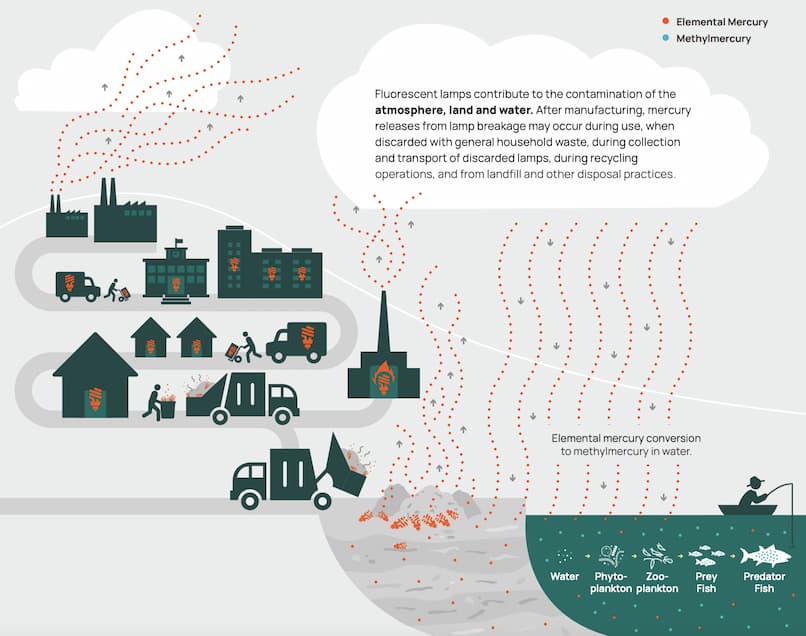
The life and death of a fluorescent lamp
Mercury released from fluorescents contaminates the atmosphere, land, and water. Breakage can occur at any point in the lamp’s lifecycle: during manufacturing or installation; when spent lamps are mixed in with general household waste; during collection, transport, processing, or recycling of discarded lamps; or when lamps are landfilled, incinerated, or illegally dumped.
When emitted to the air, mercury can be transported globally in the atmosphere for up to a year, ultimately settling on land or in water. The chemical can be washed from the soil into surface waters and accumulates up through the food chain into the fish people eat.
The impacts of mercury toxicity are not equitable
Exposure to the mercury from a broken lamp is especially dangerous for children and pregnant people. Infants and toddlers are likely to be most exposed when a lamp breaks, especially in an unventilated space, because the vapors concentrate closer to the ground where babies crawl and play. Exposure to mercury early in life not only results in a higher relative dose than in adults but also increases the risk of developmental disabilities.
Workers are exposed to mercury during manufacturing, recycling, and disposal of fluorescent lamps. An investigation of environmental contamination at a fluorescent lamp recycling facility in Madison, Wisconsin found elevated mercury levels among five of seven workers (two declined to be tested), and clinical signs of mercury toxicity, like tremors, in two of those five workers. There was reported inadequate use of personal protective equipment and mercury levels in indoor air exceeded safe thresholds. Mercury was also found in workers’ vehicles, indicating the risk of take-home exposure.
Marginalized and low-income communities are at greater risk of mercury exposure due to environmental and location-based factors. Across geographies and income levels, most pollutant emission sources consistently result in higher exposures for people of color.
Finally, fluorescent lamp drop-off locations that are part of recycling programs mandated by the state, such as at Home Depot locations or local recycling facilities, may also put workers and customers at risk because lamps easily break in drop-off bins.
Where to go from here
California has an opportunity to accelerate the transition to clean, modern, mercury-free LED lighting through the passage of AB-2208, proposed by Assemblyman Ash Kalra. The bill would effectively eliminate all compact fluorescent lamps (CFLs) lighting in the state beginning in 2024 and linear fluorescent lamps (LFLs) in 2025.
The Appliance Standards Awareness Project (ASAP) estimates that by 2030, California’s residential, commercial, and industrial consumers could save about $1 billion annually on their utility bills if they transition from fluorescent lamps to LEDs. ASAP also projects that by 2030, California could see annual electricity savings of about 5,600 gigawatt hours, preventing the release of 950,000 metric tons of CO2 per year. AB 2208 can be considered a bill that addresses two issues that California cares about 1) toxics reduction and 2) climate action.
You can help us spread the word about the bill through social media by using hashtags #YesOnAB2208 and #CAgoesLED and calling your local Californian representative to support the bill.
Now is the time for California to phase out the sale of outdated and dangerous fluorescent lighting for the safety of people and the planet.
Brazil and China Meet to Discuss the Future of Cooling MEPS
On 17 March, CLASP convened government representatives and experts from China and Brazil for a discussion on energy efficiency policies for multi-connected air conditioner systems. This collaborative gathering included participants from the Chinese National Institute for Standardization (CNIS), the Brazilian Ministry of Mines and Energy, and the National Electricity Conservation Program (Procel), as well as energy efficiency consultants from Mitsidi in Brazil. China currently leads the world in technical requirements multi-connected AC systems, which are primarily used in commercial buildings.
Commercial AC market in Brazil
Brazil’s commercial air conditioning market is populated equally by three system types: variable refrigerant flow (VRF), packaged and chilled water. VRFs are significantly more energy efficient than the other two system types, primarily due to their use of inverter technology. Building commercial AC standards to increase the uptake of VRFs and continually improve VRF efficiency is critical to achieving energy savings in Brazil’s commercial cooling market.
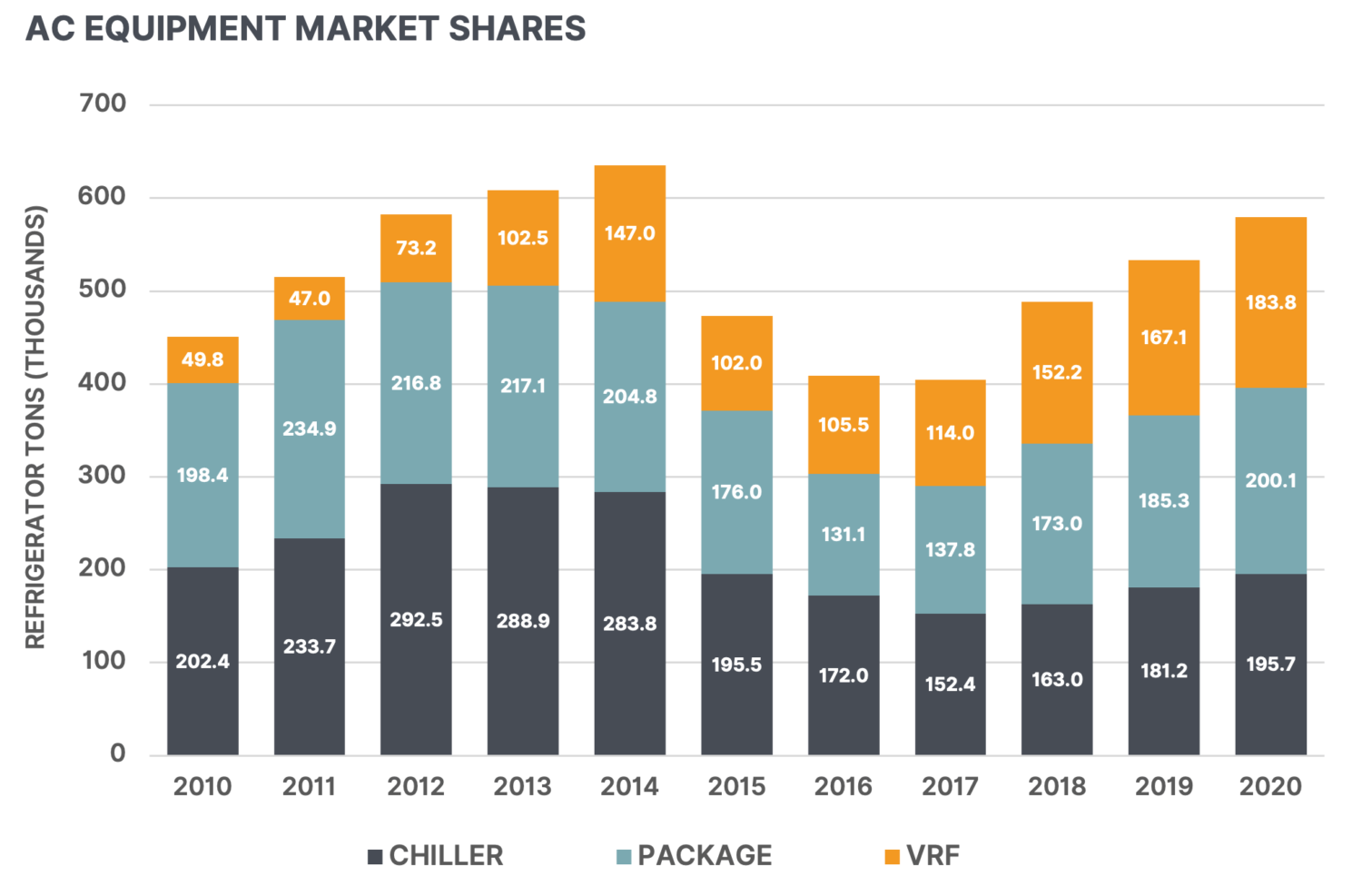
VRF commercial air conditioning units have grown on average 15% per year since 2011 and haven't reached their peak yet.
Source: revistadofrio.com.br/mercado-de-vrf-continua-em-expansao
But in Brazil, increasing the inverter market share is no easy task. There are currently no minimum energy performance standards (MEPS) for central AC equipment, so any regulation would have to be built from the ground up. The lack of regulation also means that the market is flooded with older, less efficient models, and owners of less efficient buildings have no incentive to replace existing systems.
China strengthens multi-connected AC policy
During the meeting, CNIS shared how they formulated their own multi-connected AC policy. Ten years after its initial adoption, China began a revision process, with the main goal of combatting climate change with stricter standards. Their current plan aims to eliminate low-efficiency products, strengthen existing MEPS and efficiency labeling grades, and lead the world in high efficiency regulations. The revision, which will go into effect in November 2022, has the potential to prevent 206 Mt in CO₂ emissions (206,000,000 tonnes) by 2030 and will move the Chinese market to 100% inverter units.
The new standards referenced international benchmarks, with the final proposal including a Grade 1 label (the most efficient tier) that supersedes all previously set requirements. The lowest threshold of China’s multi-connected AC MEPS is on par with existing standards in the EU and US. For Brazil, this benchmarking approach could help position their first-ever multi-connected AC MEPS and ensure ambitious yet realistic goals.
At present, Mitsidi is in the exploratory phase of their market assessment, collecting data through interviews with various stakeholders and secondary research. As Brazil looks to create their own commercial AC regulations, this interchange provided an excellent starting point for a successful course of action. CLASP is looking forward to supporting this effort and aid the Brazilian Ministry of Mines and Energy in their goal of drafting a policy that would be adopted by the end of 2023.
Partners


Convention on Mercury Promises CFLs Phase-Out; Action on LFLs Delayed
Bali, Indonesia – At the Minamata Convention on Mercury fourth Conference of Parties (COP4), 137 governments adopted amendments to phase out a major category of fluorescent lighting, but actions were stalled on others. All fluorescent light bulbs contain mercury, a chemical of major public health concern according to the World Health Organization.
In a major win for environmental and human health, the Parties agreed to phase out compact fluorescent lamps (CFLs) by 2025. By accelerating the transition to LED lighting, which is more energy-efficient and non-toxic, the move will avoid 26.2 metric tonnes of mercury pollution and 261.5 million metric tonnes CO₂ emissions from 2025-2050, and save people $77.8 billion in lower energy bills.
However, last-minute interventions delayed a decision on linear fluorescent lamps (LFLs), the long tubes commonly found in offices and stores, until Minamata COP5 in November 2023.
“LEDs are a rare silver bullet technology – they’re ready now, they cost half as much to run as fluorescents, and they constitute a double win for climate change mitigation and reducing toxics pollution. We were amazed to see the international cooperation on lighting at COP4. We hope for continued global alignment and momentum at COP5,” said Corinne Schneider, Chief Communications Officer at CLASP.
Over days of intense negotiations, a group of countries came together to agree on phase-out dates for all lighting categories, including the EU, India, Indonesia, Japan, Norway, Pakistan, Switzerland, the US, and many Latin American governments, including Argentina, Bolivia, Brazil, Chile and Colombia. However, not all Parties were prepared to move forward, citing the need for more time and additional feasibility analysis.
A phase-out of LFLs by 2027 – the date that most countries rallied around by the end of the week – would have captured significantly greater benefits, avoiding a further 71.7 million metric tonnes of mercury pollution and 2.72 Gt of CO₂ emissions and saving $1.06 trillion in cost savings, according to experts at CLASP.
Last year, 36 governments representing the Africa region submitted a proposal to the Minamata Convention to phase-out virtually all fluorescent lighting by the end of 2025. With many OECD countries banning fluorescents in the coming years in favor of more efficient LEDs, less regulated markets risk becoming dumping grounds for toxic lighting.
“The Africa region recognizes that lighting is crucial in promoting livelihoods. Through our proposal, we took the first step towards a global phase-out of mercury-containing fluorescent lighting,” explained Oumar Cissé, Head of Delegation (Mali) in his opening statement at COP4. “The case to phasing out fluorescent lamps – both CFLs and LFLs – is already justified today from a public health, environmental, technical as well as economic perspective.”
“The original proposal by the Africa region is consistent with our findings that a transition to clean and efficient lighting is feasible everywhere today. The move to phase out CFLs represents a major win, as it will remove toxic, inefficient bulbs from our homes. But keeping LFLs on the market continues to disadvantage our offices, hospitals, schools and childcare centers, needlessly increasing energy costs and risking mercury exposure,” said Ana Maria Carreño, Director of Climate at CLASP.
NGO groups around the world advocated over the past year to address mercury in lighting at COP4. The Climate Action Network launched a petition that garnered over 200 signatures from climate and environmental groups, as well as the private sector, urging governments to take action to phase out fluorescents.
“We are leaving this COP with mixed emotions. Un- and under-regulated markets are increasingly vulnerable to dumping of fluorescents that many countries have already banned due to their toxicity and inefficiency,” said Elena Lymberidi-Settimo, International Co-coordinator of the Zero Mercury Working Group. “The decision to phase out CFLs is one step in the right direction, and we congratulate governments for their efforts to progress the Convention’s promise to ‘Make Mercury History.’ We hope to see action on LFLs at COP5 in November 2023.”
“We are proud of the work the Africa region has done to protect people from toxic lighting products,” said Roger Baro, Vice President of COP4 (Burkina Faso). “We will continue working to phase-out all fluorescent lighting and stop it from causing further mercury pollution in our communities.”
Fluorescent lighting represents about 10% of mercury in all products globally. In the past, fluorescent lamps were promoted as an energy-efficient alternative to incandescent and halogen lamps, and the mercury risks were tolerated as a necessary tradeoff. Today, thanks to major advances in LED technology, mercury-free LED lamps can cost-effectively replace fluorescents in virtually all applications.
35 Countries Show Climate, Health and Economic Benefits of LEDs
WASHINGTON, DC – New evidence from the Clean Lighting Coalition demonstrates that LEDs are a more cost-effective, safe and climate-friendly alternative to mercury-containing fluorescents for countries around the world.
The NGO and partners collected market data and analyzed thousands of lightbulbs in more than 35 countries, finding that in every market LEDs perform better and save users substantial energy costs. The evidence is outlined in the new global overview report and regional profiles for the Asia Pacific, African, and Latin American and the Caribbean regions.
In April 2021, the African region proposed an amendment to Annex A of the Minamata Convention on Mercury to remove exemptions for mercury-containing fluorescent lamps, phasing out virtually all fluorescents by 2025. While fluorescent lamp exemptions may have been necessary in 2013 when the Convention was drafted, the current accessibility and affordability of mercury-free LED retrofit lamps makes the fluorescent lamp exemption unnecessary.
“The extensive data collected by the Clean Lighting Coalition and partners unequivocally demonstrates that a global transition to LEDs is feasible and would provide consumers with the economic, environmental and health benefits of efficient, mercury-free lighting,” says CLASP CEO, Christine Egan. “We strongly encourage the delegates to the Minamata Convention to adopt the amendment proposed by African governments and accelerate a clean lighting transition for all.”
If adopted at the Minamata Convention, the bold but feasible proposal by African delegates would avoid 3.5 GT of CO2, reduce global energy use by 3%, and eliminate 232 tonnes of mercury by 2050.
In many countries around the world, fluorescents and LEDs have reached cost parity, though LEDs are perceived as more expensive. Real data collected from shops and online retailers show that in the few cases where LEDs alternatives cost marginally more than fluorescents, LEDs rapidly pay customers back in decreased energy bills. In countries like Chile, Ghana, the Philippines and South Africa, the payback period is less than two months or instantaneous. In several more countries, consumers will recover savings from any excess upfront costs in six months or less.
LEDs are designed to have the same form, fit and function as the fluorescent lamps that they are replacing – and often function even better in terms of light output and no flickering. LED retrofits for compact and linear fluorescents (CFLs and LFLs) are widely available and have high rates of compatibility – with more than 90% compatibility globally. Compatible retrofits are particularly accessible in many developing and emerging markets due to the higher share of magnetic (choke) ballasts, on which LED lamps have reached 100% compatibility.
The analyses also quantify the opportunity for CO2 emission mitigation and mercury avoidance on for individual countries. On the regional level, a fluorescent phase out by 2025 would avoid 220 MT of CO2 in Africa, prevent 75,900 kg of mercury pollution in the Asia Pacific region, and mitigate 239 MT of emissions in Latin America and the Caribbean by 2050.
This evidence is published alongside several new reports, events, and resources by the Clean Lighting Coalition and partners, including the #EndToxicLighting Petition which calls on delegates to the Minamata Convention on Mercury to support the proposed African Amendment.
Read the global overview and regional profiles.
# # #
About the Clean Lighting Coalition: The Clean Lighting Coalition is a global partnership coordinated by CLASP to capture the health and environmental benefits of eliminating mercury-based lighting. To learn more, visit www.cleanlightingcoalition.org and follow the Coalition on Twitter, Facebook, and LinkedIn.
Media Contact:
Alexia Ross
Communications Associate, Clean Lighting Coalition
CLASP Commemorates International Women’s Day with Safe & Efficient Hospital Lighting
To commemorate International Women’s Day, throughout March we will highlight the voices and work of women working to advance CLASP’s mission across our global offices. Our first article features Nyamolo Abagi, a Manager in CLASP’s Nairobi office who is bringing progressive LED industry into the fight for clean, energy-efficient lighting.
“I have been with CLASP for over four years, primarily focused on developing the market for high-quality, energy-efficient off-grid solar appliances in Sub-Saharan Africa and South Asia,” explains Nyamolo. “Last year, I transitioned to join the CLASP-led Clean Lighting Coalition as the Industry Lead. In my new role, I build partnerships with LED companies around the world to prove that the private sector is not only ready but pushing for a global transition to clean LED lighting.”
Nyamolo Leads Hospital Retrofits in Brazil, Nigeria and the Philippines
On Tuesday, Nya’s team is launching three LED retrofit pilots at hospitals in Brazil, Nigeria, and the Philippines. The pilots aim to demonstrate that institutional buildings can easily and cost-effectively replace outdated, toxic lighting products with energy-efficient LEDs. The retrofitted LEDs will not only lower hospital energy costs, but also provide better quality lighting and reduce the risk of mercury exposure for both patients and staff.
“Our hospitals have been particularly stretched through the pandemic and could greatly benefit from cost saving solutions. Our partner hospitals are currently operating with outdated, toxic fluorescent lamps which consume 50-60% more energy than LED lamps. Halving their lighting bill is as simple as changing a light bulb!” explains Nya. “By replacing their current lighting with LEDs, we also improve working conditions for hospital staff as LEDS provided a higher quality lighting experience”
Fluorescent Lighting Poses a Threat to Women & Children
All fluorescent bulbs contain mercury – a harmful neurotoxin that the WHO classifies as one of the ten major chemicals of public health concern. Fluorescent lamps release mercury whenever they break. Because the bulbs are fragile, this can occur in homes, schools, childcare settings, office and apartment buildings, retail stores, factories, health care and other facilities.
“We are excited to launch these pilots on International Women’s Day because safe and energy efficient technologies play an important role in women’s empowerment,” says Nya. “Mercury is most dangerous to children, babies and developing fetuses. All of our hospital partners have maternity wards so in addition to the energy and cost benefits of LEDs, we want to remove any risk that the mothers or babies could be exposed to mercury.” Uptake of mercury vapor in early life not only results in a higher relative dose than in adults, but also increases the risk of developmental disabilities.
Accelerating the Global Transition to LEDs
Nya and the rest of the Clean Lighting Coalition team are working to accelerate the transition to LEDs globally, by removing exemptions for fluorescent lighting under the Minamata Convention on Mercury. Later this month, 137 countries – representing more than 6 billion people – will meet in Bali to vote on a proposed amendment to end the manufacture, export and import of fluorescents by 2025.
“The hospital retrofits are a component of our global strategy to bring together environmental and health advocates, private sector, technical experts and world leaders to demonstrate that it’s time to make mercury lighting history.”
Join Nya and our partners in Lagos, São Paulo and Manila for a special International Women’s Day Twitter Space event on Tuesday, 8 March at 8am ET to learn more about the retrofits and the benefits of LEDs. You can follow and engage with the launches via the Clean Lighting Coalition and CLASP Twitter accounts and sign our petition urging Heads of Delegation to the Minamata Convention phase-out fluorescents.
Low-Cost LEDs Should Replace Mercury-Laced Fluorescent Bulbs
Transition to More-Efficient Bulbs Would Cut Greenhouse Gas Emissions
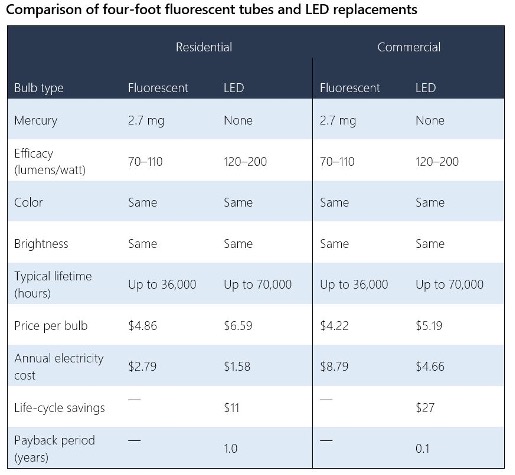
Washington, DC —Fluorescent tube light bulbs, once embraced as an energy-efficient option, use far more energy than today’s LEDs and are now a needless toxic health risk, according to a study published today. Laws and rules restricting the use of toxic mercury have generally exempted these mercury-containing bulbs because of a lack of better options, but the study shows for the first time that LEDs are now available in all needed shapes and sizes—and cost less to own and operate.
Transitioning all new fluorescent bulbs to LEDs in the United States alone would cut annual carbon dioxide emissions in 2030 by an amount equal to the emissions from 4 million typical passenger cars over a year, the report finds. The new study is published jointly by the American Council for an Energy-Efficient Economy (ACEEE), the Appliance Standards Awareness Project (ASAP), CLASP, and the Clean Lighting Coalition.
State, federal, and international policymakers should now phase out the fluorescent bulbs to prevent more mercury from being introduced into households and the environment while cutting greenhouse gas emissions, the study argues. As soon as this month, international negotiators meeting to update a convention on mercury pollution can do so.

An example of one common type of fluorescent bulb
The bulbs at issue are the four- and eight-foot tubes common in commercial buildings and in some home kitchens, basements, and garages, as well as several types of compact fluorescent bulbs designed for use in certain fixtures. Their toxic mercury can be released in several ways. An estimated 75% of fluorescent bulbs used in the United States are not recycled or disposed of properly; mercury leached from landfills eventually reaches rivers, lakes, and oceans, where it bioaccumulates in fish and shellfish. Consumption of contaminated seafood is the leading cause of human exposure to mercury. Broken bulbs in homes and buildings, if not properly cleaned up, can also present a health risk to those nearby.
Rapidly phasing out most fluorescent models would prevent bulbs containing 16,000 pounds of mercury from being sold and installed in the United States through 2050, the study finds—a massive amount for a toxin that can damage the human brain with only a miniscule quantity.
“Fluorescent bulbs used to be the energy-efficient option, but that’s just not the case anymore. LEDs have changed the game and we found there’s no good reason to keep using fluorescents at this point,” said Jennifer Thorne Amann, senior fellow at ACEEE and report coauthor.
Joanna Mauer, technical advocacy manager for ASAP and fellow coauthor, said, “LEDs are now widely available as drop-in replacements for fluorescent bulbs. In addition to not containing mercury, LEDs last about two times longer than fluorescents and cut energy use in half. Any increase in initial price more than pays off through the reduced electricity costs.”
An international agreement among 137 countries, the Minamata Convention on Mercury, is phasing out the use of mercury in numerous products and industrial processes and uses. But the convention—drafted in 2013—specifically exempts lighting, citing a lack of cost-effective alternatives at that time. Later this month, the nations will consider a proposal that would ban the manufacture, import, and export of fluorescent bulbs in the participating countries.
“The United States can be a leader in the global transition to clean lighting,” said Ana Maria Carreño, director at CLASP, which funded the report. “By supporting the African Lighting Amendment at the Minamata Convention on Mercury, U.S. policymakers will be making a statement to the world that it is time to say farewell to fluorescents.”
The report also finds:
- For businesses—where most linear fluorescent bulbs are used—additional upfront costs for the most common LED bulbs in the United States are paid back in less than two months. For households, the payback period for the most common LED bulbs is about a year.
- A complete transition from fluorescent bulbs to LED lighting in the United States would cut 18 million metric tons of carbon dioxide emissions annually in 2030. On a cumulative basis, a phaseout would cut carbon dioxide emissions by more than 200 million metric tons through 2050.
The United States can support a global phaseout of fluorescents by 2025 through the Minamata Convention, and the federal government and U.S. states can phase out fluorescents in the United States through several mechanisms:
U.S. states: Twenty-three states have prohibited the sale of some products that contain mercury, but all include exemptions for most fluorescent bulbs. The California and Vermont legislatures are considering bills that would end the sale of common fluorescent bulbs.
U.S. federal government: Several federal laws and rules govern mercury pollution, limiting emissions from industrial sources and governing end-of-life product disposal. A phaseout of mercury-containing bulbs could be accomplished either through EPA regulation under existing law or through congressional modification of federal bulb efficiency standards. (Separately, two pending Biden administration proposals could phase out most incandescent and halogen bulbs, which are much less efficient than fluorescent bulbs).
###
The American Council for an Energy-Efficient Economy (ACEEE), a nonprofit research organization, develops policies to reduce energy waste and combat climate change. Its independent analysis advances investments, programs, and behaviors that use energy more effectively and help build an equitable clean energy future.
The Appliance Standards Awareness Project (ASAP) organizes and leads a broad-based coalition effort that works to advance, win, and defend new appliance, equipment, and lighting standards that cut emissions that contribute to climate change and other environmental and public health harms, save water, and reduce economic and environmental burdens for low- and moderate-income households.
The Clean Lighting Coalition is a global partnership coordinated by CLASP to capture the health and environmental benefits of eliminating mercury-based lighting. To learn more, visit www.cleanlightingcoalition.org and follow the Coalition on Twitter, Facebook, and LinkedIn.
Media Contact:
Ben Somberg, Senior Communications Manager
Appliance Standards Awareness Project
202-658-8129