
First-of-its-kind Campaign Raises Awareness on Solar Water Pumps in Kenya
Through Efficiency for Access, CLASP ran an awareness-raising campaign across five sub-counties in Machakos, Kenya. The campaign sought to stimulate consumer awareness of the benefits of solar water pumps (SWPs) for improved agricultural productivity and potentially increase the demand for SWPs among rural households.
The campaign engagement strategy included a variety of mass communication and tailored direct-to-consumer activities, including community education forums, farm-to-farm visits, product demonstrations, and radio advertisements. By the end of December, we reached over 30,000 people through direct in-person engagement, and we estimate that the local radio ads reached 3,000,000 people, exceeding our target audience of 770 households.
We partnered with Shamba Shape Up to film an episode on a solar water pump installation for Ted, a Kenyan farmer who previously relied on an electric pump for irrigation.
Here are some insights from the campaign:
- Between the baseline and the end-line surveys, awareness levels increased by 46%, indicating that more people were knowledgeable about the benefits of SWPs.
- Almost 80% of the farmers interviewed indicated they would like to adopt solar irrigation within one year; but we have not yet seen any conversion into sales. A lack of financing options was cited as the main reason.
- Community members identified water source challenges, inadequate knowledge and lack of capital as the most significant barriers to solar irrigation adoption.
- Despite increased awareness of the benefits of solar water pumping, there is a massive gap in local supply and brand-specific technical awareness among the farmers.
Download the campaign readout or watch our YouTube video to learn about the campaign’s outcomes and Efficiency for Access’ recommendations for increasing demand among rural households.
You can also watch a recording of the live Q&A session Efficiency for Access hosted with Kilian Blumenthal from Water and Energy for Food and Kavita Ndolo, an agribusiness owner from Machakos, Kenya for insights on the awareness-raising campaign.
Kenya Consumer Experience Study: Insights on Solar Appliances
Currently, the information on the penetration of off-grid solar appliances and how consumers experience and interact with them is quite limited. VeraSol recognizes that this kind of data is essential for manufacturers to design products more effectively, for sector stakeholders to identify market gaps, and for programs and policymakers to scale quality assurance (QA) efforts. Using data collected during the 2021 CLASP commissioned study on off-grid solar product usage from 4,195 surveyed households in Kenya, the VeraSol team has taken a deeper look at solar appliance data to produce new insights on ownership of and consumer experience with off-grid solar appliances in Kenya.
Key findings from this research include:
- Top consumer considerations when purchasing solar appliances
- Insights on ownership and projected demand for TVs, refrigerators and solar water pumps in Kenya
- Other consumer perspectives on solar appliance affordability, accessibility, and after-sales care
Download the Kenya Consumer Experience Study: Insights on Solar Appliances report.
About Efficiency for Access
Efficiency for Access is a global coalition working to promote renewable and energy efficient appliances to deliver clean energy to the world’s poorest people. It is coordinated jointly by CLASP and the UK’s Energy Saving Trust.
CLASP in the Field: Seeing First-Hand How Solar-Water Pumps Are Improving Livelihoods in Kenya
On November 19, 2021, Efficiency for Access team members went out into the field to witness some of the ongoing activities of our solar water pump consumer awareness-raising campaign in Machakos county, Kenya. During this visit, they met Samuel Ndutu, a farmer from the Mwala sub-county, who relies on solar water pumping to irrigate his farm.
Samuel is a widowed father of two who left formal employment a few years back and now relies on farming to provide for his family’s needs, such as his sons’ education. On his farm, Samuel grows various vegetables and fruits, including tomatoes, cabbages, kales, bananas, pawpaws, eggplants, and more. These crops go through different growth cycles, requiring different levels of care and intervention, as well as need varying amounts of water to produce high and healthy yields. For example, tomatoes and cabbages require frequent watering, which is a scarce resource in the hot and dry Machakos county.

Section of Samuel’s farm where he has planted cabbage
Samuel’s farm is approximately half a kilometre away from the nearest water pan (a pond for storing rainwater), which he and surrounding households rely on as a water source for their livestock and crop farming. After weeks of research on online farming forums, looking for an effective and affordable means of getting the water to his farm, Samuel came across a neighbour who had shared her experience using a solar water pump on her farm. He got in touch with her and learned more about the pump’s performance, its purchase process, and how it had impacted her farming output. Satisfied with this information, Samuel contacted a local pump supplier and purchased a submersible solar water pump kit with a battery. By the time of the field visit, he had been using the pump for six months and was pleased with its performance, not having experienced any breakdowns so far. He was particularly impressed by the pump successfully pumping water uphill across a distance of over 400 meters. Aside from pumping water, he also uses the solar home system the pump came with for lighting and charging small household appliances like mobile phones.
“The pump has met the expectations I had, especially considering the distance and elevation of my farm. I have had no issues so far,” says Samuel. He further appreciated the freed-up time to attend to other tasks while water is pumped into his tank automatically. Before the purchase, he would fetch water himself—a time-consuming task.
Samuel explained that he typically pumps between 7,000- 8,000 litres over eight to nine hours. He switches the pump on in the morning, lets it run till lunchtime, empties the storage tank by watering his crops and then re-fills the tank. Samuel only pumps once a week during humid periods, but when it is drier, he pumps twice weekly. He mentioned an interest in purchasing a second pump, preferably a more powerful model than his current one, since he is keen to expand his farm to increase yields and, therefore, his income.

Storage tank on Samuel’s farm which stores the water he pumps
In addition to the pump performing as advertised, Samuel liked that he was not incurring ongoing costs to get water to his farm. If he had a fuel-powered pump, it would cost him about 5-8 USD per use. Additionally, he appreciated the convenience of the “pay as you go” product-financing model he used as an alternative to having to part with a prohibitive upfront payment. Samuel is also satisfied with the after-sales support offered by the manufacturer. The company’s engineer installed the pump at no extra cost, and after that, whenever he has had an inquiry, all he has had to do is get in touch with the manufacturer’s support team on the phone for assistance.

Samuel holding his submersible pump
Samuel is considered an influencer farmer in the area, and neighbours come to him to learn about farming with a solar water pump. Visiting his farm and seeing how using the solar water pump has boosted his farming productivity was a great reminder that efficient, solar-powered appliances improve and support the livelihoods of off-grid communities and households sustainably.
As CLASP continues to manage the Efficiency for Access consumer awareness campaign through February 2022, we look forward to uncovering more insights from the end-users like Samuel. To learn more about the campaign, follow us on Twitter or email us via info@efficiencyforaccess.org.
Off-Grid Solar Products Deliver High Satisfaction for Kenyan Consumers
Nairobi, Kenya, November 16, 2021– The growth of the off-grid solar sector into a USD 1.75 billion industry, delivering energy services to 420 million global users, speaks to the sectors’ immense value. CLASP, which leads the VeraSol quality assurance initiative, commissioned a study to evaluate consumers’ experiences with off-grid solar products in Kenya, a global off-grid market leader. Overall, the consumers surveyed confirmed that off-grid solar products are indeed delivering as expected, with about 70% expressing satisfaction with solar products’ durability, price and aftersales services offered.
“It seems that years of quality assurance and consumer awareness support have had their intended impact and led to Kenya’s consumers being more discerning when purchasing solar products, which could be a significant factor in driving the high levels of user satisfaction,” says Dana Rysankova, Global Lead for Energy Access at the World Bank.
This study was the first of its kind and sought to complement existing data gathered through laboratory testing by focusing on how consumers interact with quality-verified and non-quality verified products. “This type of consumer survey is important and will continue to be critical for the sector to understand the effectiveness of adopting quality standards by interrogating the type of products that ultimately reach the consumer and the user experience (which supports the need for quality verification of products),” says Pauline Githugu, Team Leader for the UK aid-sponsored Africa Clean Energy Technical Assistance Facility.
In addition to being a key off-grid market, Kenya is also an early adopter of the IEC quality standards for solar products, making it a suitable example of the value of leveraging government support in implementing national quality assurance measures. EED Advisory conducted the consumer study by visiting and interviewing a nationally representative sample of 3915 households in early 2021 about their experiences with solar lanterns, lighting kits, home systems, and appliances. The study found that 28% of Kenyan households have access to at least one standalone off-grid solar product, with 21% using it as the primary source of lighting. Rural households were more than twice as likely to have off-grid solar products as were urban households (37% vs 16%), and seven counties (Homa Bay, Kilifi, Kitui, Machakos, Migori, Narok and Siaya) stood out as having a higher prevalence of off-grid solar products compared to the rest of the country.
The study results highlight a clear link between quality assurance and consumer satisfaction in many but not all aspects. For example, respondents indicated similar satisfaction rates with product durability for quality-verified (77%) versus non-quality verified (72%) solar lighting systems. However, for product breakdowns, a significantly higher proportion of non-quality verified solar lanterns (19%) and solar home systems (31.3%) were reported to have broken down compared to quality-verified ones (9.2% and 8.9%, respectively). There was a stark difference in repair cost, with non-quality verified lanterns over three times more expensive to repair than quality-verified lanterns in Kenya.
The study proposes building firm-level verification methods and standards, strengthening partnerships between affiliate brands and last-mile distributors, and leveraging brand integrity to predict products’ quality and service to enhance quality assurance. Read the full ‘Quality in the Off-Grid Solar Market: An Assessment of the Consumer Experience in Kenya’ report for more information.
—
About VeraSol
An evolution of Lighting Global Quality Assurance, VeraSol supports high-performing, durable off-grid products that expand access to modern energy services. VeraSol builds upon the strong foundation for quality assurance laid by the World Bank Group and expands its services to encompass off-grid appliances, productive use equipment, and component-based solar home systems. VeraSol is managed by CLASP in collaboration with the Schatz Energy Research Center at Humboldt State University. Foundational support is provided by the World Bank Group’s Lighting Global program, UK aid, IKEA Foundation and others. Please visit VeraSol.org for more information.
For media inquiries, please get in touch with Lisa Kahuthu at lkahuthu@clasp.ngo.
Can Solar Improve Livelihoods for Small-Scale Farmers?
Solar Increasingly Powers Agriculture in Kenya
Over the past decade, the off-grid solar industry has grown to meet the energy demands of dispersed communities across Kenya, selling over 4 million solar lanterns and systems since 2016. As communities move up the energy ladder, solar-powered appliances improve the quality of life and offer new business opportunities.
In Kenya, agriculture plays a significant role in the economy, accounting for 40% of the overall workforce and contributing more than half of export earnings. The agriculture industry primarily consists of family-operated farms to meet both subsistence and commercial needs. Maize is a staple and can be eaten in popular maize dishes like Ugali, which is consumed by 78% of the population. However, there is a gap between raw maize production and the refining process to turn it into the commonly consumed flour. Because small-scale Kenyan farmers have limited access to milling machines, they rely on using third parties or mill manually. However, neither option is ideal. Milling through third parties is expensive, while manual milling does not produce a consistent grain texture. With access to smaller, more affordable mills, communities can improve agricultural productivity and the lives of off-grid communities.
Agsol Leads in Innovative Milling Technologies
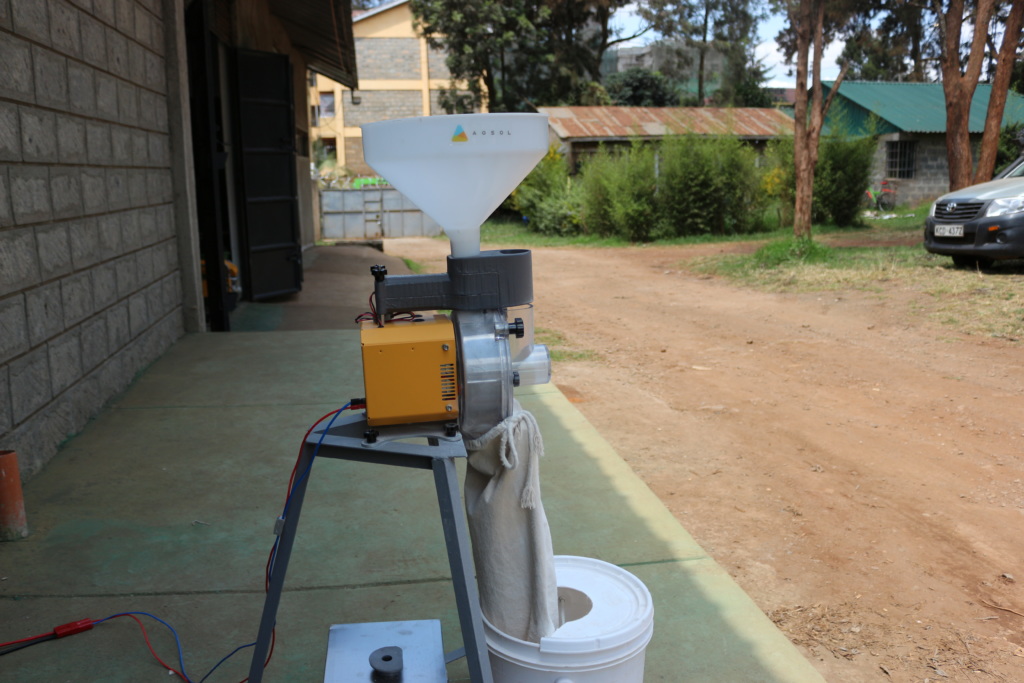
Agsol solar-mill
In 2016, Matt Carr and Greg Denn founded Agsol to build on early successes with “solarising” small agro-processing machines.
“Because diesel mills are large expensive machines and have really high operating costs, they are typically only found in larger towns and centres. That means most rural farmers waste huge amounts of time accessing these essential services. Our solar mills are specifically designed to be viable in smaller communities to bring milling services closer to the people that need them. They are cheaper to buy and cheaper to run than a diesel mill and can be operated by a non-trained technician.” explains Carr.
In 2019, Agsol won an Efficiency for Access R&D grant, which helped them develop the most efficient small grain mill known in the market. Our team has stayed in touch with Agsol since the grant. We recently visited their factory in Kikuyu to better understand their range of milling products and how farmers in Kenya use these appliances.
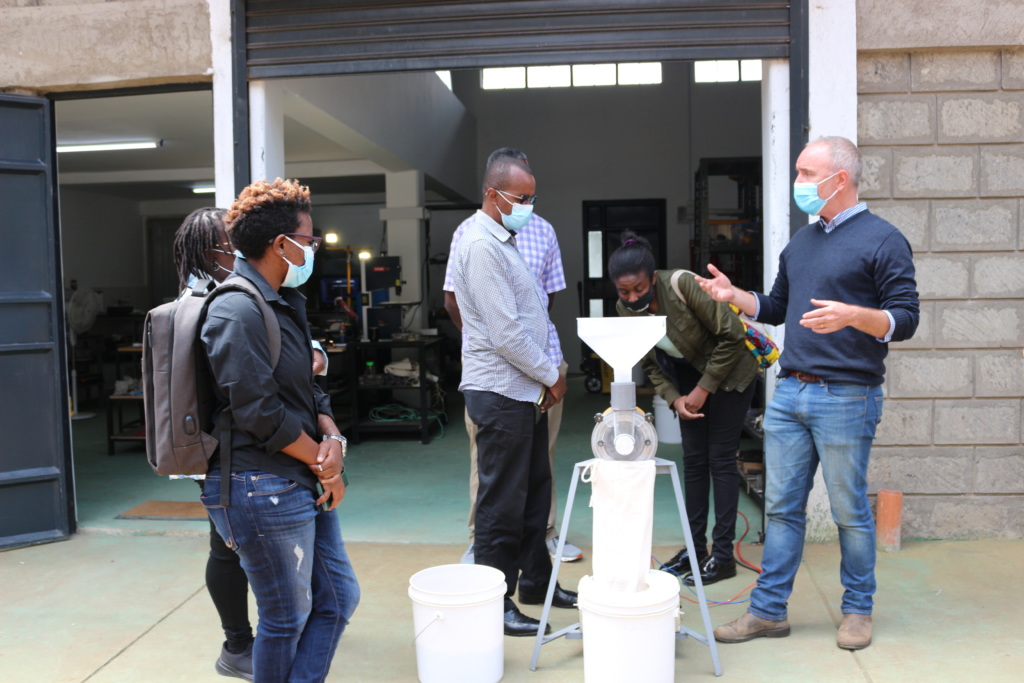
Agsol ’s Mills Offer Flexible Milling Hours
Agsol has developed a small hammer mill with interchangeable screens to produce fine flour or coarse grits for animal feed. Thanks to a specialized high-speed brushless DC (BLDC) motor, Agsol’s MicroMill is highly energy-efficient at converting power into flour – over 2.5 times more efficient than typical electric mills.
The Agsol MicroMill uses only 0.8kW, allowing for small quantity batch milling. This is not the case for diesel-powered mills, which can only mill in large quantities to conserve fuel. Diesel mill owners often make customers wait until there is sufficient volume to warrant starting up the diesel mill.
The need to conserve energy and mill in large quantities has led to millers setting specific milling times of the day, ensuring a large turnout of customers and large loads of cereal to be milled. In turn, solar mills offer flexible milling times as they consume less energy and can mill smaller batches.
“Customers told us the previous version of the MicroMill was too slow, and it needed to be twice as fast. That was our goal for the current version. But by developing our own custom BLDC motor, we’ve actually tripled the production speed, increased efficiency by another 30%, and reduced the costs by 45%. The MicroMill can process over 300 kg/day of flour, and we’re excited this product has real potential to outcompete diesel mills in most off-grid settings.” Carr explained.
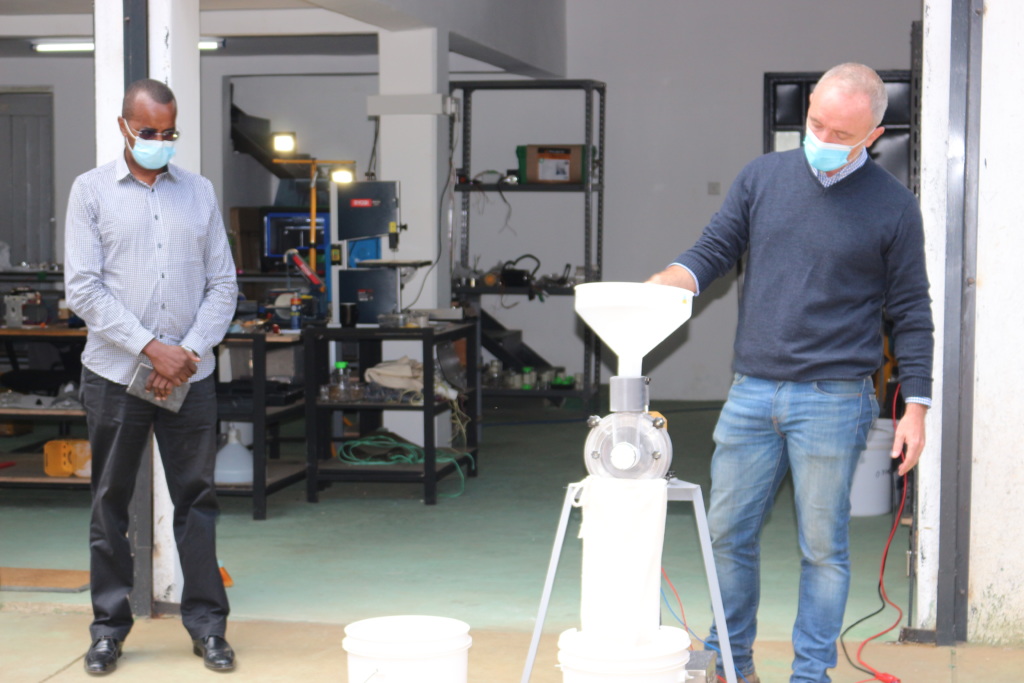
Solar Mills Offer Opportunity to Power Other Appliances
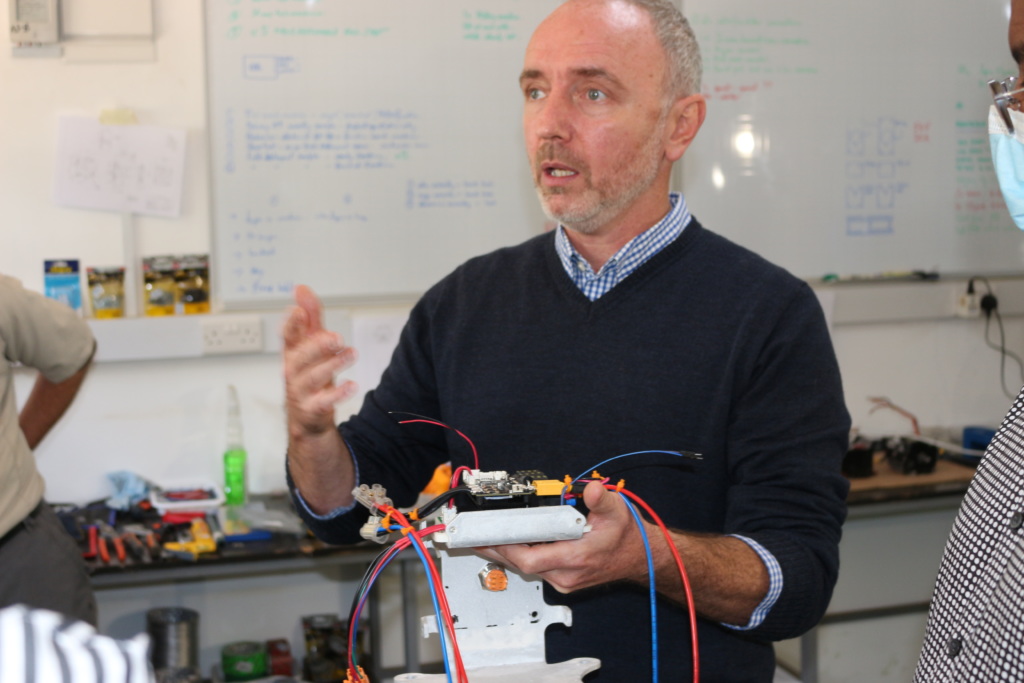
Consumers have the option of purchasing the Agsol mills with a power offtake module that can supply 12V and 5V DC to power devices like phones, clippers, fans, TVs, etc. The mill comes with an LFP lithium-ion battery to store excess power during periods of high irradiation, providing energy during periods of reduced sun exposure.
Are Solar Mills the Future of Small-Scale Farming?
Electric-powered mills are the most cost-effective milling option for domestic and small-scale commercial use, especially in rural areas. With no running and negligible maintenance costs, mills pay for themselves in less than two years, while diesel mills use up to 35% of the generated revenue in maintenance and fuel costs. They are environmentally friendly and adequately sized to allow more distributed placement, reducing the time and labour burden associated with accessing milling services.
“Our mills have the potential to create a more decentralized and accessible network of essential services, saving rural women time otherwise spent walking long distances to and from diesel mills. They can be used as a source of [clean] energy as well as support new income-generating activities in small communities.”
Transforming the Cookstoves Market through Standards & Labeling in Kenya
The private sector, the government of Kenya, and local and international NGOs, including the Clean Cooking Association of Kenya and the Global Alliance for Clean Cookstoves, seek to transition Kenyan households to cleaner and more efficient stoves and fuels to improve health and reduce environmental impacts. This transition, in part can be enabled through the implementation of standards and labeling (S&L) policies and programs. Well-designed standard programs transform markets by removing poor- performing or low-quality products, while labeling programs encourage and empower consumers and other buyers to make informed decisions about the products they purchase. S&L policies and programs exist in a variety of types, often enable complementary market transformation projects, and can be adapted to most cultures, countries, and markets.
The status of the cookstoves market in Kenya indicates that S&L policies and programs can support the goal of substantially increasing consumer uptake of cleaner and more efficient cookstoves (also referred to as improved cookstoves, or ICS).
The following key findings were gathered from conversations with cookstove stakeholders, and influence the approach to devising and implementing a cookstove S&L strategy in Kenya:
- The national ICS market is growing but not yet mature.
- Improving accuracy and timeliness of testing would benefit all stakeholders.
- Government is engaged in the cookstoves policymaking process and political will exists at multiple levels.
- Multiple, overlapping S&L policies and programs are in existence or development, and need to be coordinated.