
Rising Temperatures Put Millions Across Latin America and the Caribbean at Risk as Cooling Appliances Remain Inefficient
Washington, DC, 25 February 2026 — As temperatures rise and demand for air conditioning accelerates, new research reveals that nearly 70 million people across Latin America and the Caribbean exposed to rising heat risks lack efficient cooling appliances.
Despite the region’s growing need for sustainable cooling, only 15% of households own an air conditioner, leaving millions vulnerable to extreme heat. For many families, the affordability of purchasing and operating an air conditioner remains a key barrier to sustainable cooling access. Consequently, the lack of access to adequate cooling along with rising temperatures severely affects human health.
A new report from CLASP and the Institute for Governance & Sustainable Development (IGSD), with the Climate and Clean Air Coalition (CCAC) finds that these challenges are compounded by environmental dumping—the export of low-efficiency, climate-harming cooling equipment that does not meet existing standards in its country of origin.
Environmental dumping raises household energy bills, increases greenhouse gas emissions, and threatens to lock the region into decades of low-efficiency and polluting cooling infrastructure.
- The research, which focused on Argentina, Barbados, Brazil, Chile, Colombia, Dominican Republic, Grenada, Jamaica, Mexico, and Uruguay, finds:
- 44% of all new air conditioners sold in Latin America and the Caribbean are categorized as environmental dumping, which means they cannot be legally sold in the countries where they are manufactured.
- More than one-third of new room air conditioners sold in the region use obsolete refrigerants, which are currently phased down or phased out under the Montreal Protocol on Substances that Deplete the Ozone Layer and its Kigali Amendment.
- Existing cooling access gaps disproportionately affect low-income households and women, and the influx of outdated equipment deepens energy inequality and increases emissions.
- Without stronger efficiency and refrigerant standards, the region could lock in 173 million tons of CO₂e by 2050, emissions equivalent to more than three coal-fired power plants over the next 20 years.
Despite these challenges, the report highlights clear positive pathways for action. Brazil and Grenada are emerging as regional leaders by adopting modern efficiency standards and climate-friendly refrigerant policies and initiatives that protect consumers and close the door to environmental dumping.
While strong national efficiency policies are among the most effective ways for countries to protect themselves from environmental dumping, solutions ultimately require shared responsibility and close collaboration between importing- and exporting-country governments, the private sector, civil society, and international partners.
As extreme heat becomes a defining risk, access to efficient and climate-friendly cooling appliances is no longer optional; it is essential,” said Martina Otto, Head of the Climate and Clean Air Coalition Secretariat. “This year marks ten years since the adoption of the Kigali Amendment, a decade that has demonstrated how effective international partnerships can drive meaningful action. By acting together now, importing and exporting countries have a clear opportunity to shape markets, protect communities, and steer the inevitable growth in cooling toward solutions that advance climate justice while delivering economic, social, and environmental benefits.
Environmental dumping is an equity issue. As our research shows, millions of people across Latin America and the Caribbean are being left behind with inefficient, outdated cooling equipment that costs too much money to run. Manufacturers have the know-how to produce better appliances but are lacking the right incentives to manufacture and export them to Latin America and other regions in the Global South. This undermines people’s ability to stay safe in a warming world and deepens existing inequalities. —Ana Maria Carreño, Senior Director of Climate at CLASP
We must pursue innovative business models that do not export energy poverty and other burdens of obsolete cooling technologies to vulnerable countries in the Global South. Multilateral platforms, South-South cooperation, and collaborative government-industry partnerships can help. In this way, these countries can leapfrog to becoming innovation hubs for next-generation cooling solutions that support clean air, climate resilience, and prosperity. —Tad Ferris, Senior Counsel at IGSD
For inquiries, please reach out to Marina Baur, Senior Communication Associate, CLASP at mbaur@clasp.ngo.
Pathways to Prevent the Environmental Dumping of Climate-Harming Room Air Conditioners in Latin America & the Caribbean
Millions of people across Latin America & the Caribbean are being left behind with inefficient, outdated cooling equipment that's too expensive to run. Manufacturers have the know-how to produce better appliances but lack the incentives to manufacture and export them to the Global South.Ana Maria Carreño
Senior Director of Climate, CLASP
Clean Lighting Coalition Case Studies
The Clean Lighting Coalition is a CLASP led campaign aimed at transitioning the world to all efficient LED lighting from incumbent technologies like incandescent and mercury-ladened fluorescent lamps.
Throughout the campaign, CLASP has documented relevant case studies of governments and institutions leveraging the power of LED lighting to achieve crosscutting benefits.
Explore and download the case studies above.
Turning the Wheel of Progress: Energy-Efficient Motor Systems Power Jobs, Economic Development, and Climate Progress in Nigeria
Energy-efficient motor systems could play a key role in driving economic growth and climate progress in Nigeria–a country that strives to reach net zero by 2060 and lift 100 million of its citizens out of poverty. While motor systems pose a significant challenge, through strategic partnerships and committed action, they also offer a significant opportunity for profound change for millions.
Motor systems: a challenge and an answer
Motor systems are essential to most automated processes and are key to the world’s manufacturing, mining, agriculture, and industrial sectors. However, motor systems have a significant emissions impact: today, they account for 27% of global industrial electricity demand1. Much of this demand is linked to the fact that low-efficiency, outdated motor systems represent two-thirds of the global motor stock.
Nigeria poised to lead on motor system efficiency
In Nigeria, the industrial sector accounts for approximately 22% of electricity consumption. Motors were estimated to consume 83 TWh in 2025—equivalent to annual energy consumption in Belgium.
Energy-efficient motor systems could deliver significant economic development without losing sight of the country’s climate goals, reaching net zero by 2060, and lifting 100 million Nigerians out of poverty.
Energy-efficient motor systems can lower national electricity demand and reduce the need for costly generation, transmission, and distribution investments. When governments and utilities are able to avoid these expenses, that capital becomes available for industry, education, healthcare, and infrastructure, which ultimately helps to drive GDP growth. At a local level, efficient motors can also reduce operational costs for small businesses and smallholder farms. Lower costs translate to improved profitability and could enable job creation in these local settings.
Partnering for progress
CLASP is currently supporting the Standard Organization of Nigeria (SON) to develop energy-efficiency standards for industrial motor systems. Setting up efficiency policy for motor systems in Nigeria could have significant benefits, including reducing energy use by 300 TWh from 2025 through 2050, avoiding 130 Mt of CO2—the equivalent of Nigeria’s annual CO2 emissions—and saving $3 billion USD through 2050.
John Bature of the Standard Organisation of Nigeria reflected on the partnership, stating:
The ongoing CLASP-supported project has reignited the drive to achieve industrial energy efficiency in Nigeria. The initiative [to develop standards] addresses the identified energy waste arising from the use of obsolete motors across the Nigerian industrial sector. The project will undoubtedly deliver significant climate and economic benefits for Nigeria.
CLASP and SON are also collaborating with the Sustainable Research and Action for Environmental Development (SRADEV) Nigeria and Eng. Achema, two local Nigerian partners who are supporting data collection and analysis, stakeholder engagement, and technical guidance. Jeremiah Ato from SRADEV underscores the importance of this collaboration: “A robust market assessment is foundational to developing efficiency policies for industrial motors in Nigeria.”
Tom Ramsson, CLASP’s technical advisor on motors and industrial products, and Angellah Wekongo, manager, co-led the project with partners at SRADEV and SON. Wekongo views the collaboration as a significant step towards a greener future: “CLASP is supporting the Standards Organization of Nigeria on the first step in their journey to unlock motor system efficiency. We look forward to continuing our collaboration on motor-driven applications like pumps, fans, and air compressors to help Nigerian industry prepare for a low-carbon future.”
Energy-efficient motor systems offer a massive untapped opportunity for people and the planet. Efficient motor systems can deliver significant energy savings and reduce strain on the grid, redirecting electricity and investment to other sectors. Alongside powering economic growth, efficient motors also have major environmental benefits.

Photo caption: CLASP with partners from SRADEV and the Ghana Energy Commission at MOP37 in Nairobi, Kenya
Photo credit: CLASP
Power for All Joins the CLASP Family
Nairobi, Kenya, 11 February 2026 – Strong and agile partnerships have been key to unlocking climate progress and sustainable development objectives. Today, a new collaboration emerges: we are delighted to announce that Power for All will join forces with CLASP.
CLASP is an international nonprofit organization dedicated to improving appliance and equipment energy efficiency, with 25 years of expertise and offices on five continents. Since 2015, Power for All has played a crucial role in the energy access sector, leading impactful campaigns, partnerships, and research to help end energy poverty worldwide.
Now, Power for All joins CLASP. By embedding Power for All’s well-honed campaign and partnership approaches in CLASP’s work, we will strengthen engagement with energy suppliers as well as our collective capacity to elevate appliance and equipment efficiency as a key solution to powering jobs and livelihoods while mitigating climate pollution.
CLASP CEO Christine Egan sees this union as a strategic move for making faster, practical progress:
Since its founding, Power for All has encouraged the distributed renewables sector to expand its thinking and partnerships for improved impact, for example, to make smarter connections with utilities. By joining forces, CLASP and Power for All will advance the integration of energy supply and energy demand. This is a critical move for sustainably getting people the energy services they need, and a direction that CLASP recently articulated in our flagship research, The Missing Piece of Energy Access. Together, our research and stakeholder networks will create a platform to super-charge climate-friendly prosperity. —Christine Egan
Since 2015, Power for All has challenged the status quo and encouraged the sector to probe deeper and better understand how best to drive a more inclusive global energy system. Over the years, they have led boundary-pushing research, publishing sector-defining report series such as their “Powering Jobs Census,” which tracks employment trends in the distributed renewable energy sector and provides critical labor market insights in key countries like Ethiopia, India, Kenya, Nigeria, and Uganda. Additionally, their ground-breaking Utilities 2.0 campaign sought to demonstrate the benefits of combining centralized and decentralized energy into an integrated energy network. This first-of-its-kind campaign showed that doing so could deliver customer-centric, clean energy solutions faster and more cheaply.
Kristina Skierka, founder of Power for All, reflects on the organization’s legacy and its new chapter:
Power for All was born from the companies that built the decentralized renewable energy sector in order to help accelerate the end of energy poverty. The combined efforts of Power for All and 500+ campaign partners in our decade of action helped connect over 500 million new energy users around the world. I’m encouraged by CLASP’s institutional strength, mission alignment, and global reach to steward the campaign’s legacy, and I remain deeply grateful to every advocate, ally, and team member who helped build this movement. —Kristina Skierka
Over the coming months, as this union takes shape, expect revived and historical Power for All offerings across CLASP channels.
Regarding the partnership, Alba Topulli, outgoing CEO at Power for All, and incoming Senior Director of Clean Energy Access at CLASP, adds:
CLASP has built one of our sector’s most trusted platforms through decades of shaping appliance markets and advancing energy efficiency, grounded in how people actually use energy. Power for All’s years of campaigning and coalition-building have shown us that systems change happens when we move together as a sector—aligning supply and demand, connecting public and private actors, and ensuring centralized and decentralized systems work as one. Together, we’re committed to a shift toward integrated energy solutions that put people at the center and make demand-side initiatives foundational to how energy access is planned, financed, and delivered. —Alba Topulli
Alba Topulli joins CLASP as Senior Director, Clean Energy Access
Adam Browning, Chair of the Board for Power for All, said:
Power for All has always championed bold collaboration and systems-level thinking to accelerate universal energy access. CLASP’s trusted leadership, global reach, and deep technical expertise offer a strong platform to expand our collective impact, grounded in shared purpose and a belief that demand-side solutions must be central to the energy access agenda. The Board is proud to support this strategic partnership, which honors Power for All’s work and positions it for greater scale and impact in the years ahead. —Adam Browning
CLASP and Power for All are delighted to unite forces and are confident that together, we can achieve even greater impact for people, enhanced prosperity, and the planet.
Watch this space as Power for All officially joins the CLASP family and collaborative efforts are announced. Follow us on LinkedIn at @CLASP and on Bluesky at @clasp-ngo.bsky.social.
CLASP Conducting New Motor Assessment in Indonesia to Inform Efficiency Policies
CLASP has identified 10 appliances that are critical to fighting climate change and improving people’s lives. Industrial Motors are one of them. They power our economies and consume a significant amount of the world’s industrial electricity demand—27%. The resulting high energy consumption leads to greenhouse gas emissions and can strain power grids.
In Indonesia, the industrial sector consumes nearly 45% of the country’s total energy. Much of this demand comes from equipment powered by electric motors, which is expected to rise as Indonesia’s local manufacturing grows.
Given energy-efficient motors’ ability to consume less electricity when performing a task, and transitioning global motor stock to modern, efficient models would have major environmental and social benefits. Higher efficiency motors offer a win-win solution.
A market assessment to inform motor efficiency policies in Indonesia
Indonesia’s rapid industrial and economic growth is increasing the demand for commercial and industrial equipment. This makes improving the efficiency of motors embedded in pumps, fans, compressors, and conveyors a priority for national policy. However, there is limited information about the country’s current domestic motor market to guide policy development.
CLASP aims to fill this gap through a detailed market assessment of electric motors. The study will quantify the market’s size and composition, including motor sizes, brands, and efficiency levels, of Indonesia’s motor market and provide policymakers with reliable data to develop new national efficiency policies. This assessment is being conducted in coordination with the Ministry of Energy and Mineral Resources (EBTKE), and key motor brands and associations, including ABB, Siemens, TEKO, and Grundfos.
What Indonesia can gain from more efficient motors
Once in place, motor efficiency policies informed by this assessment could deliver major benefits. Early projections show that by 2060, Indonesia could save ~542 TWh of electricity, enough to power 115 million Indonesian households for one year, and avoid ~460 Mt CO₂ emissions, equal to taking 100 million passenger cars off the road for one year. This will support the country’s 2060 net-zero climate goals and its Nationally Determined Contribution, or national climate goal.
For consumers and businesses, efficient motors mean access to higher-quality products and lower energy bills during the equipment’s lifespan. For the broader economy, efficient motors mean improved productivity, stronger industrial competitiveness, and enhanced energy security.
Ensuring that Indonesia’s industrial motors become more energy efficient is key to building a competitive and sustainable industrial future.
Economies Can Boom When Powered by Efficient Motor Systems
Motors are the invisible heartbeat to economic progress. They are found across industrial facilities, powering production lines for goods like metals, paper, cement, textiles, and packaged food and beverages. Energy efficient motors and their associated components are key tools to enable economic growth, but inefficient ones can hinder progress via high energy demand and associated costs.
A golden opportunity
Efficient motors systems offer a golden opportunity for all countries –from existing economic powerhouses to newly industrializing nations– to expand and thrive in global markets while simultaneously slashing energy costs and emissions.
Motor systems 101
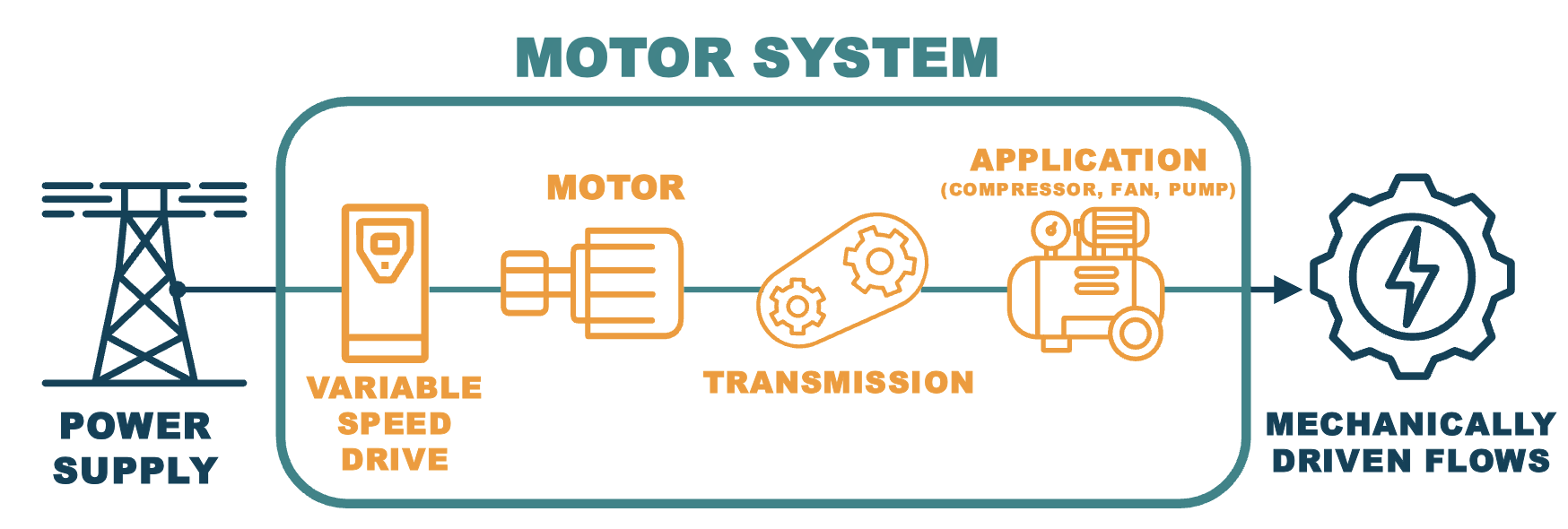
Industrial motors, like those found in factories, are part of a system of several components. When evaluating efficiency, governments and the private sector must look at and address the whole system, from power source to mechanical output. These systems are responsible for powering many recognizable factory features like conveyer belts and air compressors.
Inefficient motor systems lock in years of downsides
Without intervention to ramp up efficiency, motor systems will account for 25% of global energy demand and 33% of global energy related emissions by 2050.
And these inefficiencies are expensive: continued use of outdated motor systems will be responsible for $9 trillion of lost GDP in 2050.
Outdated and inefficient motors represent two-thirds of today’s global stock. These motors can last upwards of 15 years, locking countries into a future of high energy consumption, unnecessary emissions, and strained power grids.
More efficient industry is the key to economic progress
Increasing the market share of efficient motor systems for all economies offers significant and sustained benefits. A timely transition will require leaders to push the boundaries on policymaking and financing.
Heavily industrialized countries, like China and the European Union, need to replace existing inefficient motor stock with the most efficient IE5 compliant technologies and pair them with variable speed drives to achieve the biggest cost and climate benefits. This move can be catalyzed by ambitious efficiency policy and will require significant financing support from sources like industrial banks.
In countries where manufacturing is expected to grow significantly, with commensurate increase in motor stock, like Nigeria and Indonesia, quick government action to incentivize or require efficient motor systems in new factories will prevent runaway emissions and costs from the start. External financial support and mechanisms, like subsidies and bulk procurement, will be critical for supporting emerging industry.
CLASP supports leaders in getting the most out of motors
Efficient motors systems have been available for decades, but barriers to entry, like cost and expertise, have slowed adoption. CLASP is supporting government and industry leaders in seizing the opportunity for big economic and climate wins through innovative policy and industrial initiatives.
- In China, where world-leading motor system efficiency policies are in place, CLASP funded a pilot project at six sites to measure the performance of motor systems in air compressors – a key piece of factory equipment. The data from these informed new voluntary national standards.
- In India, CLASP’s market research and analyses are helping policymakers build the case for ambitious efficiency policy improvement and revised motor labeling classes that will empower industry to choose more efficient equipment.
- In Nigeria and Indonesia, our experts are working with policymakers to gather market data to inform new motor efficiency requirements.
- In Pakistan, CLASP and partner, SAMA^verte, created an Industry Accelerator program, aimed at building the expertise of local manufacturers and helping improve their ability to produce more efficient motors.
To explore more of CLASP’s motor work, check out our motors page and news section.
Brazil Put a Spotlight on its Efficiency Agenda at COP30
In recent years, Brazil has taken initial steps toward a more sustainable future powered by energy efficiency. As the host of COP30, held in Belém in November, Brazil put a spotlight on this smart climate solution for the world to see.
The country is already a global leader in sustainable energy, generating 89% of its electricity with renewables. However, rapidly rising energy demand and decreased hydropower capacity are forcing policymakers and utilities to reevaluate the current energy mix.
Global warming and Brazil’s deep income inequality further complicate this challenge. For example, Brazil’s summers are growing hotter; in 2023, the country hit a new record temperature of 112.6° F (44.8° C). As a result, air conditioning, once considered a luxury, is becoming necessary for health and productivity. But today, air conditioning is found in only 20% of all homes, concentrated mainly in higher-income households.
The challenges lower-income Brazilians face in accessing energy services like air conditioning are reflected in the fact that almost half of the lowest-income Brazilians spend more than half of their household income on electricity and gas.


Air conditioners above a Rio de Janeiro street.
Credit: CLASP
Brazil’s solution for booming energy demand and high electric bills
Brazil’s leaders increasingly view efficiency as a cost-effective, climate-friendly tool for meeting the country’s energy needs while addressing economic barriers to energy access.
Analysis reveals that, in the absence of other interventions, meeting skyrocketing energy demand would require increasing domestic natural gas production by up to 300%. To avoid this, the government can embrace energy efficiency, making services like cooking and cooling less energy-intensive and therefore reducing overall energy demand.
Appliance efficiency has provided early wins in Brazil, although there are major opportunities to do more. New policies for air conditioners and LED lights are making the models available in Brazil more efficient. This, in turn, makes these appliances more affordable to operate—and therefore accessible to more people.
COP host puts efficiency on the podium
In conversations throughout COP30, the Brazilian government and media showcased energy efficiency as a key tool for meeting national and global climate targets, growing the country’s economy, and delivering accessible energy services for all.

Panelists from COP30 ABDI energy efficiency event.
In his speech to negotiators and delegates at the COP’s opening plenary session, Brazilian Vice President Geraldo Alckmin underscored the importance of meeting the COP29 pledge to double energy efficiency by 2030. “This COP must mark the beginning of a decade of acceleration and delivery—the moment when rhetoric gives way to concrete action, and when all parties move from setting targets to fulfilling them,” he said.
During a day dedicated to energy efficiency, the Brazilian Agency for Industrial Development (often referred to by its Portuguese acronym, ABDI) put together a packed agenda bringing together leaders from government, businesses, and international organizations to discuss how Brazil can achieve its goals through efficiency. During a session about the role of efficiency in the energy transition, speakers noted that a significant advantage of efficiency compared to other solutions is that technologies like efficient industrial equipment already exist and can be implemented immediately.
Another event organized by Casa Civil, the powerful organization run by Brazil’s presidential chief of staff, focused on the role of efficiency in achieving a just energy transition and expanding the Brazilian industry’s presence in the global marketplace. The event highlighted the fact that local appliance manufacturers can increase sales by making their products more efficient, which allows them to match international benchmarks and sell their products around the world.
Major Brazilian media outlets also jumped into the efficiency conversation at COP. Folha de São Paulo, the country’s largest newspaper, co-hosted a session with the Crux Alliance, a philanthropic organization focused on global climate policy, on leveraging demand-side strategies to deliver on renewable energy and efficiency targets.
Carving a sustainable path forward
With COP delegates from around the globe now back home, they have many opportunities to keep energy efficiency front of mind—and strong reasons for doing so.
“Efficiency lowers costs, expands access, and strengthens domestic industry,” said Edilaine Camillo, leader of CLASP’s Brazil program. “The more elements we add to this puzzle, the clearer it becomes how interconnected the energy transition is—and how it can positively impact multiple sectors of the economy and people’s everyday lives.”
CLASP Contributes to European Commission Dialogue on Energy-Efficient Products
In October 2025, CLASP was invited to join policymakers, manufacturers, retailers, civil society representatives, and market surveillance authorities at the European Commission’s implementation dialogue on energy-efficient product legislation.
Hosted by Commissioner for Energy and Housing Dan Jørgensen, the discussion focused on how to strengthen the implementation, enforcement, and real-world impact of the European Union’s (EU) product efficiency policies.
During the dialogue, Nicole Kearney, the director of CLASP’s Europe program, highlighted that ambitious ecodesign and energy labeling policies drive progress far beyond the EU’s borders. Drawing on CLASP’s global experience and collaboration with policymakers, she noted how countries like Australia, Brazil, China, India, and South Africa often look to EU policies as models for their own frameworks—or even adopt them directly.
“The European Union sets the pace for global progress on energy and climate through product efficiency,” Kearney said. “Every step forward in Brussels accelerates action worldwide, and every delay slows it down.”
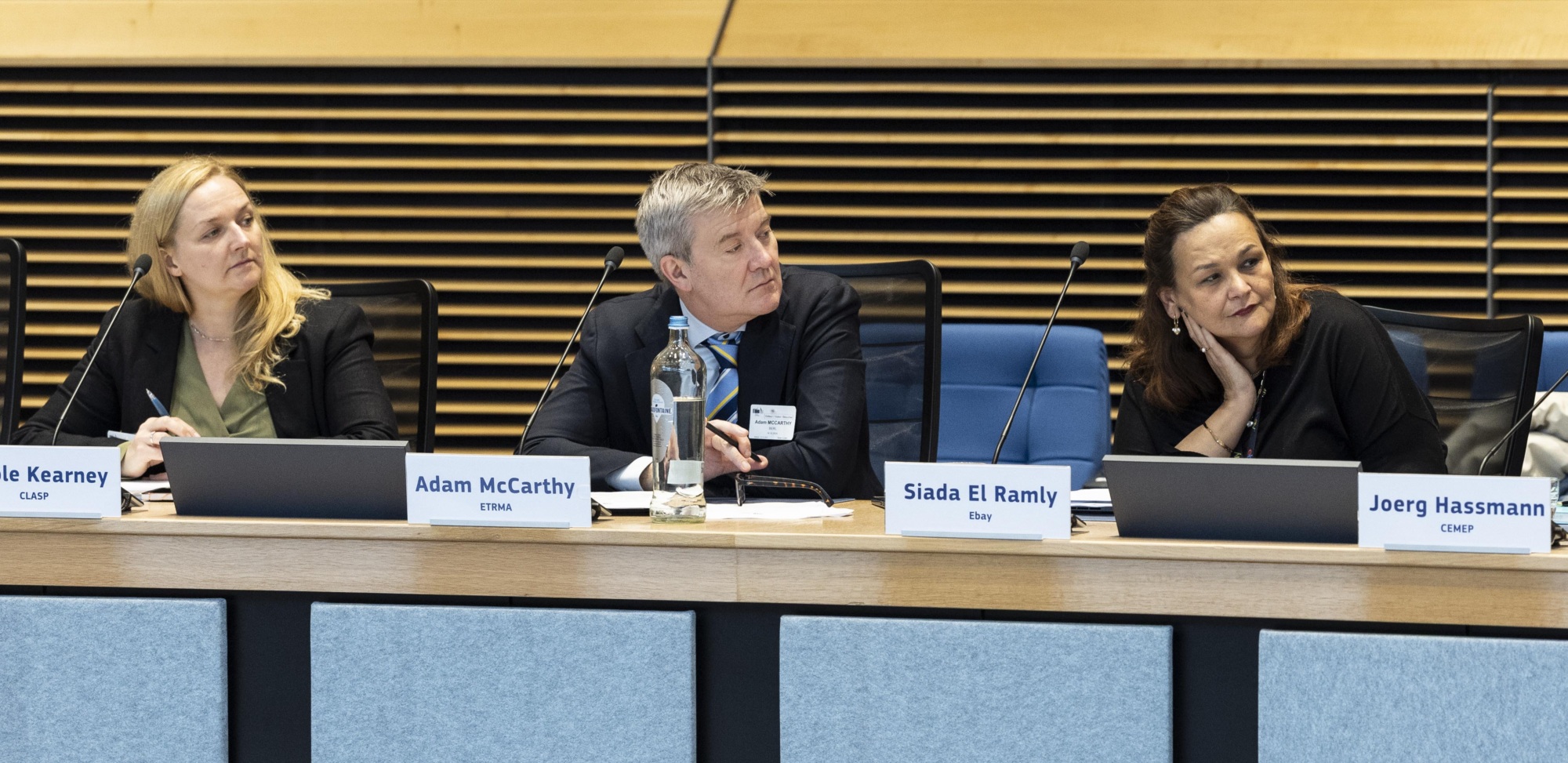
Left to right: Nicole Kearney, Director at CLASP, Adam McCarthy, Secretary General of the European Tyre and Rubber Manufacturers Association, and Siada El Ramly, Head of Government Affairs EU at eBay at the European Commission's Implementation Dialogue on energy efficiency of products in October 2025.
[Photo: Lukasz Kobus] © European Union, 2025, CC BY 4.0
Most organizations present stressed the need for clear, transparent, and well-resourced policy processes to minimize delays and enable the EU to achieve its climate and energy objectives. Many emphasized the importance of strengthening market surveillance and compliance mechanisms and supporting them with additional resources.
CLASP also called for deeper civil society engagement in standards development to help ensure that standards remain relevant, ambitious, and responsive to technological innovation.
In addition, CLASP believes that improved coordination, digital tools, and consistent guidance across EU Member States are key to ensuring that products sold on the market meet EU efficiency standards.
CLASP is proud to support the European Commission and EU Member States in strengthening product efficiency policies that benefit people, businesses, and the planet, in Europe and beyond.
Making the Switch: The Deployment Handbook for Institutional eCookers
This report, “Making the Switch: The Deployment Handbook for Institutional eCookers,” conducted by Efficiency for Access in partnership with the Modern Energy Cooking Services (MECS) programme, aims to inform practitioners seeking advice on the design, deployment, and operation of commercially available institutional eCooking technologies and provide actionable recommendations for scaling eCooking in institutions in Kenya. This guide covers commercially available institutional eCooking technologies designed for both on- and off-grid applications. It provides:
- An overview of the current state of eCooking in institutions in Kenya
- Step-by-step advice for the pre-assessment, planning, installation, and commissioning of eCooking solutions
- Opportunities to scale the adoption of institutional eCooking
Download “Making the Switch: The Deployment Handbook for Institutional eCookers” to access key findings, recommendations, and guidance on electric cookers in institutional settings.
About Efficiency for Access
Efficiency for Access is a global coalition dedicated to advancing access to energy and affordable, energy-efficient appliances in underserved communities. It is a catalyst for change, accelerating access to off- and weak-grid appliances that boost incomes, avoid carbon emissions, improve quality of life, and support sustainable development. The coalition is co-chaired by UK aid from the UK government via the Transforming Energy Access platform and the IKEA Foundation.
About the MECS programme
Modern Energy Cooking Services (MECS) is an eleven-year research programme funded by UK Aid (FCDO). MECS is a geographically diverse, multicultural, and transdisciplinary team working in close partnership with NGOs, governments, the private sector, academia, research institutes, policy representatives, and communities in 16 countries of interest to accelerate a transition from biomass to genuinely ‘clean’ cooking.
In seeking to spark a new approach to clean cooking, the MECS programme researches the socio-economic realities of a transition from polluting fuels to a range of modern fuels. Whilst the research covers several clean fuels, the evidence is pointing to the viability, cost-effectiveness, and user satisfaction that energy-efficient electric cooking devices provide. Significant progress has been made in access to electricity in the last decade, but these gains are sometimes disconnected from the enduring problem of clean cooking. By integrating modern energy cooking services into the planning for electricity access, quality, reliability and sustainability, MECS hopes to leverage investment in renewable energies (both grid and off-grid) to address the clean cooking challenge.