
Accelerating India’s Shift to Clean Cooking
Events
CLASP brings global expertise in market transformation to the Modern Energy Cooking Forum 2025 in India.
CLASP participated in the fourth Modern Energy Cooking Forum (MECF 2025) in New Delhi on 26 September. The event brought together diverse stakeholders to work towards integrating electric cooking (e-cooking) into India’s energy and climate policies.
Efficient cooking advances health, equity, and climate goals
Globally, more than 2 billion people still rely on polluting fuels like wood, charcoal, kerosene, or coal as their main cooking fuel1. In India, about 54% of households use traditional solid fuels, either as their main source of energy or alongside liquefied petroleum gas, contributing significantly to indoor air pollution2. Dependence on solid fuels negatively impacts people’s quality of life. It harms people’s health through exposure to smoke and pollutants, and it also limits productivity and keeps households trapped in a never-ending cycle of labor-intensive chores.
Improving household access to e-cooking helps address these challenges while advancing energy and climate goals. Shifting to cleaner, more efficient electric cooking can help reduce respiratory illness symptoms and other health impacts, save households time and money, while freeing up hours spent on fuel collection and cooking. From a climate perspective, the widespread adoption of e-cooking can reduce emissions from the residential energy sector and contribute to India’s decarbonization goals.
CLASP supports India's shift to clean cooking
At MECF 2025, Neha Dhingra, CLASP’s Director, India, shared CLASP’s approach for accelerating India’s clean cooking transition. The approach focuses on market-shaping activities:
- Policy and institutional collaborations: CLASP has a longstanding relationship with the Bureau of Energy Efficiency (BEE) and will continue working with government stakeholders to align policies, standards, and procurement with clean cooking solutions. These collaborations are critical to ensuring that solutions are available and supported by national policies.
- Evidence and risk reduction: By providing robust appliance performance data and consumer insights, CLASP helps policymakers, financiers, and companies make informed investments in e-cooking.
- Consumer awareness and demand: CLASP will continue supporting campaigns that highlight the tangible benefits of e-cooking, from household savings to improved air quality and safer kitchens.
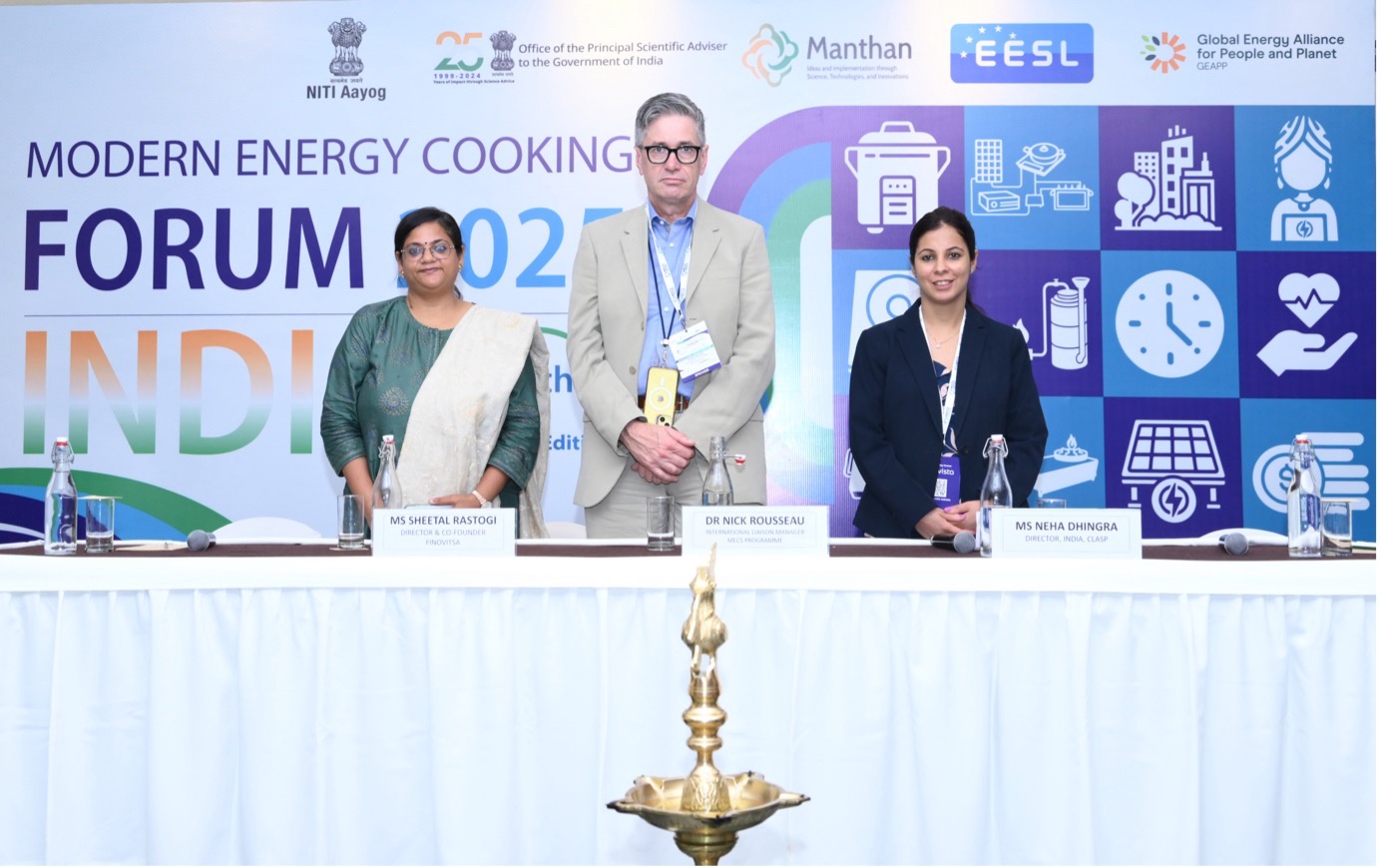
Photo by Finovista.
Left to right: Sheetal Rastogi, Director and Co-founder of Finovista, Dr. Nick Rousseau, International Liason Manager at MECS Programme, and Neha Dhingra, Director at CLASP.
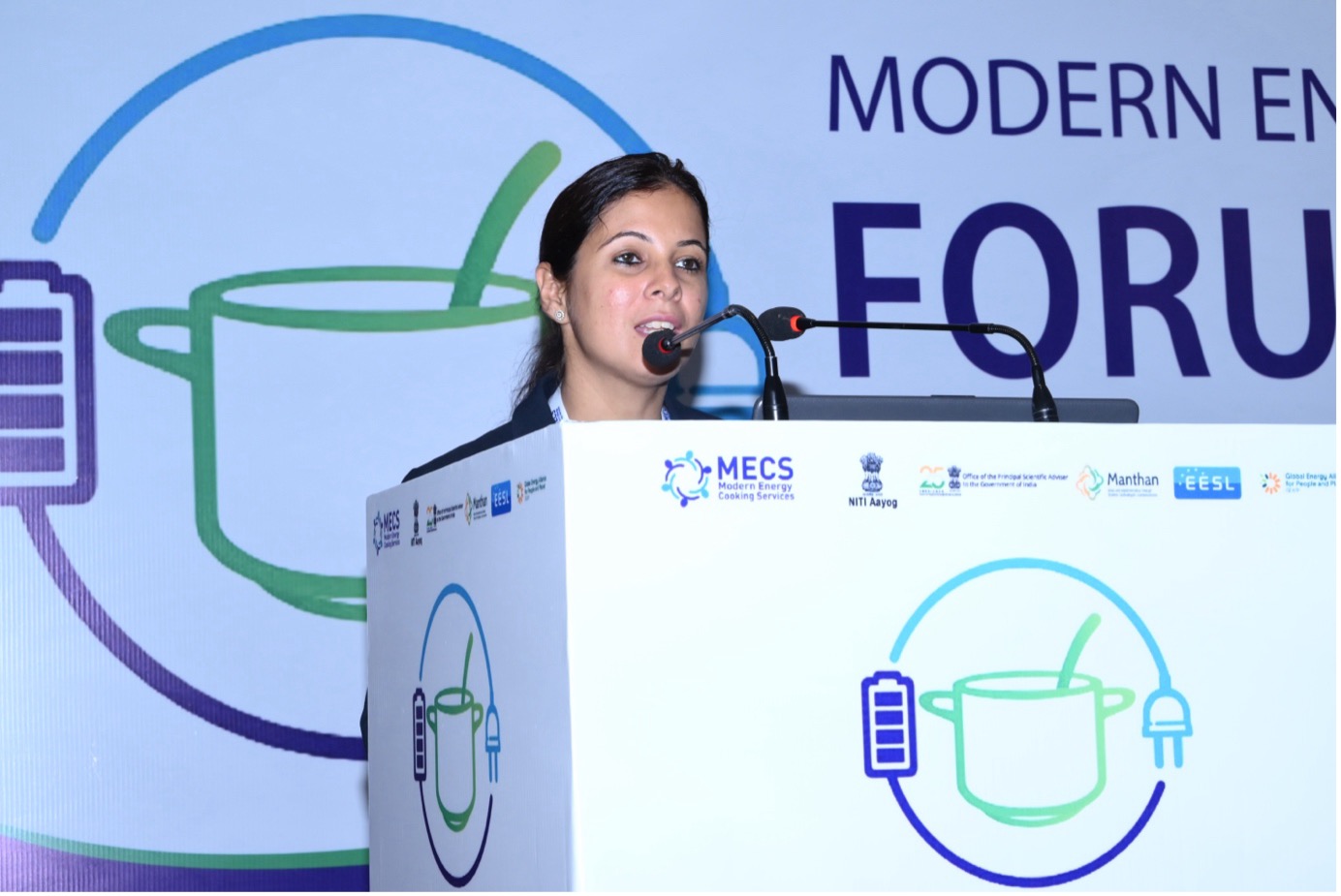
Photo by Finovista.
Neha Dhingra, Director at CLASP, presents CLASP's approach for scaling clean cooking in India at the Modern Energy Cooking Forum (MECF) 2025 in New Delhi.
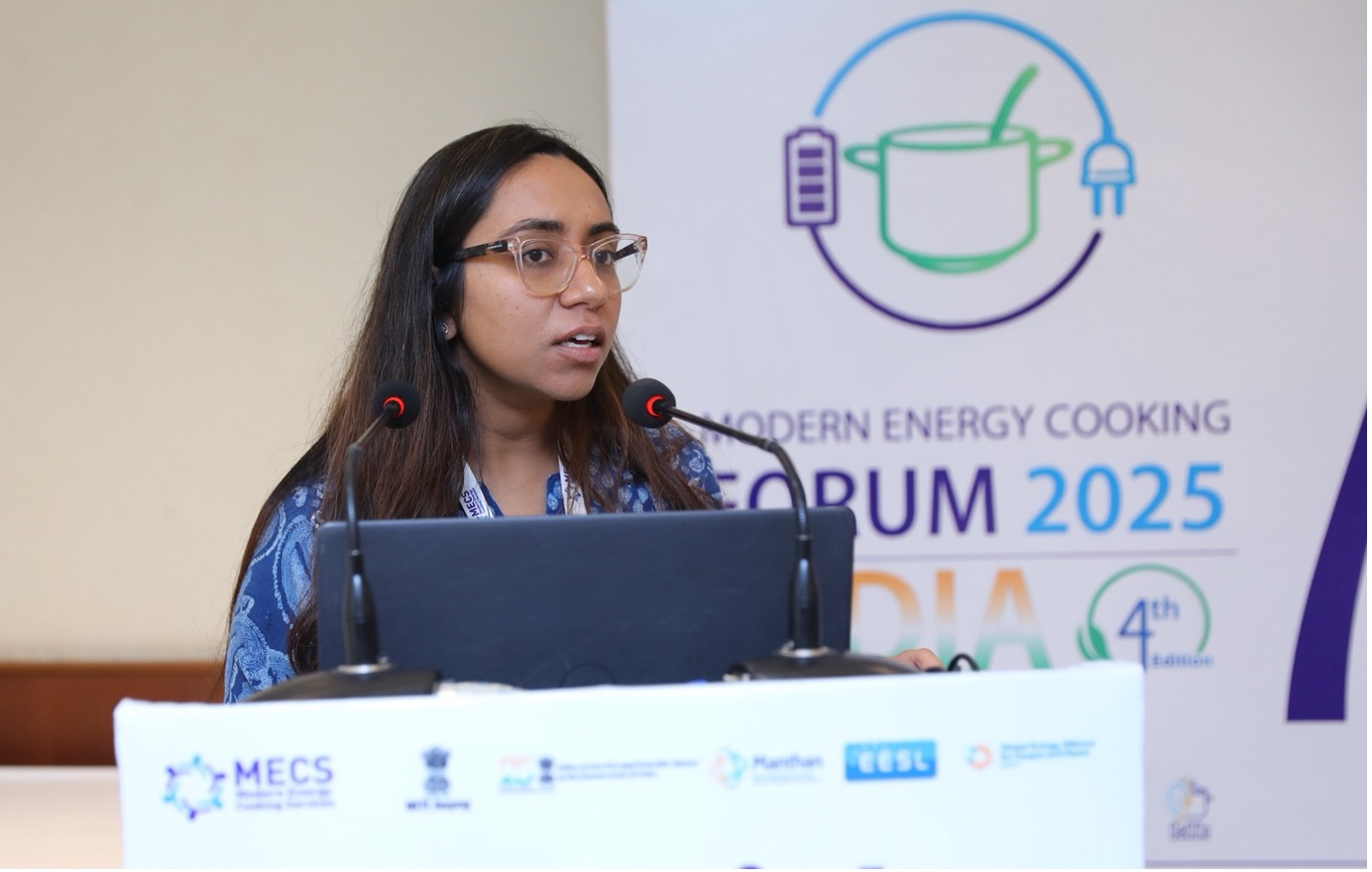
Photo by Finovista.
Sumedha Awasthy, Senior Associate at CLASP, showcases CLASP's clean cooking initiatives at MECF 2025.
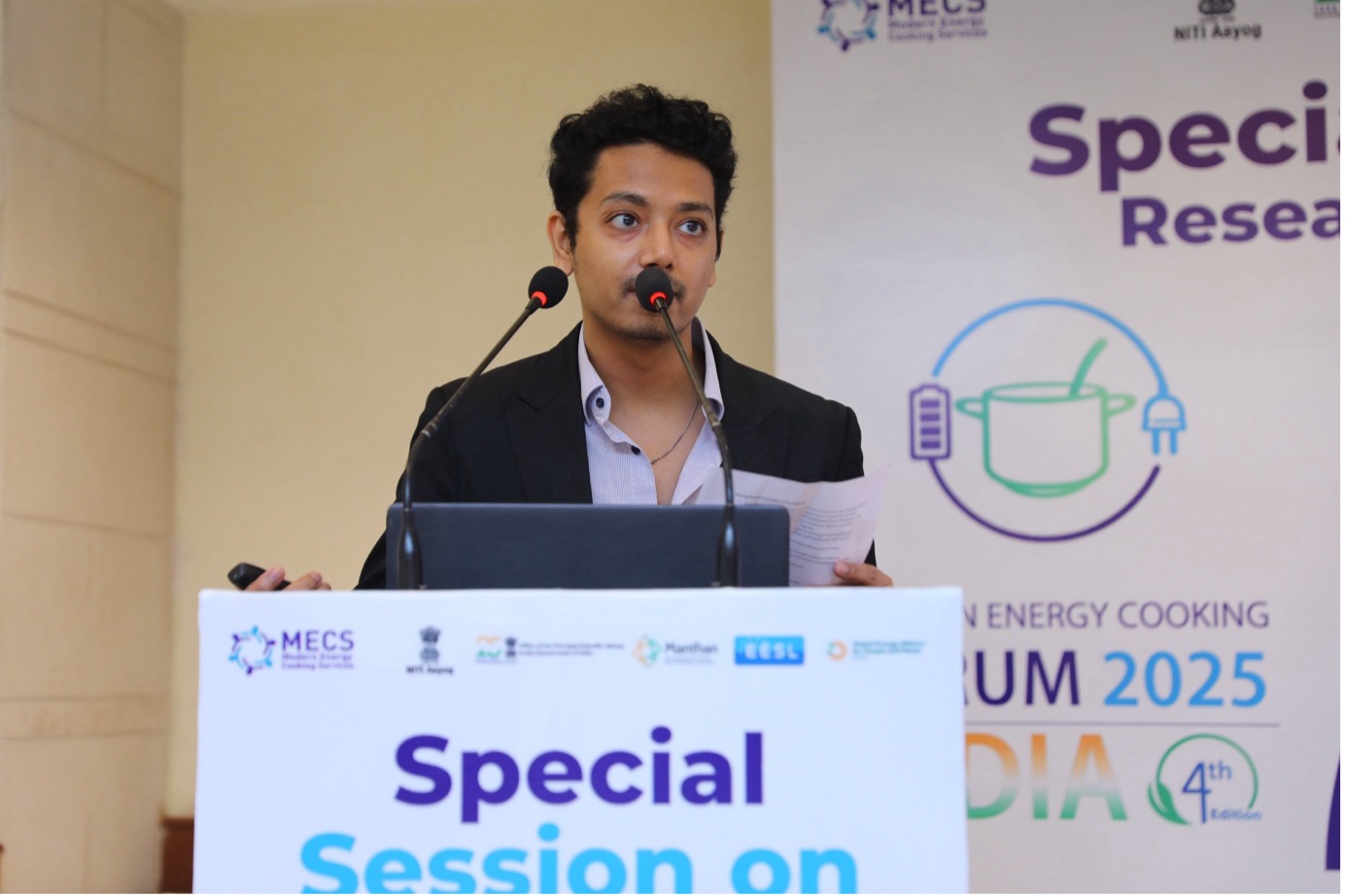
Photo by Finovista.
Jatin Mathur, Associate at CLASP, speaks in a session on research in clean cooking at MECF 2025.
“Through MECS, we see opportunities for Indian companies to grow in the domestic market and expand into new markets globally. CLASP is excited to help fill gaps where we can, and ensure that together, we accelerate the transition to efficient e-cooking in India and beyond.”
Neha Dhingra
Director, India (CLASP)
With this approach, CLASP aims to ensure that clean cooking appliances are available, but also affordable, trusted, and widely adopted. Through our partnership with MECS and in collaboration with local partners like Finovista, CLASP will provide venture-building support to Indian manufacturers, help identify high-growth opportunities, refine business models, and develop strategic connections with funders and partners.
CLASP’s Sumedha Awasthy (Senior Associate, Clean Energy Access) and Jatin Mathur (Associate, Clean Energy Access) also contributed to a special session on research and innovation in e-cooking, demonstrating how policy, finance, and market-building can speed up the shift. Their presentation highlighted initiatives such as the Global Leap Awards and the Institutional E-Cooking Demo.
The opportunity for India to scale efficient e-cooking
With universal electricity access3 and a strong cooking appliance industry, India is well-positioned to scale domestic adoption and tap into international markets. CLASP is committed to working alongside partners in India and beyond to ensure that affordable, efficient, clean cooking solutions reach households that need it most. By further improving standards and policies, building markets, and implementing consumer-centric approaches, India can turn MECF’s momentum into lasting impact.
About the Modern Energy Cooking Forum (MECF)
MECF is hosted by Finovista and the Modern Energy Cooking Services (MECS) programme. This year’s forum strengthened its role as a key platform driving India’s clean cooking dialogue and strategy since 2022. MECF 2025 was supported by NITI Aayog, the Office of the Principal Scientific Adviser to the Government of India, Energy Efficiency Services Limited, and the Global Energy Alliance for People and Planet.
Discussions focused on decarbonizing the cooking sector, equity, state-level programs, financing, and demand-side challenges and opportunities to scale up e-cooking. A highlight of the forum was the Innovation Pavilion, where new technologies were showcased through live cooking demonstrations for diverse consumer segments.
0. International Energy Agency, “Access to Clean Cooking”. https://www.iea.org/reports/sdg7-data-and-projections/access-to-clean-cooking
1. Modern Energy Cooking Services programme, “The Green Shift in Clean Cooking Fuel in India”, 18 May 2023. https://mecs.org.uk/blog/the-green-shift-in-clean-cooking-fuel-in-india/
2. International Energy Agency, “Electricity access continues to improve in 2024 – after first global setback in decades”, 5 November 2024. https://www.iea.org/reports/sdg7-data-and-projections/access-to-clean-cooking