
State-Driven Hybrid Heating Wins in the United States
A selection of case studies illustrating how US states are advancing heat pump adoption and decarbonization.
Table of Contents
Overview
Heat pumps are vital solutions for the US to slash energy demand, reduce energy bills, and get on track for electrification goals. Despite these crosscutting benefits, heat pump adoption remains slow due to barriers like the federal policy landscape and upfront costs.
CLASP and local partners have identified state action on hybrid heating, a strategy pairing heat pumps with legacy equipment, as a pivotal, cost-effective approach to improving the rate of heat pump ownership.
This research lays out the case for state hybrid heating initiatives and explores three examples of successful programs in Massachusetts, Minnesota, and Utah.
Table of Contents
Hybrid Heating 101
Hybrid heating refers to the installation of a two-way air-source electric heat pump to complement the existing fossil fuel heating system or replace one-way air conditioner. The pre-existing furnace remains in place to serve as backup mainly during extreme cold conditions.
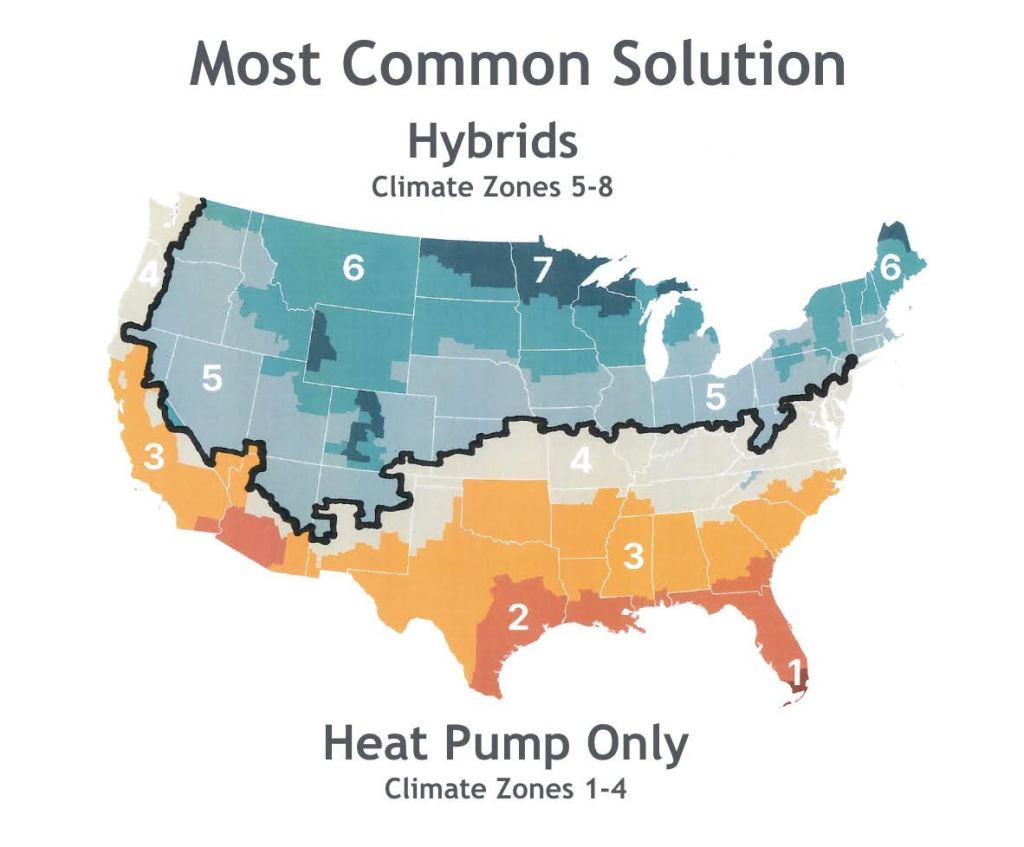
Credit: Nate Adams
This pragmatic solution paves the way for heat pump adoption nationwide. In warmer regions (climate zones 1-4), heat pumps alone can handle the service load. In colder climates (climate zones 5-8), a hybrid beating set up offers an energy-efficient, cost-effective path toward electrification
In addition to grid decarbonization, this innovative approach to heating carbonization and super-efficient cooling has crosscutting benefits:
-
Lower peak season energy demand and bills: Heat pumps offer super-efficient heating and cooling services. Since they require less energy to run than legacy technologies, households and businesses enjoy lower energy bills while placing less strain on local grids. Hybrid heating households can save up to $77–$555 per year for heating services as compared to homes that rely entirely on gas furnaces.1 Simultaneously, these households can reduce their peak summer electricity demand by up to 10% by running their heat pump for cooling versus using a transition central AC.2
-
Improved accessibility to heat pump transition: Hybrid heating offers people the opportunity to approach heat pump use incrementally instead of making an all-in jump. This can be a game changer for by reducing the upfront cost of major upgrades, people living in colder regions, or those weary of decarbonization.
-
Decreased direct impact of global energy crises: Hybrid heat pump systems could reduce fossil fuel use for heating by roughly 39% under conservative assumptions.3 As conflicts across the globe impact global fossil fuel prices, households that can rely even partially on electric heating benefit from more stable pricing and affordable services.
The Role of State Action
States are in a uniquely position to unlock barriers to hybrid heating adoption for families and businesses across the US.
Overcoming federal barriers: Today’s federal political environment is not primed to promote heat pump adoption. State policymakers, however, have many mechanisms at their disposal to overcome the stagnant pace of national progress including the following:
-
Enact legislative amendments enabling the promotion of fuel switching by utilities (which in turn can permit heat pumps to count as demand side measures (DSM).
-
Require utilities to consider and propose favorable electricity rates (either generally favorable to heat pumps, or more specifically structured to benefit hybrid heat systems).
-
Promote collaboration between gas and electric utilities such as with coordination examples that employ revenue decoupling.
-
Supportive financial measures including tariff on bill financing (TOB) or inclusive utility investment (IUI), rebates and incentives, and various approaches to incentives/rebate stacking (discussed in more detail in the following section.
Supporting affordability: High purchase prices, rate designs that disadvantage electricity use, and inconsistent incentive programs stand as firm barriers to entry for many potential heat pump adopters. To mitigate these challenges, states can take the following actions:
-
Enact legislation/amendments or updates permitting the promotion of fuel switching
-
Implement legislative mandates to consider favorable rates for heat pumps/hybrid heat systems maybe put this as ‘Implement favorable electric rate designs that reduce winter operating costs for heat pump users.’)
-
Provide programs/resources that make it possible to easily access and combine utility, local, and state rebates
-
Support innovative financing mechanisms that eliminate large upfront payments
Explore the case studies below, highlighting how policymakers in Utah, Minnesota, and Massachusetts have leveraged these tactics to promote hybrid heating in their states.
Case Study: Utah
Utility Collaboration and Fuel Switching
Summary: In 2020, Utah adopted a simple legislative amendment clarifying that heat pumps qualify as eligible DSM measures. This change enabled regulated utilities to actively promote heat pumps and hybrid heating systems through revenue decoupling mechanisms and coordinated utility incentive programs. The result has been growing heat pump adoption, greenhouse gas emissions reductions, and a replicable model for accelerating electrification through utility collaboration.
Context: A key barrier to hybrid heat pump adoption in historically gas-heating dominant states, like Utah, is whether regulated electric utilities are legally permitted to promote “fuel switching.” In states that do not permit fuel switching, electric utilities may be prohibited from offering specific rebates or more favorable rebates and incentives for heat pumps relative to conventional air conditioning and gas furnace systems.
The potential loss of utility revenue associated with reduced gas sales poses another barrier in the state. Without mechanisms to address this issue, gas utilities may have limited incentives to support heat pumps and hybrid heating technologies.
Solution: In Utah, a simple one-sentence legislative amendment in 2020 clarified that heat pumps qualify as eligible demand-side management measures.4 This change allowed the state’s regulated electric utility, Rocky Mountain Power (RMP), to include residential heat pumps in its DSM plans and actively promote them as part of the utility’s energy efficiency and emissions reduction efforts. Utah is a strong example of how a relatively straightforward, narrow legislative amendment can permit utility promotion of hybrid heating without overhauling a broader regulatory framework.
A supportive mechanism called revenue decoupling was also essential for the gas utility to develop rebates for heat pumps without a net loss of revenue from selling less gas. Revenue decoupling separates utility revenue recovery from volumetric energy sales, protecting utilities from the lost revenue associated with increased energy efficiency and fuel switching. This enables gas utilities to promote heat pumps and hybrid heating while still meeting financial obligations and regulatory requirements. For electric utilities, revenue decoupling can also help promote energy efficiency without losing revenue from selling less electricity.
Both the electric and gas utilities claim energy savings from the dual-fuel heat pump programs, helping them achieve their respective energy-saving goals. Electric savings (kWh) and gas savings (therm reductions) are both captured and credited toward utility performance goals. Both utilities estimate reduced gas usage through energy modeling of installed heat pump systems. Dominion claims the therms of energy savings directly, while RMP converts therm savings to kWh, with a slight adjustment that subtracts 15% to partially account for increased electricity consumption associated with heat pump operation.
As part of their efforts to promote hybrid heating and heat pumps, both RMP and Dominion Energy offer significant incentive programs.5 Customers installing qualifying air-source heat pumps can combine rebates from both utilities, with total rebates of up to $2,400, significantly reducing upfront cost barriers. Incentive levels have evolved over time, with periodic adjustments reflecting budget constraints, performance targets, and market response.
Contractors can apply for rebates on behalf of customers, reducing administrative burden and improving program uptake. In an early phase of the program, contractors received $100 per heat pump installation incentive.6 While these contractor bonuses were later reduced to $50, installation rates continued to grow, suggesting that once market familiarity increases, programs may require reduced spending to sustain participation. In addition to incentives, RMP’s program implementer, Evergreen, provides ongoing support through regular “lunch-and-learn” trainings that offer updates on program requirements, technical best practices, and incentive changes.7 Participating contractors also have the option to be listed in a preferred contractor network.
Impact: RMP and Dominion Energy’s dual-fuel heat pump incentive programs resulted in nearly 5,900 heat pumps being installed between 2021 and 2023.8 The associated greenhouse gas emission reductions are estimated at approximately 14,700 tons of carbon dioxide equivalent annually, equivalent to removing about 2,900 vehicles from the road annually.
By enabling fuel switching through targeted legislative reform and pairing that authority with coordinated rebates and contractor engagement, Utah has created a replicable model for increasing hybrid heating and heat pump uptake. Where utilities are permitted and financially structured to promote electrification, coordinated dual-fuel programs can scale without requiring entirely new funding streams or large infrastructure investments.
Case Study: Minnesota
Coordinated Utility Programs and Fuel Switching
Summary: Through legislation enabling fuel switching, innovative utility electric rates, stacked financial incentives, and comprehensive contractor and consumer support provided by the Minnesota Air Source Heat Pump (ASHP) Collaborative, the state has successfully accelerated adoption of hybrid and cold-climate heat pumps.
Context: Minnesota has created a policy environment that supports hybrid heating. The passage of the Minnesota Energy Conservation and Optimization (ECO) Act of 2021 reformed the 2007 Next Generation Energy Act to allow utilities to promote fuel switching as part of their energy savings goals.9 Additionally, Minnesota’s Energy Efficiency Resource Standards (EERS) require utilities to achieve annual energy savings targets of approximately 1–1.75%, creating a compliance-driven incentive to adopt high-impact efficiency measures such as hybrid heat systems. The state allows utilities to count total savings for certain dual-fuel, efficient fuel-switching applications, creating an incentive to promote heat pumps, including in hybrid configurations. Because utilities are permitted to promote fuel switching through ECO programs, equipment incentives can be paired with innovative electric rate designs. Most Minnesota electric cooperatives and investor-owned utilities offer dual-fuel electric rates that significantly reduce per-kWh electricity charges for qualifying hybrid systems compared to standard rates.10111213 These rate structures improve the operational cost-effectiveness of hybrid heating systems. In addition, the Minnesota ASHP Collaborative provides the Heating and Cooling Savings Estimator tool, allowing consumers to compare electricity, gas, and propane rates by utility and home type.14 Xcel Energy also offers a whole-home electric space-heating rate for both fully electric and dual-fuel systems when the heat pump serves as the primary heating source.
Solution: Minnesota complements its legislative framework with coordinated financial incentives, technical assistance, and workforce development. The ASHP Collaborative, led by the Minnesota Center for Energy and Environment,15 provides a centralized platform that enables homeowners to identify and stack city, utility, and federal incentives for hybrid and cold-climate heat pump installations. For low- and moderate-income households, up to 70–100% of installation costs may be covered, with additional grant funding available in some cities for rental properties. Many metropolitan-area communities also offer utility rebate matching programs.
Available rebates are organized in two clear tiers: one for air conditioning replacements (hybrid systems that retain a gas furnace) and a cold-climate heat pump tier (including systems paired with a gas system or electric resistance supplemental heat).16 The platform also includes tools to identify local rebate matches, special dual-fuel or whole home electric rates, financing options, and promotional programs. Helping homeowners locate qualified contractors is another important feature of the platform available via the “Find Contractor tool”.17 By centralizing these resources, the MN ASHP Collaborative reduces administrative burden and transaction costs for both homeowners and contractors, making participation significantly easier. Recently, the MN ASHP Collaborative compiled information and resources for homeowners in a comprehensive Step-By-Step Guide to help with navigating the sometimes-overwhelming process of acquiring a heat pump.18
In addition to consumer-facing tools, the MN ASHP Collaborative maintains a technical resource hub for contractors that includes guidance on incentive requirements, equipment selection, installation best practices, system controls, and homeowner education.19 Regular in-person and virtual training sessions further strengthen contractor familiarity with cold-climate heat pump applications and hybrid configurations, increasing installer confidence and the likelihood that these systems are recommended to customers.
Impact: Minnesota demonstrates how coordinated legislation, utility rate design, stacked incentives, and comprehensive consumer and contractor support can work together to accelerate hybrid heat pump adoption. Market transformation strategies deployed by the Minnesota ASHP Collaborative, together with innovative utility rates, fuel-switching rebates, and the 25C tax credit, have increased air-source heat pump market share from 4% of air conditioning sales in 2022 to 15% in 2025 (when comparing ASHP sales to AC sales).20 Minnesota serves as an example of successfully combining statutory fuel-switching authority, innovative utility programs, and strong workforce support to facilitate hybrid heat adoption.
Case Study: Massachusetts
Summary: In addition to permitting fuel switching, Massachusetts has pursued complementary programs for hybrid heat and heat pump deployment, including utility rate design, Inclusive Utility Investment (IUI) financing pilots, and incentive programs to drive new heat pump adoption.
Solution:
Rate Design
Massachusetts has implemented an innovative seasonal electricity rate structure for households with heat pumps, that is designed to lower winter heating costs and better align electricity pricing with grid use patterns.21 Starting November 1, 2025, all three of the state’s major investor-owned utilities (IOUs) (Eversource, National Grid, and Unitil) began offering lower electric rates during the winter heating season (November 1–April 30) for households that heat all or part of their homes with heat pumps, a categorization which includes hybrid heating. IOUs were mandated to investigate and implement rates as part of efforts to meet state climate targets through Climate Compliance Plans. Massachusetts law allows gas utilities to deliver thermal energy as ‘low-carbon’ energy (this means thermal energy may count toward the utility’s emissions obligations, which is classified as low carbon energy), facilitating hybrid heat adoption alongside planned decommissioning of old gas pipelines.
Originally recommended by the state’s Commission on Clean Heat, the Department of Public Utilities (DPU), the Massachusetts Clean Energy Center (MassCEC), the Department of Energy Resources (DOER), and the IOUs collaborated to rapidly design and implement the Massachusetts rate structures and incentive programs over a three-year period. Automatic enrollment for heat pump users was piloted, and while stakeholder engagement was minimal, utilities and program administrators experienced reduced administrative barriers and successfully coordinated the smooth implementation of rates and incentives. MassCEC commissioned a technical study to investigate and propose alternative rates for heat pump households, which formed the basis for the proposed heat pump rate.
The new rates reduce the delivery (distribution and, in some cases, transmission) charges on electricity bills during the winter months for heat pump users, while supply charges remain unchanged. Because heat pump households on average use significantly more electricity than those who heat with fossil fuels, the fixed costs of electricity delivery are distributed across a larger volume of electricity, lowering the effective delivery rate. By lowering these charges in winter when the grid is not capacity-constrained, heat pump users see a 40% reduction in heating cost relative to using the standard rate.22
Under traditional rate structures, winter electric delivery charges often remained high despite the grid having unused winter capacity because utility pricing is based on summer peak loads. By offering lower winter delivery charges, Massachusetts is more accurately reflecting the lower cost of delivering electricity during periods of lower demand. This makes heat pump operation more financially competitive with natural gas heating, which continues to dominate in the state.23
Massachusetts aims to install 500,000 heat pumps by 2030, a significant increase from just over 90,000 installed as of 2024.24 State regulators and utilities estimate that these seasonal rate discounts for heat pump customers who switch to the new rate could reduce winter heating costs by an average of $540 per household during the heating season.25 A report commissioned by environmental groups found that if regulators adopt deeper proposed rate changes, up to 82% of Massachusetts homes with heat pumps could see median annual winter savings of $687 because of fairer pricing that reflects actual seasonal grid costs.26
Utility Financing
Massachusetts has piloted alternative financing mechanisms to address the upfront cost barrier associated with hybrid and fully electric heating systems. The Ipswich Electric Light Department (IELD), a municipal utility, launched an IUI pilot program using a tariffed on-bill (TOB) financing model to support electrification and weatherization upgrades.27 The program was initiated with $100,000 in seed funding and focused on enabling comprehensive home energy retrofits aligned with the state’s goal of electrifying 500,000 homes by 2030.28
Under the IUI structure, the utility invests directly in cost-effective home improvements (such as heat pump installations and building envelope upgrades) and recovers its investment through a monthly tariff attached to the electric meter, rather than to the individual customer. The tariff is structured so that monthly IUI payments do not exceed the estimated energy cost savings generated by the improvements, ensuring that participants experience net bill neutrality or savings from the outset. Because the tariff obligation is tied to the meter and transfers automatically to subsequent household occupants if the home is sold, the model avoids reliance on individual creditworthiness and eliminates the need for customers to take on personal debt. This design distinguishes IUI from traditional on-bill financing programs, which function as loans and may exclude households with limited access to capital.
Massachusetts utilities and other program administrators also implement comprehensive statewide incentives through the Mass Save heat pump incentive structure. Mass Save is a statewide energy efficiency and electrification initiative funded by a charge on customers’ utility bills and administered jointly by Massachusetts program administrators as an initiative focused on the state’s energy efficiency and greenhouse gas reduction objectives defined in the Massachusetts Clean Energy and Climate Plan.29 The program’s purpose is to reduce energy consumption, lower costs for participants, and support clean energy goals by offering rebates, technical assistance, and coordinated services for efficiency upgrades, including heat pumps.30
Designed to accelerate electrification while accommodating hybrid configurations, the program offers tiered rebates based on the degree to which a heat pump displaces existing fossil fuel or electric resistance heating.31 The program distinguishes among three rebate categories. Whole-home rebates, the largest rebates available, are for eligible customers who install heat pumps as the sole source of heating and cooling. In 2026, these rebates provide $2,650 of financing per ton of installed capacity, up to a maximum of $8,500. Partial-home rebates, intended for hybrid configurations where an existing boiler or furnace remains in place for supplemental heating, offer $1,125 per ton up to $8,500 (installation of “integrated controls” that connect the system to a legacy fossil fuel system is required, as well as set switchover temperature of 30F or less for oil and natural gas, and 5F or less for propane).32 Customers installing properly sized systems that can meet their total heating load needs are eligible for an additional $500 sizing bonus, and those completing recommended weatherization measures may receive a $500 weatherization bonus. Basic rebates, at $250 per ton up to $2,500, apply to installations that do not displace fossil fuel heating, such as cooling-only upgrades or installations in seasonal homes.
Importantly, the program incorporates enhanced incentives for income-qualified households. Low- and moderate-income customers may receive up to $16,000 for whole-home systems, or, in some cases, near-zero upfront cost through turnkey delivery services.33 For context, average installation costs for whole-home air-source heat pump systems in 2022 were approximately $22,000. Under standard incentives, this reduces net customer cost to roughly $13,500; under enhanced incentives, net costs may fall to approximately $6,000 or lower.
Impact:
Early results from the Ipswich IUI pilot demonstrate that tariff-based financing mechanisms can effectively address upfront affordability barriers to heat pump adoption, particularly for households that may not qualify for traditional financing. Although the pilot relied on external seed funding and participation by a municipal utility, it provides a replicable model for expanding equitable access to hybrid and fully electric heating systems without requiring customers to make significant upfront investments.
While the IUI model delivered the greatest financial benefits when paired with complementary measures such as weatherization and solar installations, early results show that the program enabled HVAC electrification in all participating homes, eliminated approximately 84% of upfront costs for customers, and achieved average energy savings of roughly 20% compared with historic household energy expenditures.34 By integrating electrification and weatherization into a streamlined offering, the pilot also reduced administrative barriers by minimizing the need for customers to independently identify contractors or navigate multiple incentive programs.
Massachusetts has also demonstrated the value of sustained statewide incentives through the Mass Save program. Since 2020, Mass Save has supported the installation of heat pumps in more than 90,000 Massachusetts households, roughly 7% of homes statewide, including both whole-home and hybrid heating systems.35 This scale of deployment reflects both sustained funding and program stability.
The Mass Save program further illustrates how incentive design can support both hybrid and full electrification pathways. By combining tiered rebates based on system configuration, income-based enhancements, weatherization bonuses, and clear technical requirements for system sizing and hybrid controls, the program addresses multiple barriers to adoption, including upfront costs, system performance, and building efficiency. Together with seasonal electric rate reforms and innovative financing models such as IUI, Massachusetts provides an example of how complementary utility and state policies can reduce operating costs, lower upfront financial barriers, and accelerate deployment of hybrid and electric heat pump systems.
Conclusion
Hybrid heating is well recognized as a pragmatic pathway for advancing building decarbonization in the US. Federal incentives under the IRA had a very limited impact on national heat pump adoption, and funding uncertainty further highlighted the limits of relying on federal programs alone to meaningfully scale heat pump adoption. Even so, the featured case studies demonstrate that meaningful progress on heat pump deployment is still occurring at the state level.
Across Utah, Minnesota, and Massachusetts, several effective practices emerged.
-
Statutory authority for fuel switching is foundational; without it, utilities face regulatory barriers to promoting the adoption of heat pumps and hybrid heating
-
Revenue decoupling or performance-based incentives reduce institutional resistance by protecting utility financial stability
-
Stable, predictable incentive structures that are sustainably financed are more effective than short-term, high-dollar rebates that run out of funding or expire quickly
-
Contractor support and training and simplified consumer-facing platforms increase the likelihood of customers accessing programs and funding for heat pumps, and make contractors more likely to recommend heat pumps/take advantage of funding for heat pumps
-
Favorable rate design (particularly seasonal or dual-fuel electric rates) can improve the operating cost of hybrid heat systems while leveraging existing grid headroom, minimizing the need for near-term infrastructure expansion and making adoption more financially feasible
The case studies also illustrate how hybrid heating advances equity objectives. Layered incentives particularly in Minnesota and Massachusetts demonstrate that low- and moderate-income households and rental properties can be meaningfully included in electrification efforts when administrative barriers are reduced, and financing mechanisms are structured to avoid debt burdens.
Amid federal uncertainty, hybrid heating programs offer states a variety of sustainable, effective pathways to sustain electrification momentum and reduce carbon emissions.
0. Malinowski, Matt, Vivian Cox, Dave Farnsworth, et al. 2023. Accelerating Heat Pump Adoption through the Inflation Reduction Act (IRA) and Complementary Policies. CLASP, RAP.
1. MN CEE. 2025. Hybrid Heating Programs and Dual-Fuel Tariffs: Minnesota Case Study Internal Report
2. Malinowski, Matt, Vivian Cox, Dave Farnsworth, et al. 2023. Accelerating Heat Pump Adoption through the Inflation Reduction Act (IRA) and Complementary Policies. CLASP, RAP.
3. HB 431 Energy Efficiency Program Amendments, H.B. 431, Utah State Legislature 2020 General Session (2020).
4. Kolwey, Neil (Southwest Energy Efficiency Project (SWEEP)). 2024. “A Unique Partnership to Promote Dual-Fuel Heat Pumps: Dominion Energy and Rocky Mountain Power – Southwest Energy Efficiency Project.” July 3.
5. Kolwey, Neil (Southwest Energy Efficiency Project (SWEEP)). 2024. “A Unique Partnership to Promote Dual-Fuel Heat Pumps: Dominion Energy and Rocky Mountain Power – Southwest Energy Efficiency Project.” July 3.
6. Kolwey, Neil (Southwest Energy Efficiency Project (SWEEP)). 2024. “A Unique Partnership to Promote Dual-Fuel Heat Pumps: Dominion Energy and Rocky Mountain Power – Southwest Energy Efficiency Project.” July 3.
7. Kolwey, Neil (Southwest Energy Efficiency Project (SWEEP)). 2024. “A Unique Partnership to Promote Dual-Fuel Heat Pumps: Dominion Energy and Rocky Mountain Power – Southwest Energy Efficiency Project.” July 3.
8. 216B.2403 Consumer-Owned Utilities; Energy Conservation and Optimization., 216B.2403 § Section 216B.2403 (2025).
9. Minnesota Air Source Heat Pump Collaborative. 2026c. “Incentives, Rates, & Financing | Air Source Heat Pump Collaborative.
10. McFarlane, Ashley (Minnesota Center for Energy and Environment). 2025. “The MN PUC Approves New Space-Heating Rates for ASHPs |.” March 26.
11. MN Center for Energy and Environment. 2023. Developing Electric Rates for Hybrid Air Source Heat Pumps in the Midwest.
12. Minnesota Air Source Heat Pump Collaborative. 2026a. “ASHP Models Compatible with Load Management Controllers | Air Source Heat Pump Collaborative.”
13. Minnesota Air Source Heat Pump Collaborative. 2025b. “Starting Your ASHP Journey Now: A Step-By-Step Guide.” July 7.
14. MN CEE. 2025. Hybrid Heating Programs and Dual-Fuel Tariffs: Minnesota Case Study Internal Report. Minnesota Center for Energy and Environment
15. Minnesota Air Source Heat Pump Collaborative. 2026e. “Utility Rebates.”
16. Minnesota Air Source Heat Pump Collaborative. 2025a. “Find a Heat Pump Service Contractor.” https://www.mnashp.org/find-contractor.
17. Minnesota Air Source Heat Pump Collaborative. 2025b. “Starting Your ASHP Journey Now: A Step-By-Step Guide.” July 7.
18. Minnesota Air Source Heat Pump Collaborative (ASHP). 2026d. “Training & Events.”
19. McFarlane, Ashley. 2026. Minnesota Efficient Technology Accelerator 2025 Annual Report. Minnesota Center for Energy and Environment.
20. Chretien, Larry, and Kyle Murray. 2025. “Heat Pumps Could Be Affordable for Most — If Rates Were Fair | Utility Dive.”
21. Massachusetts Department of Energy Resources (Mass.Gov). 2025b. “Residential Electric Seasonal Heat Pump Rates.”
22. Massachusetts Department of Energy Resources (Mass.Gov). 2025a. “Massachusetts Household Heating Costs.” November 10.
23. Massachusetts Department of Energy Resources (Mass.Gov). 2024a. “2024 Massachusetts Climate Report Card – Buildings Decarbonization.”
24. Wasser, Miriam. 2025. “What to Know about Mass.’ New Electricity Rates for Heat Pump Users.” October 20.
25. Murray, Bryan, and Juan-Pablo Velez. 2025. Report: MA Heat Pump Rates.
26. Center for Ecotechnology. 2025. “Inclusive Utility Investment (IUI) Pilot Program: Ipswich Electric Light Department.”
27. Peter McPhee, “Massachusetts CEC Interview,” January 30, 2026)
28. Massachusetts Department of Energy Resources (Mass.Gov). 2024b. “Massachusetts Clean Energy and Climate Plan for 2025 and 2030.”
29. Broussard, Allison (HomeWorks Energy). 2024. “What Is Mass Save® & How Does It Work?” August 16.
30. Mass Save (Mass Save). 2026a. “Air Source Heat Pumps.” May 18.
31. Mass Save. 2026b. Residential Air Source Heat Pump Rebate Form – Up to $8,500 per Home. Mass Save.
32. Mass Save (Mass Save). 2026a. “Air Source Heat Pumps.” May 18.
33. Center for Ecotechnology. 2025. “Inclusive Utility Investment (IUI) Pilot Program: Ipswich Electric Light Department.”
34. Mass Save (Mass Save). 2026a. “Air Source Heat Pumps.” May 18.