
Combating High Fuel Prices with Hybrid Heating: The Case for Swapping Air Conditioners for Heat Pumps

If all 53.8 million households that are ready to transition from oil, methane, propane and electric resistance to hybrid heat pumps make the switch, the US would cut 67 Mt CO₂ emissions and reduce national heating bill costs by $13.6 billion annually.
Every six seconds a new residential furnace or air conditioner starts up in the US, meaning homes lose out on the opportunity to decarbonize until the product is ready to be replaced – likely not until 2035-2040. This report advocates for households to replace existing air conditioning units at the end of their useful life with look-alike electric heat pumps – a super-efficient technology that can both heat and cool indoor spaces.
Two-way heat pumps offer a reliable, cost-effective and efficient alternative to traditional air conditioners, enhancing energy security and reducing fossil fuel consumption. In this proposal, households would keep their legacy heat system in place, using it to supplement the heat pump at lower temperatures. As of 2022, there are 54 million US homes that are ready for hybrid heating.
This report, expanding on findings from CLASP’s 2021 3H Hybrid Heat Homes Report, offers benefit analyses of four major heating fuel types – oil, propane, methane and electric resistance – and outlines key recommendations for how state governments and utilities can support accelerated heat pump adoption across the US.
By transitioning these households to super-efficient hybrid heating, US could reduce national heating bills by $13.6 billion and cut annual CO2 emissions by 67 Mt, the equivalent of removing 14.4 million passenger cars from the road for an entire year.
New report finds US hybrid heating could cut national heating costs by $13.6 billion
Read the full press release here.
A new report from CLASP and the Regulatory Assistance Project (RAP) finds that the US could reduce national heating bills by $13.6 billion and cut annual CO2 emissions by 67 Mt, the equivalent of removing 14.4 million passenger cars for an entire year, by swapping air conditioners for heat pumps.
The report, “Combating High Fuel Prices with Hybrid Heating: The Case for Swapping Air Conditioners for Heat Pumps”, advocates for households to replace existing air conditioning units at the end of their useful life with look-alike electric heat pumps – a technology that can both heat and cool indoor spaces. In this proposal, households would keep their legacy heat systems in place, using them to supplement the heat pump at lower temperatures.
“AC retirements are a low-cost opportunity to bring super-efficient heat pumps into US homes,” said Matt Malinowski, report author and Director of Climate Research at CLASP. “Our report offers a robust argument in favor of making the swap, including huge cost savings for households and meaningful mitigation impacts.”
Every six seconds a new residential furnace or air conditioner starts up in the US, meaning these households miss out on the opportunity to begin home decarbonization until that equipment is retired in 2035-2040. In contrast, 1.7 million oil, 3.1 million propane, 16 million electric resistance, and 33 million methane gas households across the country can benefit right now from swapping one-way ACs for hybrid heat pumps. Households will also reduce their heating bills by $77-$555 per year, while reducing CO2 emissions by 11%-20%, depending on fuel.
“The transition away from fossil heating in the US requires millions of new electric heat pumps to be installed in the next few decades,” said Steve Pantano, Chief of Research at Rewiring America. “But the opportunity is clear. We can tackle a big part of this challenge at a very low cost, save consumers money on their energy bills, and accelerate progress toward our nation’s climate goals.”
The report, which extends the research in CLASP’s 2021 3H report, offers an analysis of the feasibility and benefits of household transition from oil, propane, methane gas, and electric resistance heating to hybrid heating systems in light of rising fuel costs and a desire to reduce fossil fuel dependence. The authors also recommend proven state and local policy tools to accelerate the adoption and overall availability of heat pumps.
“Rerunning the numbers, the Hybrid Heat Homes idea makes even more sense this year than last,” said Nate Adams, founder of HVAC 2.0 and co-author of the 3H paper. “All fuel prices are up substantially, so savings amounts got higher. Particularly for rural areas with expensive fuels and lower income, it’s a boon for equity. And, of course, being able to run on renewables helps deliver true energy independence so we’re less prone to price shocks like those caused by events like Russia invading Ukraine.”
Pushing for a swap from air conditioners to heat pumps over the next 5-10 years will smooth the way for full-building electrification and advance the United States towards its ambitious goal of achieving net zero by 2050.
“Electrification of the existing housing stock is a big mountain to climb,” said Max Dupuy, coauthor of the report and Principal at RAP. “Every home is different. Our proposal to swap AC to heat pumps opens a clear path to get rolling.”
HEATR Act Introduced in US Senate
Heat pumps, which can both cool and heat indoor spaces, are up to four times more efficient than traditional equipment, providing a significant opportunity to save people money on energy bills, cut greenhouse gas emissions, and decrease our reliance on oil and gas. With the rapid increase in fossil fuel prices and an accelerating climate crisis at hand, US policymakers are scoping out effective and affordable climate solutions.
In early May, Senator Amy Klobuchar introduced the Heating Efficiency and Affordability Tax Relief (HEATR) Act. Drawing directly from recommendations in CLASP’s 3H Hybrid Heat Homes report, the bill aims to establish upstream incentives for manufacturers to transition production to heat pumps, resulting in lower upfront costs to consumers and accelerated deployment of the super-efficient technology.
Supplementing traditional home heating with heat pumps offers noteworthy climate and economic benefits. The average household can cut fossil fuel use by 39% when running a heat pump above 41°F/5°C and save $154 per year in operating costs.
Support the HEATR Act
Underscored by the Russian invasion of Ukraine and skyrocketing oil and gas prices globally, CLASP and our partners are urging other NGOs and civil society organizations to voice their support for the bill.
To endorse the HEATR Act, please fill out this form.
Thus far, the legislation is endorsed by CLASP, the Appliance Standards Awareness Project (ASAP), the American Council for an Energy-Efficient Economy (ACEEE), the Natural Resource Defense Council (NRDC), RMI, AFL-CIO and 21 additional organizations.
More About the Bill
The HEATR Act was introduced by Senator Klobuchar and co-sponsored by Senators Hickenlooper, Whitehouse, Leahy, Merkley, and Booker.
Targeted manufacturer incentives can help keep the purchase cost of the equipment low by avoiding markups along the manufacturing and distribution process. This strategy helps to reduce the high upfront costs to consumers, lowering the barrier for mass heat pump deployment across the US, and complements the consumer-facing incentive currently proposed in Build Back Better.
The bill is currently awaiting approval from the Senate Finance Committee.
To learn more about the bill and heat pump technology, explore the following resources:
- Bill Text and Bill Status
- CLASP 3H Hybrid Heat Homes Report
- Replacing Residential Heating Oil with Heat Pumps in the US
Press
- Senator Klobuchar’s Press Release.
- Senator Smith’s Press Release.
- A new bill could speed up American electrification by 20 years, Canary Media.
- New Senate Bills Encourage U.S. Heat Pump Manufacturing Jobs, NRDC.
- The U.S. Is Addicted To Gas Heating. A New Bill May Make Going Electric The Easy Choice, Huffington Post.
- Two new bills could help pump up a climate-friendly system for heating and cooling homes, Popular Science.
Vermont Governor Signs Clean Lighting Bill
On May 19, 2022, Vermont Governor Phil Scott signed H.500 into law, making Vermont the first state in the US to ban all four-foot linear fluorescent lamps. The bill will go into effect January 1, 2024, complemented by an existing law to phase out all screw-based compact linear fluorescents beginning February 17, 2023.
Taken together, these two policy actions will remove well over 90% of the fluorescent lighting products from the Vermont market by 1 January 2024, saving Vermont residents $167 million in reduced utility bills by 2040 by cutting 1,000 gigawatt hours of electricity.
Vermont stands as a leader in the US clean lighting transition. California and Rhode Island have produced similar bills that are awaiting approval. Learn more about efforts in California here.
Vermont Becomes First US State to Ban Common Fluorescent Tubes
Read the full press release here.
Today, the Vermont Senate adopted legislation to ban the sale of 4-foot linear fluorescent light (LFL) bulbs in 2024. Climate, environmental, and health advocates applaud the vote, noting the widespread availability of more energy-efficient, mercury-free LED alternatives.
“Vermonters no longer need to tolerate fluorescent lighting, which contains mercury, a potent neurotoxin,” said Michael Bender, Director of the Mercury Policy Project. “By passing this legislation, Vermont is making a clear statement that it will not accept outdated and toxic technologies when safer, more efficient bulbs are widely available.”
Four-foot LFL bulbs are the most common type of fluorescent bulb, covering about 90% of fluorescent installations including lighting in most offices, schools, and other indoor spaces.
According to a recent report, fluorescents release mercury whenever they are broken, posing a threat to the environment and vulnerable groups like pregnant women, infants and others with chemical sensitivities.
“Who wants to put toxic mercury lighting in their homes, day care centers, schools, offices, hospitals, or shops when they don’t have to?” said Paul Burns, Executive Director of Vermont Public Interest Research Group. “LED alternatives are available, cost-effective, are mercury free and offer better quality light than fluorescents.”
Experts say that in the majority of cases, efficient LED retrofit solutions are widely available and can save Vermont residents and businesses money by cutting electricity costs in half.
A new study from the Appliance Standards Awareness Project (ASAP) found a typical school could see $24,000 in lifetime savings from transitioning to LEDs. Further, by 2040 Vermont could see savings of $167 million in reduced utility bills thanks to just over 1,000 gigawatt hours of saved electricity due to transitioning to LED four-foot tubes.
“Based on our analysis of drop-in retrofit LED bulb prices in Vermont, we concluded that an LED bulb can pay for itself 5 times over in electricity bill savings over its lifespan,” said Brian Fadie of ASAP. “Clearly LED is the lowest cost option today.”
In response to a consumer advocate petition last fall and a subsequent review, the Vermont Agency of Natural Resources issued a determination in February that will end the sale of screw-based mercury-containing compact fluorescent lamps (CFLs). This restriction will begin on February 17, 2023, to allow Vermont retailers and distributors sufficient time to sell any existing inventories.
“We applaud the leadership of Vermont’s legislators in setting phase-out dates for the most common fluorescent lighting technologies in state”, said Ana Maria Carreño, Director at CLASP. “There is no place for mercury in lighting today, especially when LED alternatives offer better performance, coupled with climate and environmental benefits”.
Governments around the world are increasingly recognizing LEDs as the foremost lighting technology on the market today. On December 16, the European Union banned the sale of almost all mercury-containing fluorescent lamps by September 2023, and in March, 137 governments voted to phase out CFLs by 2025 through the Minamata Convention on Mercury.
# # #
For more information:
Vermont ANR determination: https://dec.vermont.gov/content/10-vsa-%C2%A77152a6-sale-mercury-containing-lamps-final-determination-notice
European Commission ban on fluorescent lamps: https://www.eceee.org/all-news/news/eu-commission-adopts-regulation-to-ban-fluorescent-lighting-by-september-2023/
About the Mercury Policy Project: Founded in 1998, the Mercury Policy Project promotes policies to eliminate mercury use and reduce mercury exposure. To learn more, visit www.mercurypolicy.org
About the Appliance Standards Awareness Project (ASAP): ASAP organizes and leads a broad-based coalition effort that works to advance, win and defend new appliance, equipment and lighting standards which deliver large energy and water savings, monetary savings and environmental benefits. To learn more, visit https://appliance-standards.org
About the Responsible Purchasing Network: RPN is an international network of buyers dedicated to socially responsible and environmentally sustainable purchasing. To learn more, visit http://www.responsiblepurchasing.org/
About VPIRG: The Vermont Public Interest Research Group is Vermont’s largest consumer and environmental advocacy organization with more than 40,000 members and supporters across the state. To learn more, visit www.vpirg.org
For more information about the transition away from mercury-based lighting, visit https://cleanlightingcoalition.org/benefits/
Replacing Residential Heating Oil with Heat Pumps in the US
Heating oil is one of the most expensive heating fuels in the US, requiring millions of households to spend more than $2,000 annually for heat. Replacing all or some oil-powered heating equipment with modern two-way heat pumps can cut greenhouse gas emissions, reduce household heating and cooling costs, and increase comfort.
This paper explores two opportunities for heat pump retrofits for oil heating equipment in the US and the costs and benefits of each based on a 2021 CLASP analysis, with updates to reflect December 2021 prices.
Convention on Mercury Promises CFLs Phase-Out; Action on LFLs Delayed
Bali, Indonesia – At the Minamata Convention on Mercury fourth Conference of Parties (COP4), 137 governments adopted amendments to phase out a major category of fluorescent lighting, but actions were stalled on others. All fluorescent light bulbs contain mercury, a chemical of major public health concern according to the World Health Organization.
In a major win for environmental and human health, the Parties agreed to phase out compact fluorescent lamps (CFLs) by 2025. By accelerating the transition to LED lighting, which is more energy-efficient and non-toxic, the move will avoid 26.2 metric tonnes of mercury pollution and 261.5 million metric tonnes CO₂ emissions from 2025-2050, and save people $77.8 billion in lower energy bills.
However, last-minute interventions delayed a decision on linear fluorescent lamps (LFLs), the long tubes commonly found in offices and stores, until Minamata COP5 in November 2023.
“LEDs are a rare silver bullet technology – they’re ready now, they cost half as much to run as fluorescents, and they constitute a double win for climate change mitigation and reducing toxics pollution. We were amazed to see the international cooperation on lighting at COP4. We hope for continued global alignment and momentum at COP5,” said Corinne Schneider, Chief Communications Officer at CLASP.
Over days of intense negotiations, a group of countries came together to agree on phase-out dates for all lighting categories, including the EU, India, Indonesia, Japan, Norway, Pakistan, Switzerland, the US, and many Latin American governments, including Argentina, Bolivia, Brazil, Chile and Colombia. However, not all Parties were prepared to move forward, citing the need for more time and additional feasibility analysis.
A phase-out of LFLs by 2027 – the date that most countries rallied around by the end of the week – would have captured significantly greater benefits, avoiding a further 71.7 million metric tonnes of mercury pollution and 2.72 Gt of CO₂ emissions and saving $1.06 trillion in cost savings, according to experts at CLASP.
Last year, 36 governments representing the Africa region submitted a proposal to the Minamata Convention to phase-out virtually all fluorescent lighting by the end of 2025. With many OECD countries banning fluorescents in the coming years in favor of more efficient LEDs, less regulated markets risk becoming dumping grounds for toxic lighting.
“The Africa region recognizes that lighting is crucial in promoting livelihoods. Through our proposal, we took the first step towards a global phase-out of mercury-containing fluorescent lighting,” explained Oumar Cissé, Head of Delegation (Mali) in his opening statement at COP4. “The case to phasing out fluorescent lamps – both CFLs and LFLs – is already justified today from a public health, environmental, technical as well as economic perspective.”
“The original proposal by the Africa region is consistent with our findings that a transition to clean and efficient lighting is feasible everywhere today. The move to phase out CFLs represents a major win, as it will remove toxic, inefficient bulbs from our homes. But keeping LFLs on the market continues to disadvantage our offices, hospitals, schools and childcare centers, needlessly increasing energy costs and risking mercury exposure,” said Ana Maria Carreño, Director of Climate at CLASP.
NGO groups around the world advocated over the past year to address mercury in lighting at COP4. The Climate Action Network launched a petition that garnered over 200 signatures from climate and environmental groups, as well as the private sector, urging governments to take action to phase out fluorescents.
“We are leaving this COP with mixed emotions. Un- and under-regulated markets are increasingly vulnerable to dumping of fluorescents that many countries have already banned due to their toxicity and inefficiency,” said Elena Lymberidi-Settimo, International Co-coordinator of the Zero Mercury Working Group. “The decision to phase out CFLs is one step in the right direction, and we congratulate governments for their efforts to progress the Convention’s promise to ‘Make Mercury History.’ We hope to see action on LFLs at COP5 in November 2023.”
“We are proud of the work the Africa region has done to protect people from toxic lighting products,” said Roger Baro, Vice President of COP4 (Burkina Faso). “We will continue working to phase-out all fluorescent lighting and stop it from causing further mercury pollution in our communities.”
Fluorescent lighting represents about 10% of mercury in all products globally. In the past, fluorescent lamps were promoted as an energy-efficient alternative to incandescent and halogen lamps, and the mercury risks were tolerated as a necessary tradeoff. Today, thanks to major advances in LED technology, mercury-free LED lamps can cost-effectively replace fluorescents in virtually all applications.
Farewell to Fluorescent Lighting: How a Phaseout Can Cut Mercury Pollution, Protect the Climate, and Save Money
Mercury-free LED replacements for linear and compact fluorescent bulbs are widely available in the US and provide the same or better lighting, longer product life, and much lower total cost than fluorescents. This study finds that drop-in LED replacement lamps are available for all common linear fluorescent tubes, pin-based compact fluorescent lamps, and specialty applications. Policies to accelerate the phaseout of fluorescent lighting and a full transition to LED lighting would eliminate a significant source of mercury pollution and its threat to human health and the environment. Government policies to limit mercury have often exempted fluorescent lighting—the most common use of mercury in homes and commercial buildings—because ready-to-go, mercury-free substitutes did not exist. Our findings show that such exemptions for fluorescent lighting are no longer necessary.
35 Countries Show Climate, Health and Economic Benefits of LEDs
WASHINGTON, DC – New evidence from the Clean Lighting Coalition demonstrates that LEDs are a more cost-effective, safe and climate-friendly alternative to mercury-containing fluorescents for countries around the world.
The NGO and partners collected market data and analyzed thousands of lightbulbs in more than 35 countries, finding that in every market LEDs perform better and save users substantial energy costs. The evidence is outlined in the new global overview report and regional profiles for the Asia Pacific, African, and Latin American and the Caribbean regions.
In April 2021, the African region proposed an amendment to Annex A of the Minamata Convention on Mercury to remove exemptions for mercury-containing fluorescent lamps, phasing out virtually all fluorescents by 2025. While fluorescent lamp exemptions may have been necessary in 2013 when the Convention was drafted, the current accessibility and affordability of mercury-free LED retrofit lamps makes the fluorescent lamp exemption unnecessary.
“The extensive data collected by the Clean Lighting Coalition and partners unequivocally demonstrates that a global transition to LEDs is feasible and would provide consumers with the economic, environmental and health benefits of efficient, mercury-free lighting,” says CLASP CEO, Christine Egan. “We strongly encourage the delegates to the Minamata Convention to adopt the amendment proposed by African governments and accelerate a clean lighting transition for all.”
If adopted at the Minamata Convention, the bold but feasible proposal by African delegates would avoid 3.5 GT of CO2, reduce global energy use by 3%, and eliminate 232 tonnes of mercury by 2050.
In many countries around the world, fluorescents and LEDs have reached cost parity, though LEDs are perceived as more expensive. Real data collected from shops and online retailers show that in the few cases where LEDs alternatives cost marginally more than fluorescents, LEDs rapidly pay customers back in decreased energy bills. In countries like Chile, Ghana, the Philippines and South Africa, the payback period is less than two months or instantaneous. In several more countries, consumers will recover savings from any excess upfront costs in six months or less.
LEDs are designed to have the same form, fit and function as the fluorescent lamps that they are replacing – and often function even better in terms of light output and no flickering. LED retrofits for compact and linear fluorescents (CFLs and LFLs) are widely available and have high rates of compatibility – with more than 90% compatibility globally. Compatible retrofits are particularly accessible in many developing and emerging markets due to the higher share of magnetic (choke) ballasts, on which LED lamps have reached 100% compatibility.
The analyses also quantify the opportunity for CO2 emission mitigation and mercury avoidance on for individual countries. On the regional level, a fluorescent phase out by 2025 would avoid 220 MT of CO2 in Africa, prevent 75,900 kg of mercury pollution in the Asia Pacific region, and mitigate 239 MT of emissions in Latin America and the Caribbean by 2050.
This evidence is published alongside several new reports, events, and resources by the Clean Lighting Coalition and partners, including the #EndToxicLighting Petition which calls on delegates to the Minamata Convention on Mercury to support the proposed African Amendment.
Read the global overview and regional profiles.
# # #
About the Clean Lighting Coalition: The Clean Lighting Coalition is a global partnership coordinated by CLASP to capture the health and environmental benefits of eliminating mercury-based lighting. To learn more, visit www.cleanlightingcoalition.org and follow the Coalition on Twitter, Facebook, and LinkedIn.
Media Contact:
Alexia Ross
Communications Associate, Clean Lighting Coalition
Low-Cost LEDs Should Replace Mercury-Laced Fluorescent Bulbs
Transition to More-Efficient Bulbs Would Cut Greenhouse Gas Emissions
Washington, DC —Fluorescent tube light bulbs, once embraced as an energy-efficient option, use far more energy than today’s LEDs and are now a needless toxic health risk, according to a study published today. Laws and rules restricting the use of toxic mercury have generally exempted these mercury-containing bulbs because of a lack of better options, but the study shows for the first time that LEDs are now available in all needed shapes and sizes—and cost less to own and operate.
Transitioning all new fluorescent bulbs to LEDs in the United States alone would cut annual carbon dioxide emissions in 2030 by an amount equal to the emissions from 4 million typical passenger cars over a year, the report finds. The new study is published jointly by the American Council for an Energy-Efficient Economy (ACEEE), the Appliance Standards Awareness Project (ASAP), CLASP, and the Clean Lighting Coalition.
State, federal, and international policymakers should now phase out the fluorescent bulbs to prevent more mercury from being introduced into households and the environment while cutting greenhouse gas emissions, the study argues. As soon as this month, international negotiators meeting to update a convention on mercury pollution can do so.

An example of one common type of fluorescent bulb
The bulbs at issue are the four- and eight-foot tubes common in commercial buildings and in some home kitchens, basements, and garages, as well as several types of compact fluorescent bulbs designed for use in certain fixtures. Their toxic mercury can be released in several ways. An estimated 75% of fluorescent bulbs used in the United States are not recycled or disposed of properly; mercury leached from landfills eventually reaches rivers, lakes, and oceans, where it bioaccumulates in fish and shellfish. Consumption of contaminated seafood is the leading cause of human exposure to mercury. Broken bulbs in homes and buildings, if not properly cleaned up, can also present a health risk to those nearby.
Rapidly phasing out most fluorescent models would prevent bulbs containing 16,000 pounds of mercury from being sold and installed in the United States through 2050, the study finds—a massive amount for a toxin that can damage the human brain with only a miniscule quantity.
“Fluorescent bulbs used to be the energy-efficient option, but that’s just not the case anymore. LEDs have changed the game and we found there’s no good reason to keep using fluorescents at this point,” said Jennifer Thorne Amann, senior fellow at ACEEE and report coauthor.
Joanna Mauer, technical advocacy manager for ASAP and fellow coauthor, said, “LEDs are now widely available as drop-in replacements for fluorescent bulbs. In addition to not containing mercury, LEDs last about two times longer than fluorescents and cut energy use in half. Any increase in initial price more than pays off through the reduced electricity costs.”
An international agreement among 137 countries, the Minamata Convention on Mercury, is phasing out the use of mercury in numerous products and industrial processes and uses. But the convention—drafted in 2013—specifically exempts lighting, citing a lack of cost-effective alternatives at that time. Later this month, the nations will consider a proposal that would ban the manufacture, import, and export of fluorescent bulbs in the participating countries.
“The United States can be a leader in the global transition to clean lighting,” said Ana Maria Carreño, director at CLASP, which funded the report. “By supporting the African Lighting Amendment at the Minamata Convention on Mercury, U.S. policymakers will be making a statement to the world that it is time to say farewell to fluorescents.”
The report also finds:
- For businesses—where most linear fluorescent bulbs are used—additional upfront costs for the most common LED bulbs in the United States are paid back in less than two months. For households, the payback period for the most common LED bulbs is about a year.
- A complete transition from fluorescent bulbs to LED lighting in the United States would cut 18 million metric tons of carbon dioxide emissions annually in 2030. On a cumulative basis, a phaseout would cut carbon dioxide emissions by more than 200 million metric tons through 2050.
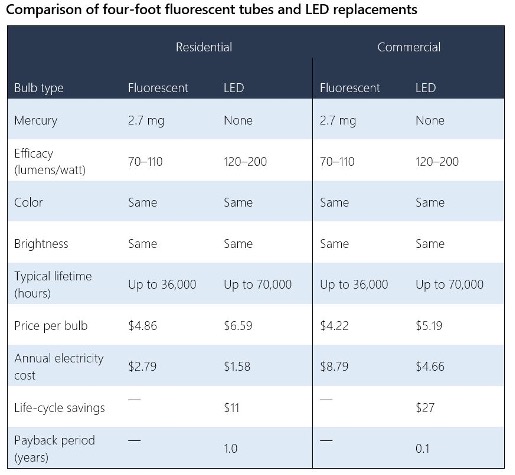
The United States can support a global phaseout of fluorescents by 2025 through the Minamata Convention, and the federal government and U.S. states can phase out fluorescents in the United States through several mechanisms:
U.S. states: Twenty-three states have prohibited the sale of some products that contain mercury, but all include exemptions for most fluorescent bulbs. The California and Vermont legislatures are considering bills that would end the sale of common fluorescent bulbs.
U.S. federal government: Several federal laws and rules govern mercury pollution, limiting emissions from industrial sources and governing end-of-life product disposal. A phaseout of mercury-containing bulbs could be accomplished either through EPA regulation under existing law or through congressional modification of federal bulb efficiency standards. (Separately, two pending Biden administration proposals could phase out most incandescent and halogen bulbs, which are much less efficient than fluorescent bulbs).
###
The American Council for an Energy-Efficient Economy (ACEEE), a nonprofit research organization, develops policies to reduce energy waste and combat climate change. Its independent analysis advances investments, programs, and behaviors that use energy more effectively and help build an equitable clean energy future.
The Appliance Standards Awareness Project (ASAP) organizes and leads a broad-based coalition effort that works to advance, win, and defend new appliance, equipment, and lighting standards that cut emissions that contribute to climate change and other environmental and public health harms, save water, and reduce economic and environmental burdens for low- and moderate-income households.
The Clean Lighting Coalition is a global partnership coordinated by CLASP to capture the health and environmental benefits of eliminating mercury-based lighting. To learn more, visit www.cleanlightingcoalition.org and follow the Coalition on Twitter, Facebook, and LinkedIn.
Media Contact:
Ben Somberg, Senior Communications Manager
Appliance Standards Awareness Project
202-658-8129