
Supporting Circular Economy for Renewable Energy Projects

The demand for more renewable energy technologies such as solar panels and wind turbines is creating pressure on the environment due to mining of critical metals and production of more e-waste as these technologies reach their end-of-life cycle, creating an opportunity for a circular economy. In a circular economy, materials have multiple life cycles and re-entry points into the market as they are systematically recovered, repaired and remade.
CLASP is part of a team that supports the U.S. Agency for International Development’s (USAID) Scaling Up Renewable Energy (SURE) program. CLASP was recently awarded a subcontract under the SURE program, led by Tetra Tech, alongside dss+ to engage strategically with governments, the private sector, civil society, and communities to support transformational policies and initiatives and to build human capital and institutional capacity to address waste challenges associated with renewable energy investments while creating economic value and jobs. Tetra Tech, CLASP, and dss+ technical experts work with partners to develop innovative tools, sustainable practices, policies, business models, and secondary markets for renewable energy parts and materials, cultivating a circular economy that is gender-inclusive, reduces waste, makes the supply chain more resilient, and extends the life of parts. CLASP supports USAID in the development of country-specific circular economy plans to ensure the demand for renewable energy sources does not negatively impact the environment.
Renewable Energy: Sustainable Solution or Environmental Risk?
Obsolete renewable energy equipment is expected to grow exponentially over the next 30 years. Instead of damaged and decommissioned equipment piling up as waste, the life of these materials must be extended beyond their original use. In 2019, an estimated 18,000 tons of solar photovoltaic (PV) panel waste was generated. By 2050, PV panel waste could increase to 10 million tons annually (BNEF 2020). There will be up to 52,000 tons per year of decommissioned wind blades by 2030 (WindEurope 2020).
Amplifying Circular Economy in Our Appliance Work
What is the Environmental Footprint of an Appliance?
Understanding circularity and circular economy (CE) principles is vital to grasp the total environmental impact of the appliances we use every day. As stewards of appliance energy efficiency, CLASP’s mission to ensure appliances are veritably beneficial to people and the planet includes all stages of the appliance lifecycle.
CE principles have the potential to substantially reduce emissions associated with the production and end-of-life, as well as when appliances are in-use. The international CE movement is still relatively new – one-third of the Nationally Determined Contributions submitted in 2021 included mentions of “circular economy” – CLASP is working to influence budding CE programs and nudge other governments in a similar direction.
Strengthening Appliance Circularity in the EU
In 2016, CLASP published a study on the GHG savings potential from applying circular economy principles to a range of products and appliances covered by the EU Ecodesign directive.
“Our research showed that by simply extending the service life of several categories of appliances, the planet would experience significant CO₂ reductions,” said lead author Marie Baton of CLASP Europe.
Applying circular economy principles to product regulation can extend and expand our CO₂ mitigation efforts, covering the whole product’s lifetime, from raw material extraction and production through to transport, use and end-of-life.
Prolonging the service life of widely owned and highly used consumer electronics (e.g., laptops, smartphones, televisions, etc.) could potentially prevent 57,991 kg of CO₂. While the EU recently implemented a ‘Right to Repair’ plan for smartphones, more progress is needed to cover a wider range of household appliances to reach ambitious climate targets. The researchers recommended further investigation on the economic consequences and opportunities to strengthen legislative infrastructure that would incentivize CE transition programs.
Earlier this year, the EU updated their Ecodesign framework to include more product categories and increase efficiency requirements for currently regulated energy-related products. CLASP participated in the consultations for these revisions, which go beyond energy efficiency and may cover product durability, reusability, upgradability and reparability; presence of substances that inhibit circularity; energy and resource efficiency; recycled content; carbon and environmental footprint.
Building Capacity for E-Waste Management in Africa
Off-grid solar technologies provide life-changing access to modern energy services. Yet, unmitigated e-waste generation and insufficient treatment capacity threatens to reverse gains made within the sector. In 2019, CLASP through the Efficiency for Access Coalition, launched the Global LEAP Awards Solar E-Waste Challenge to address e-waste logistical and infrastructure challenges in sub-Saharan Africa.
“The first round of the Challenge supported eight companies – three recyclers and five solar companies – implement projects in take-back and collection, recycling, repairability and consumer awareness raising,” explained Monica Wambui who managed the project. “The second round is currently supporting four solar companies to design products and batteries that can be easily recycled and repaired.”
Some highlights from the Challenges include designing more easily replaceable batteries for solar home systems (Aceleron Energy); establishing a network of e-waste collection points across Rwanda, including rural areas and border points (Enviroserve Rwanda); and several take-back/buy-back programs to encourage circular reintegration (WeTu, SunnyMoney, d.light, and ENGIE Energy Access).
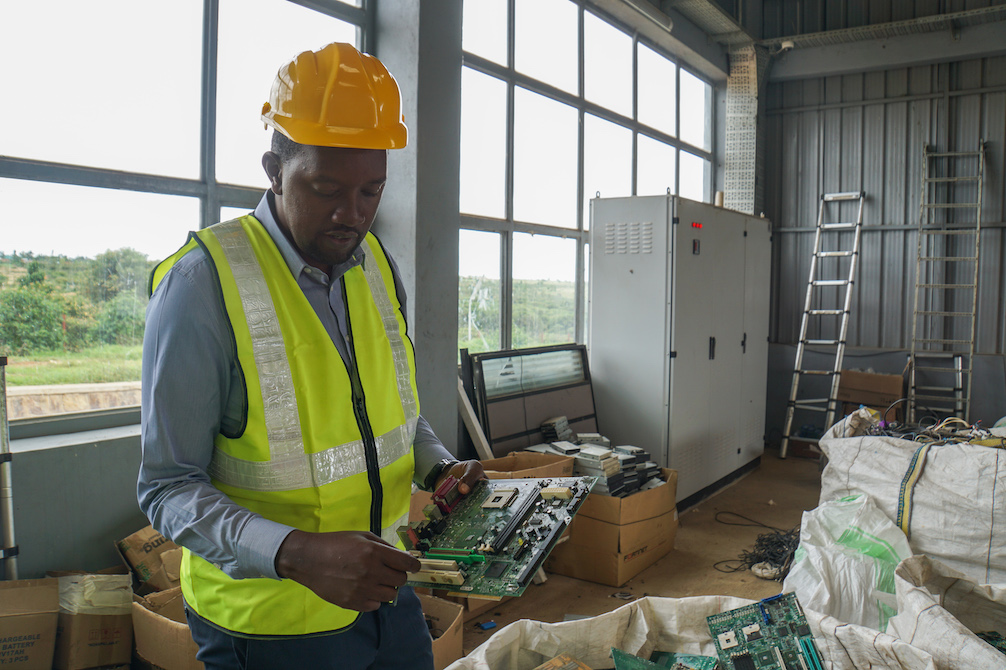
Hinckley Recycling, winner of the first round of the Challenge, recently partnered with CLASP through the Clean Lighting Coalition to procure the first mercury bulb crusher in Africa. The Nigerian facility is now able to safely dispose of fluorescents, preventing environmental contamination and negative health impacts from mercury exposure.
Charting a Course to Circularity in Thailand
“In Thailand, we cited global best practices in international CE labelling programs, like the German Blue Angel in Germany, and the Repairability Score in France, to provide a foundation for their own program,” explains CLASP’s Sara Demartini. CLASP organized an international CE labeling knowledge exchange in June with representatives from the Thai government as well as international stakeholders and the Thai industry.
“Our research coupled with the knowledge exchange led to recommendations for the Electricity Generating Authority of Thailand to be considered as they integrate CE into their program.” Though the recommendations were aimed at the Thai government, the conclusions remain relevant for any circular economy labeling scheme.
CLASP is also scoping opportunities to support Thailand introduce an end-of-life action plan for air conditioners by conducting international research and working with partners on the ground to understand current situation and challenges. The final output will be an end-of-life action plan for ACs, expected to be finalized in October.
Scaling Circularity for Renewable Energy
CLASP is also working as a subcontractor with Tetra Tech on USAID’s Scaling Up Renewable Energy (SURE) program to develop, promote and pilot CE initiatives around the world, focused on recycling renewable energy mechanisms.
“We will support the plan, design and execution of activities that will help USAID and its partner countries to better understand, implement, and promote a circular economy for renewable energy,” explains Monica Wambui who is overseeing CLASP’s contributions to the project.
CLASP looks forward to broadening the knowledge base for practical application of CE principles and will continue to advocate for appliances that will deliver the greatest benefits for people & planet.
Combating High Fuel Prices with Hybrid Heating: The Case for Swapping Air Conditioners for Heat Pumps

If all 53.8 million households that are ready to transition from oil, methane, propane and electric resistance to hybrid heat pumps make the switch, the US would cut 67 Mt CO₂ emissions and reduce national heating bill costs by $13.6 billion annually.
Every six seconds a new residential furnace or air conditioner starts up in the US, meaning homes lose out on the opportunity to decarbonize until the product is ready to be replaced – likely not until 2035-2040. This report advocates for households to replace existing air conditioning units at the end of their useful life with look-alike electric heat pumps – a super-efficient technology that can both heat and cool indoor spaces.
Two-way heat pumps offer a reliable, cost-effective and efficient alternative to traditional air conditioners, enhancing energy security and reducing fossil fuel consumption. In this proposal, households would keep their legacy heat system in place, using it to supplement the heat pump at lower temperatures. As of 2022, there are 54 million US homes that are ready for hybrid heating.
This report, expanding on findings from CLASP’s 2021 3H Hybrid Heat Homes Report, offers benefit analyses of four major heating fuel types – oil, propane, methane and electric resistance – and outlines key recommendations for how state governments and utilities can support accelerated heat pump adoption across the US.
By transitioning these households to super-efficient hybrid heating, US could reduce national heating bills by $13.6 billion and cut annual CO2 emissions by 67 Mt, the equivalent of removing 14.4 million passenger cars from the road for an entire year.
Vermont Governor Signs Clean Lighting Bill
On May 19, 2022, Vermont Governor Phil Scott signed H.500 into law, making Vermont the first state in the US to ban all four-foot linear fluorescent lamps. The bill will go into effect January 1, 2024, complemented by an existing law to phase out all screw-based compact linear fluorescents beginning February 17, 2023.
Taken together, these two policy actions will remove well over 90% of the fluorescent lighting products from the Vermont market by 1 January 2024, saving Vermont residents $167 million in reduced utility bills by 2040 by cutting 1,000 gigawatt hours of electricity.
Vermont stands as a leader in the US clean lighting transition. California and Rhode Island have produced similar bills that are awaiting approval. Learn more about efforts in California here.
Find CLASP at the International Conference on Energy Efficiency in Domestic Appliances and Lighting (EEDAL)
After more than two years, we are excited to attend in-person conferences to share insights into our global appliance energy efficiency work. From 1-3 June, team members from our Washington D.C., Nairobi, Europe and New Delhi offices will present at the International Conference on Energy Efficiency in Domestic Appliances and Lighting (EEDAL) in Toulouse, France.
Their presentations will cover the impact of television and lighting efficiency policy in India; Mepsy, a new tool to model energy and carbon reduction policies; product registration systems to support compliance of energy efficiency policies; opportunities for solar e-waste management in Sub-Saharan Africa; digital marketing campaigns for national energy labels; online energy label regulation in our changing digital markets, and more.
Find out more about their sessions below and reach out if you or one of your colleagues will be attending.
Wednesday June 1st, 2022
14:00 – 15:40
Session 1.a Policy 1
Evaluation of Television Efficiency Policy and Market Transformation in India
Kishore Kumar, CLASP India
Introducing Mepsy: The Appliance & Equipment Climate Impact Calculator
Angellah Wekongo, CLASP Kenya
Thursday June 2nd, 2022
10:45-12:25
Session 4.a Policy 4
Evaluation of Lighting Efficiency Policy and Market Transformation in India
Kishore Kumar, CLASP India
14:00-15:40
Session 5.a Policy 5
Role of Product Registration Systems in Supporting Compliance of Energy Efficiency Policies
Neha Dhingra, CLASP India
14:00-15:40
Session 5.b Appliances
Innovations for Sustainable Off-grid E-Waste Management Across Africa
Monica Wambui and Hannah Blair, CLASP Kenya
Friday June 3rd, 2022
8:30-10:10
Session 7.a Behaviour
Can digital advertising raise consumer awareness of energy efficient domestic appliances? A case study of the #KenyaEnergyLabel campaign
Hannah Blair and Angellah Wekongo, CLASP Kenya
10:45-12:25
Session 8.a Policy 6
Online Energy Labeling Regulation and Compliance in the Growing Online Market
Katriana Dubytz and Lina Kelpsaite, CLASP United States with Marie Baton (CLASP Consultant, Europe)
Abstracts
Evaluation of Television Efficiency Policy and Market Transformation in India
Kishore Kumar, CLASP India
Televisions play an essential role in the lives of millions of Indians as a source of information, entertainment and education. The television market in India has doubled over the last decade as the appliance has become commonplace across households, businesses and institutions, driven in part by increasing disposable income. The penetration of television ownership among households in the country is close to 66%, with sales of about 8.5 million units in Fiscal Year 2019-20.
Anticipating the rising sales of televisions and associated electricity demand, in 2009 India adopted an energy efficiency policy for televisions. The policy covers four technologies: cathode ray tube (CRT); liquid crystal display (LCD) with cold cathode fluorescent lamp (CCFL) backlit; LCD with light-emitting diode backlit (LCD-LED); and plasma. Since its adoption the television efficiency policy has been revised 3 times, raising minimum energy performance standards by 45% from initial levels and transforming the television market toward more efficient LED technologies. As of last year, India’s television efficiency policy had saved 20 Terawatt-hours of electricity and reduced carbon emissions by a cumulative 16.7 million tons.
This paper analyses market growth, technology evolution and market transformation resulting from the television energy efficiency policy, assesses potential policy revisions, and calculates potential efficiency gains through 2030.
Introducing Mepsy: The Appliance & Equipment Climate Impact Calculator
Angellah Wekongo, CLASP Kenya
Mepsy is CLASP’s free digital tool to model the impacts of energy and carbon reduction policies. Setting policies and achieving their benefits requires accurate, actionable data. Mepsy’s dynamic, user-friendly interface guides researchers and policymakers in identifying efficiency policy opportunities and analyzing their energy and carbon impacts. Pre-loaded with data from 162 countries, it supports analysis and prioritization for the most energy-intensive appliances and equipment— space heaters, air conditioners, refrigerators, fans, electric motors, televisions, and lighting—with more technologies being planned to be included in the tool. Efficiency standards often called MEPS (minimum energy performance standards) are a key building block in most national plans but the analytical tools used to support policy design have long been too difficult or expensive to use and customize. CLASP developed Mepsy to address these issues and make rigorous efficiency policy analysis accessible to the widest possible audience.
Mepsy accumulates appliances sales over lifetime to determine the number of appliances in use in a country, then incorporates the energy performance of locally-representative products, typical usage patterns, the climate-intensity of the national grid, and other variables to analyze the energy consumption, carbon dioxide emissions, and consumer energy costs associated with given policy scenarios.
Evaluation of Lighting Efficiency Policy and Market Transformation in India
Kishore Kumar, CLASP India
Electric lights are used by millions across India. The lighting market has increased exponentially over the years due to rapid population growth, more dwelling units, concept of smart lighting, and electrification at remote places. In Fiscal Year 2018-19, India manufactured about 1.4 billion lamps and tube-lights. The lighting segment consumes approximately 18% of total electricity use in the residential sector, resulting in 40 million tons of greenhouse gases (GHG) emissions.
Energy efficient lighting is one of the most cost-effective measures to address the impacts of growing electricity demand from the sector. Recognizing this, India adopted an energy efficiency policy for Tubular Fluorescent Lamps (TFL) in 2006. A decade later, an efficiency policy for LED bulbs was also announced to cover another new category of lamps as LEDs gaining a mainstream lighting market across industrial, commercial and residential installations. Since its adoption, 1.2 billion TFLs and 0.8 billion LED lamps have been star-labeled, thereby developing the market towards more energy-efficient lighting. India has experienced one of the most remarkable successes in market transformation for lighting as a result of efficiency policies and mass procurement exercises such as the UJALA scheme. Over the last 15 years, lighting efficiency policies have resulted in cumulative electricity savings of 18 Terawatt-hours and reduced GHG emissions by 15 million tons.
This paper analyses and discusses the trends in market growth, technology evolution, and market development as a result of lighting efficiency policies and further assess the potential for future policy revisions.
Role of Product Registration Systems in supporting compliance of energy efficiency policies
Neha Dhingra, CLASP India
Robust policy compliance and enforcement are key to realizing and safeguarding the benefits and the impact of appliance energy efficiency policies and market transformation initiatives. A product registration system is an integral tool to support policy compliance both at the national and regional level. It serves as an initial compliance gateway where manufacturers and suppliers register eligible products market entry, thereby accelerating implementation of the national and regional product efficiency policies. The product registration system also enables compliance authorities to share market intelligence on non-compliant and suspicious products, so they can strategically target their market surveillance activities and allocate resources for more effective compliance initiatives. The data captured within the tool can also be used to guide consumer and procurement purchasing decisions, and to track product trends and efficiency levels, which can inform new and future policy revisions.
A well-maintained and resourced tool can help transform the market towards more efficient appliances, build credibility of the energy efficiency program amongst consumers and provide a level playing field to the industry. The paper will cover qualitative analysis of regional product registration systems across the world with a specific focus on Economic Community of West African States (ECOWAS) regional product registration system. The paper will share key lessons and considerations for policymakers to develop a regional system ranging from political buy in, early agreements, consultative process amongst others. This paper will shed light on what goes into the development and operation of these tools; potential barriers and provide recommendations to develop and run a robust system. The comparative analysis of different systems will benefit countries developing a new product registration system or upgrading an existing one.
Innovations for Sustainable Off-grid E-Waste Management in Sub-Saharan Africa
Monica Wambui and Hannah Blair, CLASP Kenya with Rebecca Rhodes, GOGLA
Over the past decade, hundreds of millions of people in off- and weak grid environments have gained access to energy services thanks to the rapid expansion of off-grid solar products and services. Yet, the proliferation of solar e-waste poses a threat to the health and environment of the very people benefiting from off-grid energy services. Across sub-Saharan Africa, infrastructure for e-waste management is either nascent or undeveloped, leaving end-users with limited to no options. Most consumers deal with their end-of-life solar products by storing, dumping, burning or disposing of them in water bodies or latrines. As solar sales grow, a sustainable solution for e-waste management must be developed.
To stimulate innovations and collaboration for off-grid solar e-waste management, the Efficiency for Access Coalition launched the Global LEAP Awards Solar E-Waste Challenge in 2019. The Challenge selected eight companies – off-grid solar, recyclers and waste management companies from five sub-Saharan African countries- to test different aspects of e-waste collection and disposal, including recycling, repair and refurbishment, take-back and collection, awareness raising and incentives. This paper aims to share the good practice that emerged from these projects, with the spotlight on Kenya, as the largest off-grid solar market on the continent and the implementing country for half of the projects. The paper explores key interventions so that other companies can replicate the successes and avoid some of the pitfalls.
Can digital advertising raise consumer awareness of energy efficient domestic appliances? A case study of the #KenyaEnergyLabel campaign
Hannah Blair and Angellah Wekongo, CLASP Kenya
In an effort to promote high-quality, efficient domestic appliances to reduce consumers’ electricity costs, the Kenyan government developed and implemented a Kenya-specific energy label. Labeling is a critical component of effective appliance energy policy, encouraging consumers to make informed purchase choices and protecting them from poor quality, inefficient products. However, consumer awareness, understanding, and trust in an energy label are central to its success. In 2019, the Energy and Petroleum Regulatory Authority (EPRA) requested support from CLASP to design and run an energy label consumer awareness campaign.
CLASP designed and implemented the #KenyaEnergyLabel campaign focused on the refrigerator, freezer, air conditioner, and motor labels across Facebook, Twitter, Instagram, and Google Ads for 4 months. The central campaign message, More Stars, More Savings, spoke to the five-star guide that demonstrates how much energy, and correlated energy expenditures, can be saved by purchasing appliances with higher star ratings. The campaign reached more than 2,500,000 Kenyans through 80 paid ads. This paper will share insights into the digital implementation of the campaign, evaluating consumer interactions with the advertisements and social media pages. The #KenyaEnergyLabel offers a case study for governments, regulatory entities, and other energy label stakeholders, outlining a low-cost, awareness raising intervention to target consumers and encourage the uptake of energy-efficient appliances.
Online Energy Labeling Regulation and Compliance in the Growing Online Market
Katriana Dubytz and Lina Kelpsaite, CLASP United States with Juraj Krivošík and Marie Baton
Energy labels engage retailers in promoting efficiency and influence consumers to choose more efficient products. To achieve this goal, they need to be visible where the purchase choices are made. With the steady growth of e-commerce, it is becoming increasingly important to require the display of energy labels for appliances sold online. In 2015-2020, e-commerce annual growth for major appliances was estimated at 17% globally, which increased to over 25% in 2020 due to the Covid-19 pandemic. Appliance e-commerce growth is expected to continue as consumers gain confidence in online purchasing and e-commerce capabilities. Regulating and enforcing online efficiency labeling regulations is necessary to secure market transformation, emissions reduction, and energy conservation targets.
Only the European Union (EU), United States, and South Africa have mandatory online labeling requirements, while the e-commerce growth has been recorded in markets in Asia Pacific, North America, the Middle East, and Africa. The EU has one of the world’s most comprehensive energy standards and labelling programs, and since 2015, has required the display of energy labels for online appliance sales. This paper discusses the status of online regulations and enforcement mechanisms globally, including unique challenges such as regulating online retail platforms for third-party sellers. It uses the EU case study, informed by the quantitative and qualitative evaluation of labeling compliance on 72 online retail websites for 5 products in six member states to provide insights and recommendations for policy makers and experts seeking to develop and increase compliance with online labeling regulations.
Vermont Becomes First US State to Ban Common Fluorescent Tubes
Read the full press release here.
Today, the Vermont Senate adopted legislation to ban the sale of 4-foot linear fluorescent light (LFL) bulbs in 2024. Climate, environmental, and health advocates applaud the vote, noting the widespread availability of more energy-efficient, mercury-free LED alternatives.
“Vermonters no longer need to tolerate fluorescent lighting, which contains mercury, a potent neurotoxin,” said Michael Bender, Director of the Mercury Policy Project. “By passing this legislation, Vermont is making a clear statement that it will not accept outdated and toxic technologies when safer, more efficient bulbs are widely available.”
Four-foot LFL bulbs are the most common type of fluorescent bulb, covering about 90% of fluorescent installations including lighting in most offices, schools, and other indoor spaces.
According to a recent report, fluorescents release mercury whenever they are broken, posing a threat to the environment and vulnerable groups like pregnant women, infants and others with chemical sensitivities.
“Who wants to put toxic mercury lighting in their homes, day care centers, schools, offices, hospitals, or shops when they don’t have to?” said Paul Burns, Executive Director of Vermont Public Interest Research Group. “LED alternatives are available, cost-effective, are mercury free and offer better quality light than fluorescents.”
Experts say that in the majority of cases, efficient LED retrofit solutions are widely available and can save Vermont residents and businesses money by cutting electricity costs in half.
A new study from the Appliance Standards Awareness Project (ASAP) found a typical school could see $24,000 in lifetime savings from transitioning to LEDs. Further, by 2040 Vermont could see savings of $167 million in reduced utility bills thanks to just over 1,000 gigawatt hours of saved electricity due to transitioning to LED four-foot tubes.
“Based on our analysis of drop-in retrofit LED bulb prices in Vermont, we concluded that an LED bulb can pay for itself 5 times over in electricity bill savings over its lifespan,” said Brian Fadie of ASAP. “Clearly LED is the lowest cost option today.”
In response to a consumer advocate petition last fall and a subsequent review, the Vermont Agency of Natural Resources issued a determination in February that will end the sale of screw-based mercury-containing compact fluorescent lamps (CFLs). This restriction will begin on February 17, 2023, to allow Vermont retailers and distributors sufficient time to sell any existing inventories.
“We applaud the leadership of Vermont’s legislators in setting phase-out dates for the most common fluorescent lighting technologies in state”, said Ana Maria Carreño, Director at CLASP. “There is no place for mercury in lighting today, especially when LED alternatives offer better performance, coupled with climate and environmental benefits”.
Governments around the world are increasingly recognizing LEDs as the foremost lighting technology on the market today. On December 16, the European Union banned the sale of almost all mercury-containing fluorescent lamps by September 2023, and in March, 137 governments voted to phase out CFLs by 2025 through the Minamata Convention on Mercury.
# # #
For more information:
Vermont ANR determination: https://dec.vermont.gov/content/10-vsa-%C2%A77152a6-sale-mercury-containing-lamps-final-determination-notice
European Commission ban on fluorescent lamps: https://www.eceee.org/all-news/news/eu-commission-adopts-regulation-to-ban-fluorescent-lighting-by-september-2023/
About the Mercury Policy Project: Founded in 1998, the Mercury Policy Project promotes policies to eliminate mercury use and reduce mercury exposure. To learn more, visit www.mercurypolicy.org
About the Appliance Standards Awareness Project (ASAP): ASAP organizes and leads a broad-based coalition effort that works to advance, win and defend new appliance, equipment and lighting standards which deliver large energy and water savings, monetary savings and environmental benefits. To learn more, visit https://appliance-standards.org
About the Responsible Purchasing Network: RPN is an international network of buyers dedicated to socially responsible and environmentally sustainable purchasing. To learn more, visit http://www.responsiblepurchasing.org/
About VPIRG: The Vermont Public Interest Research Group is Vermont’s largest consumer and environmental advocacy organization with more than 40,000 members and supporters across the state. To learn more, visit www.vpirg.org
For more information about the transition away from mercury-based lighting, visit https://cleanlightingcoalition.org/benefits/
Replacing Residential Heating Oil with Heat Pumps in the US
Heating oil is one of the most expensive heating fuels in the US, requiring millions of households to spend more than $2,000 annually for heat. Replacing all or some oil-powered heating equipment with modern two-way heat pumps can cut greenhouse gas emissions, reduce household heating and cooling costs, and increase comfort.
This paper explores two opportunities for heat pump retrofits for oil heating equipment in the US and the costs and benefits of each based on a 2021 CLASP analysis, with updates to reflect December 2021 prices.
What Happens to the Mercury in Your Fluorescent Lamps?
All fluorescent light bulbs contain mercury, a neurotoxin listed by the World Health Organization as a top 10 chemical of major public health concern. When fragile fluorescent glass bulbs break, the mercury inside disperses in the air allowing it to enter the lungs and blood quickly, potentially resulting in long-term health impacts for any living thing exposed to it.
Do you know what to do if a fluorescent lamp breaks in your home?
There is no “safe” level of exposure to mercury. When a lamp breaks in your home or office, the clean-up recommendations detailed by the EPA are above and beyond what most people are aware of and prepared to do, including immediate evacuation, ventilating the room for several hours, shutting off central heating and cooling to avoid mercury dispersion, collecting all contaminated materials (clothing, protective gloves, rugs) in a sealed plastic container – following the state law for disposal of fluorescents.
In California, where fluorescents are still readily available, citizens and the environment are at risk of mercury exposure and the higher costs associated with using an inefficient, outdated technology. From production to recycling, mercury-containing fluorescents put Californians and others at unnecessary risk.
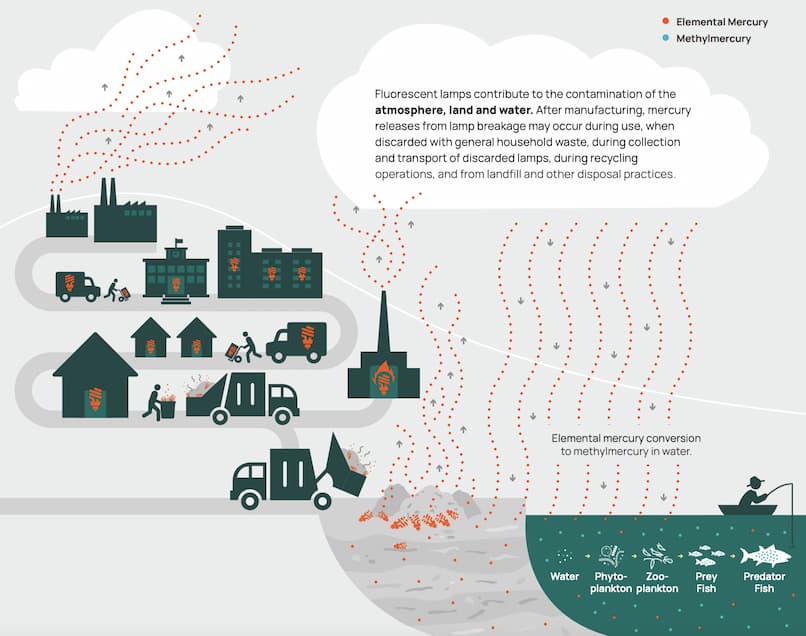
The life and death of a fluorescent lamp
Mercury released from fluorescents contaminates the atmosphere, land, and water. Breakage can occur at any point in the lamp’s lifecycle: during manufacturing or installation; when spent lamps are mixed in with general household waste; during collection, transport, processing, or recycling of discarded lamps; or when lamps are landfilled, incinerated, or illegally dumped.
When emitted to the air, mercury can be transported globally in the atmosphere for up to a year, ultimately settling on land or in water. The chemical can be washed from the soil into surface waters and accumulates up through the food chain into the fish people eat.
The impacts of mercury toxicity are not equitable
Exposure to the mercury from a broken lamp is especially dangerous for children and pregnant people. Infants and toddlers are likely to be most exposed when a lamp breaks, especially in an unventilated space, because the vapors concentrate closer to the ground where babies crawl and play. Exposure to mercury early in life not only results in a higher relative dose than in adults but also increases the risk of developmental disabilities.
Workers are exposed to mercury during manufacturing, recycling, and disposal of fluorescent lamps. An investigation of environmental contamination at a fluorescent lamp recycling facility in Madison, Wisconsin found elevated mercury levels among five of seven workers (two declined to be tested), and clinical signs of mercury toxicity, like tremors, in two of those five workers. There was reported inadequate use of personal protective equipment and mercury levels in indoor air exceeded safe thresholds. Mercury was also found in workers’ vehicles, indicating the risk of take-home exposure.
Marginalized and low-income communities are at greater risk of mercury exposure due to environmental and location-based factors. Across geographies and income levels, most pollutant emission sources consistently result in higher exposures for people of color.
Finally, fluorescent lamp drop-off locations that are part of recycling programs mandated by the state, such as at Home Depot locations or local recycling facilities, may also put workers and customers at risk because lamps easily break in drop-off bins.
Where to go from here
California has an opportunity to accelerate the transition to clean, modern, mercury-free LED lighting through the passage of AB-2208, proposed by Assemblyman Ash Kalra. The bill would effectively eliminate all compact fluorescent lamps (CFLs) lighting in the state beginning in 2024 and linear fluorescent lamps (LFLs) in 2025.
The Appliance Standards Awareness Project (ASAP) estimates that by 2030, California’s residential, commercial, and industrial consumers could save about $1 billion annually on their utility bills if they transition from fluorescent lamps to LEDs. ASAP also projects that by 2030, California could see annual electricity savings of about 5,600 gigawatt hours, preventing the release of 950,000 metric tons of CO2 per year. AB 2208 can be considered a bill that addresses two issues that California cares about 1) toxics reduction and 2) climate action.
You can help us spread the word about the bill through social media by using hashtags #YesOnAB2208 and #CAgoesLED and calling your local Californian representative to support the bill.
Now is the time for California to phase out the sale of outdated and dangerous fluorescent lighting for the safety of people and the planet.
CLASP Collaborates with Hinckley to Mitigate Mercury Pollution from Fluorescents in Nigeria
Global Collaboration for Improved E-Waste Management
In sub-Saharan Africa, most e-waste is not disposed of properly. Collected and properly recycled e-waste (not just lighting products) was 4% in Southern Africa, 1.3% in Eastern Africa and close to 0% in other regions. Nigeria is among the top five e-waste generating African countries; in 2017, data shows that Nigerians generated about 300, 000 tonnes of electronic waste.
“We have been collaborating with CLASP to grow e-waste management capacity in Nigeria for more than three years,” explains Adrian Clews, Director at Hinckley Recycling in Lagos, Nigeria. “First as Winners of the Global LEAP Awards Solar E-Waste Challenge, CLASP helped us grow capacity to recycle off-grid solar products. Now, we are turning our attention to mercury in fluorescent lamps.”
All fluorescent light bulbs contain mercury, a neurotoxin classified by the World Health Organization (WHO) as one of the top ten chemicals of public health concern. Fluorescent bulbs release mercury whenever they are broken, which can occur in homes, schools, childcare settings, offices and apartment buildings, retail stores, factories, health care and other facilities.
Hinckley Installs Nigeria’s First Fluorescent Bulb Crusher
Fluorescents require specialized handling to dispose of the mercury contents properly. But the small size and weight of bulbs makes them easy for people to mistakenly dispose of in general waste, where they break easily. When broken, bulbs release mercury into the environment and put the health of workers and the public at risk.
“Fluorescents lamps are classified as hazardous e-waste. We have been collecting and storing them due to a lack of equipment to ensure proper and safe disposal. We currently have over 10 tonnes of fluorescents at our storage,” says Clews.
In 2019, over 850,000 Nigerians were at risk of mercury poisoning. To mitigate mercury exposure and promote proper handling and processing of fluorescents at end of life, CLASP is supporting Hinckley to install a fluorescent bulb crusher.
What is a Bulb Crusher?
A bulb crusher properly destroys fluorescent lamps by isolating dust and mercury vapour. The mercury released during this process is directly absorbed by the machine’s filter, actively neutralising the mercury and preventing it from being released into the atmosphere.
“We hope that Hinckley sets an example to e-waste recyclers across the continent to build capacity and recycle hazardous fluorescent bulbs,” says Nyamolo Abagi, Manager at CLASP. “Proper management of fluorescents has the potential to protect the environment and human health from mercury poisoning.”
Farewell to Fluorescent Lighting: How a Phaseout Can Cut Mercury Pollution, Protect the Climate, and Save Money
Mercury-free LED replacements for linear and compact fluorescent bulbs are widely available in the US and provide the same or better lighting, longer product life, and much lower total cost than fluorescents. This study finds that drop-in LED replacement lamps are available for all common linear fluorescent tubes, pin-based compact fluorescent lamps, and specialty applications. Policies to accelerate the phaseout of fluorescent lighting and a full transition to LED lighting would eliminate a significant source of mercury pollution and its threat to human health and the environment. Government policies to limit mercury have often exempted fluorescent lighting—the most common use of mercury in homes and commercial buildings—because ready-to-go, mercury-free substitutes did not exist. Our findings show that such exemptions for fluorescent lighting are no longer necessary.