
Off- and Weak-Grid Appliance Market: Uganda
Uganda’s electrification rate is growing rapidly, but 59% of people still do not have access to electricity. This large off- and weak-grid population, a sharp increase in mobile money operations, and the established markets for component-based solar energy systems all provide a strong foundation for appliance sales in Uganda.
While the solar market in Uganda is growing fast, ownership of appliances such as TVs and refrigerators remain extremely low. There is also insufficient data about off-grid appropriate appliances that can help manufacturers, policymakers, distributors, mini-grid operators, investors, and other market actors to make informed decisions and identify high quality, efficient products sold in their region.
To help address this challenge, Efficiency for Access has worked to gather data on the availability of off-grid appropriate appliances in key countries, including Uganda. The Off- and Weak-Grid Appliance Market Country Profile for Uganda analyses four types of off-grid appliances surveyed in 2018 and 2020—TVs, fans, refrigerators and SWPs.
The profile explores the overall market landscape in Uganda, the common power type, size, price and warranty of off-grid appliances sold in retail markets, and other findings. The market insights can help inform sector stakeholders, such as development programmes, distributors, manufacturers, mini-grid developers, policymakers, and others, on the state of the market. In addition, we hope that the publication can help its readers identify opportunities to encourage higher market penetration for high-quality off- and weak-grid appropriate appliances.
Download the Off- and Weak-Grid Appliance Market: Uganda report here.
About Efficiency for Access
Efficiency for Access is a global coalition working to promote renewable and energy efficient appliances to deliver clean energy to the world’s poorest people. It is coordinated jointly by CLASP and the UK’s Energy Saving Trust.
Appliance Efficiency: An Underutilized Opportunity on the Path to Net-Zero Emissions
This article uses an up-to-date analysis from CLASP’s new tool, Mepsy, to showcase the value of appliance efficiency policies and estimates the avoided CO₂ emissions that could be achieved if stringent minimum energy performance standards (MEPS) were adopted worldwide in 2021.
Energy efficiency plays a critical role in the race to a net-zero carbon economy. Investments in efficiency can reduce total demand for electricity, alleviate strain on the grid during periods of peak demand, and enable the early decommissioning of coal and other fossil-fuel power plants. Together these benefits can lower emissions while saving customers money on their electric bills. Efficiency improvements can contribute about half of the reduction in energy-related greenhouse gas emissions required over the next two decades to put the world on a path to meeting international energy and climate goals.
Energy efficiency is often touted as the “first fuel” of a sustainable energy system, but progress has often lagged behind development and investment in the power sector. According to the IEA, urgent action is needed: global efficiency improvements have been declining since 2015. Around the world, governments have incorporated energy efficiency measures into their energy and climate policies. In 2017, it was estimated that 68% of global energy use was not covered by efficiency codes or standards, still many opportunities remain untapped.
Of this untapped potential, appliance efficiency policies remain a bright spot for technical efficiency gains and climate action. 53 countries mention building energy efficiency in their Nationally-Determined Contributions (NDCs) to the Paris Climate Agreement. Of these, a smaller portion directly mention appliance standards. As countries continue to update and revise their NDCs, policies like minimum energy performance standards (MEPS), which aim to eliminate inefficient products, could have a large impact on global emissions. A forthcoming report from the IEA Technology Collaboration Programme on Energy Efficient End-Use Equipment (4E TCP) assesses the energy and climate achievements of standards and labeling programs in the commercial, residential and industrial sectors. It finds the electricity savings recorded from mature programs with the largest product coverage are encompass roughly 15% of total economy-wide electricity consumption.
Mepsy: CLASP’s Appliance & Equipment Impact Calculator
In February 2021, CLASP launched Mepsy, the appliance and equipment climate impact calculator. Mepsy is designed to help practitioners compare and prioritize appliance and equipment policy options. The free online tool displays the energy and climate impacts of appliance efficiency standards for key energy-using products and supports national, regional, and global analysis. Mepsy includes data for 162 countries and six products, and will soon be extended to include 10 product types, covering more than 75% of global residential and commercial energy use and more than 50% of global electricity use by industry.
Moving Beyond Business-As-Usual
Mepsy clearly communicates the value of appliance energy efficiency. In Figure 1 we plot annual emissions, energy consumption, and the total stock of appliances for five product classes (air conditioning, ceiling & portable fans, refrigerator-freezers, space heating, and televisions) by region (according to the World Bank’s regional classifications). The animation depicts changes in these variables over a 2005 to 2030 time frame under a business-as-usual scenario. The x-axis shows total energy consumption in terawatt-hours (TWh) on a logarithmic scale, and the y-axis shows CO₂ emissions in metric megatons (Mt) on a logarithmic scale. The area of each data point (shown as a bubble) corresponds to the total number of units in each region for that year.
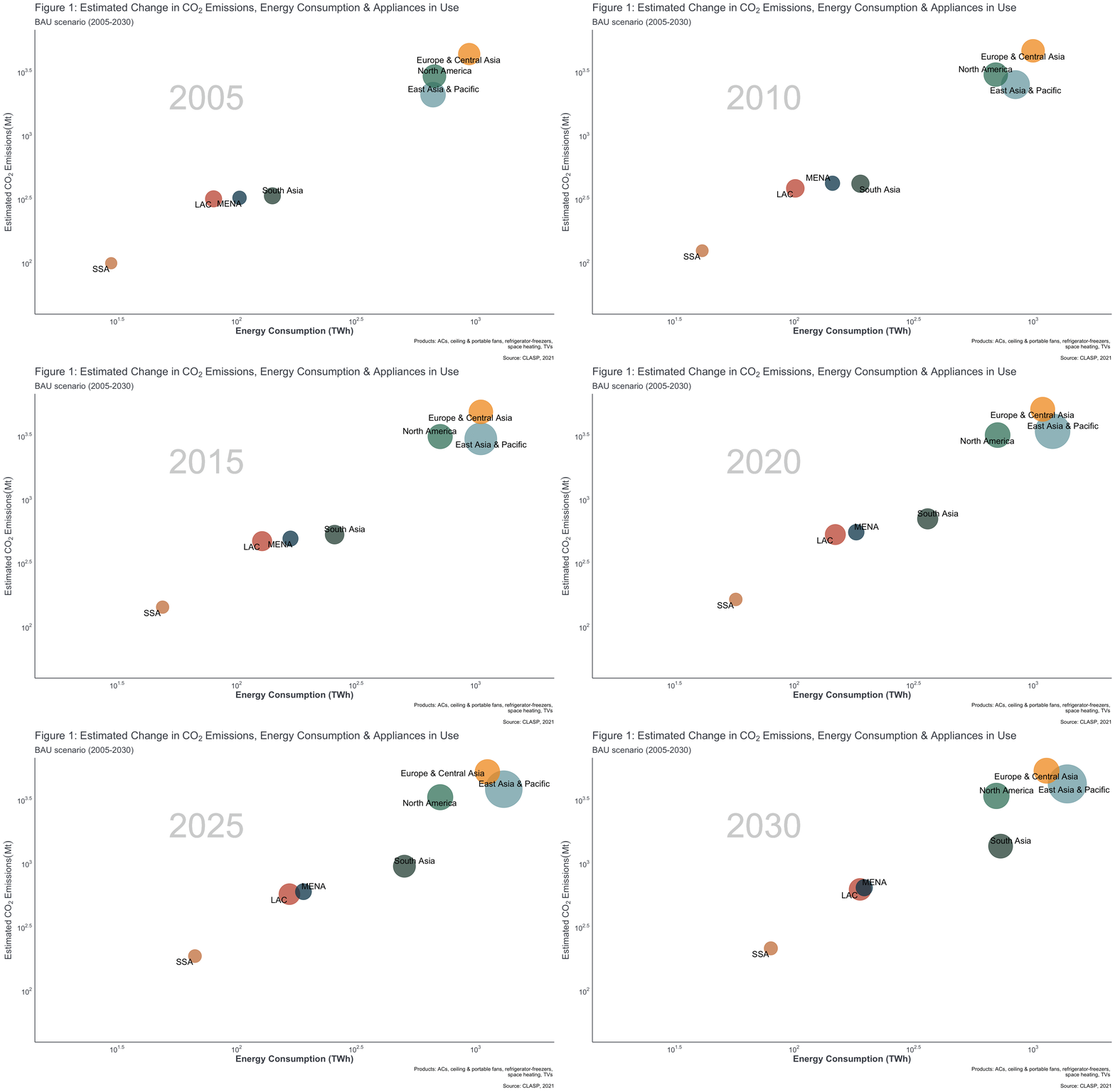
The data reveal three important trends:
- Appliance markets in North America, Europe, Central Asia, and parts of East Asia are saturated, but efficiency opportunities remain as relevant as ever. The total number of appliance units in use grows only slightly from 2005 to 2030, suggesting that markets in North America and Europe & Central Asia are saturated. The total number of appliances in use in East Asia & the Pacific is projected to continue to grow through 2030, largely due to sustained economic growth in China. Mepsy data show the number of appliances in use for other countries in the region (e.g., Japan and South Korea) has remained relatively constant and similar to trends in Europe, Central Asia, and North America. A typical household in a high-income country owns between 15 and 40 different appliances with the market penetration of some appliances, like refrigerators and TVs, estimated at 100%. High levels of appliance ownership correlate with high energy consumption. Household energy consumption in the United States and Europe is 5-10 times greater than in India and 10-20 times greater than in Nigeria. High market penetration of appliances, coupled with high energy consumption creates significant opportunities for MEPS to deliver large climate impacts.
- South Asia and Latin America and the Caribbean (LAC) are high-value opportunities for timely efficiency policies. Penetration of appliances in middle-income countries varies by region and appliance type. In India, residential air conditioner ownership in cities exceeds 30%, while nationwide penetration is estimated at 4%. In Brazil, appliance sales and energy consumption are predicted to increase as these economies grow and disposable incomes rise. In the absence of strong efficiency policies and a push for low-carbon energy generation, this transition will lead to higher emissions. By adopting standards now, nations could alleviate stress on the electrical grid, while changing the trajectory of household energy consumption and CO₂
- Sub-Saharan Africa (SSA) has the potential to “leapfrog” inefficient and outdated technologies. Compared to other regions, energy consumption and CO₂ emissions from appliances in Sub-Saharan Africa are relatively low, largely due to low rates of electricity access and appliance ownership in rural areas. 580 million Africans lack access to electricity and rural households typically own between 2 to 5 appliances. Ensuring a balance of policies that expand energy access and increase energy efficiency will be critical to ensuring all households can harness the benefits of clean, affordable, and reliable power. For example, improving the efficiency of off-grid appliances enables households frees up additional capacity to run additional appliances on a solar home system. Quality standards can further help to ensure the benefits of energy access translate into social and economic gains by advancing consumer protection and facilitating the growth of clean energy.
Quantifying the Potential Climate Impacts
If minimum energy performance standards for air conditioning, ceiling and portable fans, refrigerator-freezers, space heating, and televisions are adopted globally in 2021, we could cumulatively avoid 3,184 Mt of CO₂ emissions from 2021 to 2030 (Figure 2). These cumulative savings are equivalent to the emissions produced by 803 coal plants in one year. Further, these gains could be achieved without requiring customers to radically alter their behavior, e.g., Mepsy does not include efforts that nudge consumers to use their appliances and equipment less. The largest reductions are predicted to occur in high-emitting, high-income regions (e.g., North America) and middle-income countries with growing economies and populations (e.g., South Asia and Latin America and the Caribbean).
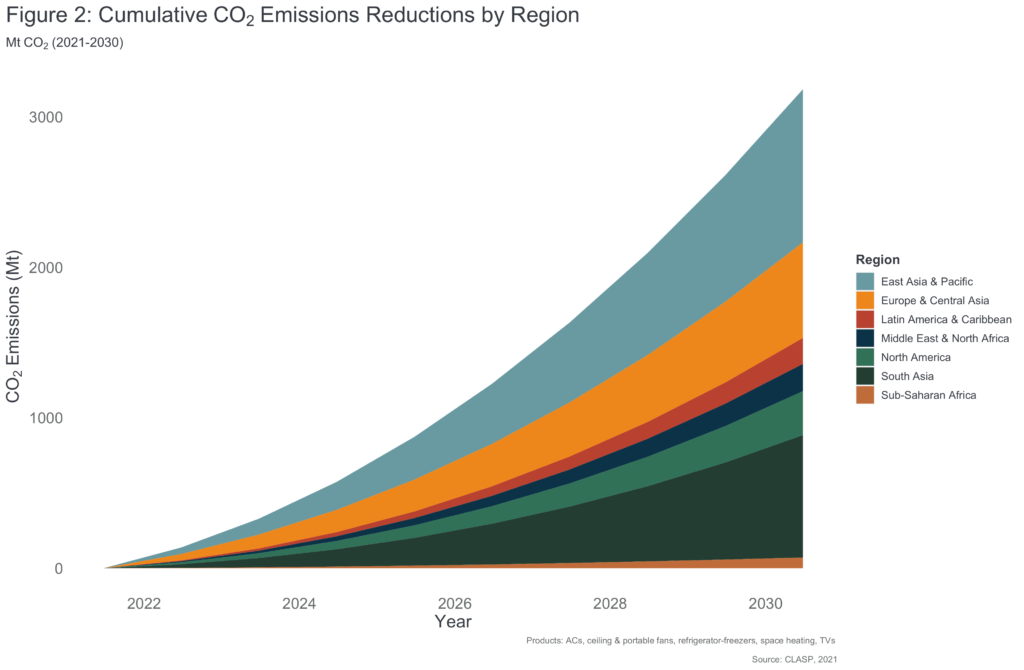
Figure 3 further illustrates the emissions that could be avoided with the widespread adoption of MEPS worldwide. It depicts the estimated CO₂ emissions from five appliance classes under Mepsy’s BAU and efficient policies scenarios. 2030 CO₂ emissions from the BAU scenario are shown in orange, while emissions from the efficient policies scenario are shown in blue. The reduction in emissions (expressed as a percentage) from the BAU scenario is shown on the right.
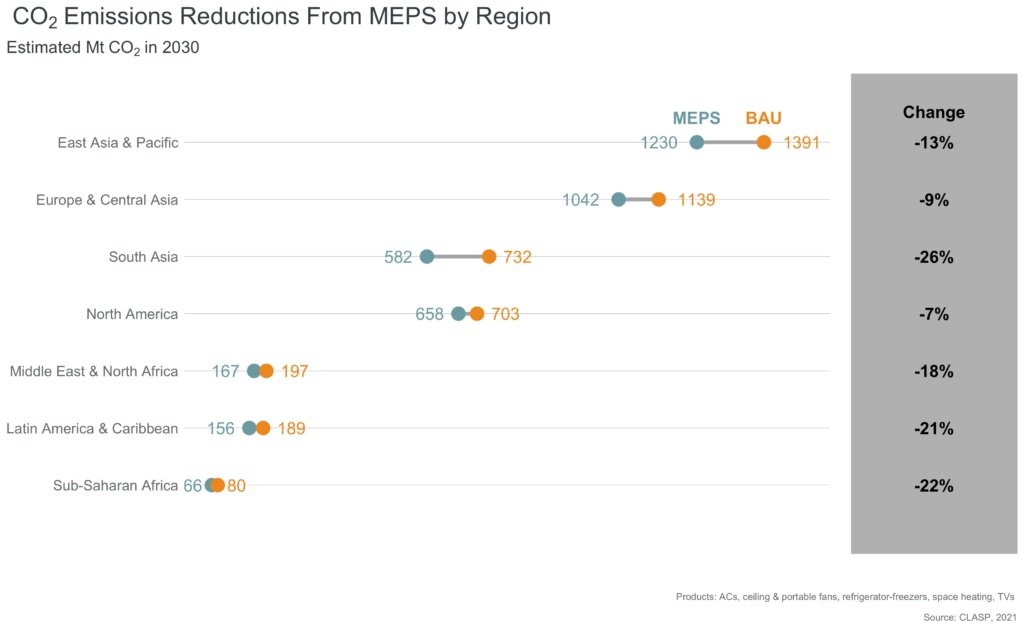
Mepsy estimates that CO₂ emissions from appliances in North America and parts of Europe and East Asia will decline or slow in both the BAU and MEPS scenario. This reflects minimal changes in electricity consumption (i.e., terawatt-hours consumed vary little from year to year) and a declining grid emissions factor due to decarbonization in the power sector. As inefficient products reach their end of life and more efficient products take their place, both the energy consumed by these products and the CO₂ emissions associated with that consumption will decrease. While high energy consumption is projected to persist in North America, we estimate that 293 Mt in emissions savings (7% reduction from BAU scenario) can be achieved by adopting stringent MEPS. Countries in Europe and Central Asia can similarly reduce their collective emissions by 636 Mt by 2030 (a 9% reduction from BAU).
Emissions from appliance use in Latin America and the Caribbean and South Asia are all projected to rise through 2030. By adopting efficient policies now governments can significantly lower their CO₂ emissions by 2030. We estimate that if MEPS were adopted this year, emissions in Latin America and the Caribbean could cut 173 Mt and South Asia 813 Mt, a 21% and 26% decrease from BAU, respectively. These cumulative savings translate to the equivalent of taking over 214 million cars off of the road for one year or the emissions from nearly 250 coal power plants in one year.
Finally, if countries in Sub-Saharan Africa were to adopt MEPS for air conditioners, ceiling & portable fans, refrigerator-freezers, space heating, and televisions, they could prevent 71 Mt of CO₂ emissions between 2021 and 2030. While this number is small in comparison to other regions, adoption of MEPS would place the region on a sustainable trajectory by ensuring efficiency policies are in place as the region develops and more people are able to afford appliances.
Conclusion
The need to address the global climate crisis is becoming increasingly more urgent. New analysis of countries’ updated NDCs finds they must “re-double” their climate efforts to achieve Paris Agreement’s goal of limiting global temperature rise by 2°C, ideally 1.5°C, by the end of the century. As we look to COP26 later this year, appliance MEPS stand to play a large role in the global effort to increase ambition on collective climate contributions and turn far-away targets into immediate action.
About This Analysis
This analysis was performed using the pre-loaded data freely available in Mepsy, with a linear projection of grid emission factors and transmission and distribution losses (between the data in Mepsy, applicable today, and historical data from 2000 and 2002 from CLASP’s Policy and Analysis Modeling System (PAMS). Mepsy uses a bottom-up accounting method that accumulates unit sales and retirements to estimate the number of appliances in use in each country (the stock) and multiplies it by the average unit energy consumption (UEC) under two different policy scenarios: business-as-usual and efficiency policies (CLASP’s recommended worldwide MEPS, often harmonized with global initiatives such as UN Environment Programme’s United for Efficiency). CLASP regularly updates Mepsy’s underlying data to reflect the latest product shipments and efficiency.
Mepsy also enables users to run their own analysis for a given date range using their own shipment (sales), equipment (e.g., lifetime, price, energy consumption), economic (consumer discount rate), and energy sector data (e.g., electricity price, transmission losses, etc.). These custom features allow policymakers, researchers, and others to generate more precise estimates for a specific policy in a specific country. To leverage these features, please select “Run Detailed Analysis” or read our Quick Start Guide.
If you have any questions about Mepsy or its underlying methodology and assumptions, please contact us. CLASP offers custom workshops for practitioners, to request a training please send us an email with your name, organization name, organization size, and a short description of the product classes and/or policies of interest.
Uses and Impacts of Solar Water Pumps
CLASP, through Efficiency for Access, worked with 60 Decibels to publish the first iteration of this report in May 2019. Since then, we have followed up with a majority of the initial 375 respondents and contacted an additional 818 customers in Kenya, Rwanda, Senegal, Tanzania, Uganda and Zambia through baseline and follow up interviews.
This analysis examines the differences between the data collected before 2020 for the first report and the data collected since January 2020 to provide more insight into any changes. The study provides compelling evidence on SWPs’ contribution to economic growth and improved livelihoods. However, users also reported challenges with the technology, including a need for wider inclusivity, improved affordability and the need for design solutions.
The customers interviewed for this report purchased their SWPs as part of the Global LEAP Results-based Financing facility.
Download the Uses and Impacts of Solar Water Pumps report here.
About Efficiency for Access
Efficiency for Access is a global coalition working to promote renewable and energy efficient appliances to deliver clean energy to the world’s poorest people. It is coordinated jointly by CLASP and the UK’s Energy Saving Trust.
Nigeria Off-Grid Appliance Market
With 220 million people, Nigeria has the largest population and one of the biggest economies in Africa. Nigeria also has one of the greatest energy access challenges. Almost half the population does not have access to electricity, and those that do face frequent power outages. This large weak- and off-grid population and other contributing factors means Nigeria could become one of the continent’s largest off-grid appliance markets. The potential value of the off-grid appliance market in Nigeria was USD$537 million in 2018, and is expected to almost double by 2030 to USD$929 million.
Insufficient data about off-grid appropriate appliances makes it difficult for manufacturers, policymakers, distributors, mini-grid operators, investors and other market actors to make informed decisions and identify high quality, efficient products. To help address this challenge, Efficiency for Access has worked to gather data on the availability of off-grid appropriate appliances in key countries.
Since 2018, Efficiency for Access has been conducting market scoping surveys in 10 countries. The Off- and Weak-Grid Appliance Market Country Profile for Nigeria explores the overall market landscape in Nigeria, the common power type, size, price, and warranty of off-grid appliances sold in retail markets, and other findings relevant to sector stakeholders working in Nigeria. The profile summarises data collected through market scoping surveys conducted in local retail shops, testing results of products sampled from the market in Nigeria, and interviews with interviewed a range of stakeholders. For the first time, the Nigeria Country Profile also analyzes the types of plugs and connectors sold with products, a key consideration for interoperability.
Findings from market surveys and interviews suggest that the off-grid appliance market in Nigeria is relatively underdeveloped, but growing. Currently, high upfront costs prevent SHSs from reaching Nigerian consumers at great scale, but field consultants shared that there is a shift in perception happening. SHSs and off-grid appliances are starting to be recognized as cost-effective alternatives to generators and unreliable grid supply. The field surveys also found that although most appliances sold in market are AC, several local solar brands are selling highly efficient products. Raising consumer awareness about the long-term benefits of solar technologies, encouraging appropriate financial mechanisms and renewing policy focus to create opportunities to help users switch from generators to SHSs will help the market reach its potential.
Off- and Weak-Grid Appliance Market: Nigeria
Almost half of Nigerian’s do not have access to electricity, and those that do face frequent power outages. This large off- and weak-grid population and other contributing factors make Nigeria a promising market for future off-grid appliance sales with the potential to become the continent’s largest off-grid appliance market.
Insufficient data about off-grid appropriate appliances makes it difficult for manufacturers, policymakers, distributors, mini-grid operators, investors, and other market actors to make informed decisions and identify high quality, efficient products sold in their region.
To help address this challenge, Efficiency for Access has worked to gather data on the availability of off-grid appropriate appliances in key countries, including Nigeria. The Off- and Weak-Grid Appliance Market Country Profile for Nigeria analyses four types of off-grid appliances surveyed in 2018 and 2020—TVs, fans, refrigerators and SWPs. In 2020, Efficiency for Access expanded the survey to collect data on other off-grid appliances found in the market, and to document the type of connectors or plugs integrated into or sold with the product. The country profile explores the overall market landscape in Nigeria, the common power type, size, price, and warranty of off-grid appliances sold in retail markets, and other findings relevant to sector stakeholders working in Nigeria.
Download the Off- and Weak-Grid Appliance Market: Nigeria here.
About Efficiency for Access
Efficiency for Access is a global coalition working to promote renewable and energy efficient appliances to deliver clean energy to the world’s poorest people. It is coordinated jointly by CLASP and the UK’s Energy Saving Trust.
Proposed Heat Pump Incentive Program Could Rapidly Transform the US Residential Market and Deliver $27 Billion in Consumer Energy Bill Savings
A new proposal from CLASP, supported by researchers at HVAC 2.0 and Harvard University, presents a low-barrier, least-cost policy package to rapidly deploy efficient space heating and cooling solutions in the United States. The study finds that a temporary Federal subsidy for residential electric heat pumps could save Americans more than $27 billion on their energy bills and deliver $80 billion in additional societal benefits over a ten-year period.
Residential heating and cooling account for 51% of household energy use and 40% of household energy bills in the US. Inefficient gas and electric resistance furnaces and air conditioners (ACs) account for more than 80% of all products currently in use. Heat pumps, which can provide both cooling and heating services, are up to four times more efficient than traditional equipment and have the potential to save consumers money on their energy bills and reduce greenhouse gas emissions.
Heat pumps are a critical technology on the path to net-zero emissions, but their deployment to date has been slow. Without intervention, heat pumps are unlikely to achieve 100% of the US market share on their own. Three million heat pumps are sold each year, compared to more than five million conventional unitary ACs. This imbalance can “lock-in” outdated infrastructure for 15 years or more.
The proposed ‘3H’ Hybrid Heat Homes program outlines an incentive program for residential electric heat pumps. While the program does not aim to achieve full heating electrification, it offers a pragmatic and cost-effective pathway to convert the entire US supply chain of unitary ACs into heat pumps. It aims to “raise the floor” for electric space heating in the residential HVAC market, delivering 45 million new installations over 10 years and paving the way for more ambitious decarbonization efforts.
The 3H program centers on a comprehensive Federal subsidy beginning in 2022 with a regulatory backstop to take effect in 2029. By ensuring that heat pumps are available and installed at the time of every future AC replacement, the market share of heat pumps in the US can increase from 10% to 44% by 2032.
Program benefits are substantial and will touch every corner of the country. On average, participating household energy bills will decrease by $169 each year, with cumulative energy bill savings totaling $27 billion over a 10-year period. Additional program benefits, estimated at $80 billion over the same 10-year period, include reduced climate impacts, cleaner air, and healthier communities. In 2032 alone, greenhouse gas emissions will be reduced by up to 49 million tons of CO₂e. Cleaner air will result in 888 fewer premature deaths, 920 fewer emergency room visits, 1,029 fewer nonfatal heart attacks, 24,476 fewer asthma exacerbations, 36,953 fewer respiratory and acute bronchitis incidents, 571,034 fewer minor restricted activity days, and 97,906 fewer lost workdays.
3H Hybrid Heat Homes: An Incentive Program to Electrify Space Heating and Reduce Energy Bills in American Homes

A temporary incentive program for residential electric heat pumps could save Americans more than $27 billion on their energy bills and deliver $80 billion in additional societal benefits over a ten-year period.
Heat pumps are a critical technology on the path to net-zero emissions, but their deployment to date has been slow. This document proposes a low-barrier, least-cost policy package to rapidly deploy efficient space heating and cooling solutions in the United States. It aims to “raise the floor” for electric space heating in the residential HVAC market, delivering 45 million new installations over 10 years and paving the way for more ambitious decarbonization efforts.
Residential heating and cooling account for 51% of household energy use and 40% of household energy bills in the US. Inefficient gas and electric resistance furnaces and air conditioners (ACs) account for more than 80% of all products currently in use. Heat pumps, which can provide both cooling and heating services, are up to four times more efficient than traditional equipment and have the potential to save consumers money on their energy bills and reduce greenhouse gas emissions.
The 3H Hybrid Heat Homes program centers on a comprehensive Federal subsidy beginning in 2022 with a regulatory backstop to take effect in 2029. By ensuring that heat pumps are available and installed at the time of every future AC replacement, the market share of heat pumps in the US can increase from 10% to 44% by 2032. Over a ten-year period, the program will save Americans more than $27 billion on their energy bills and deliver $80 billion in additional societal benefits.
Webinar Materials | How to Evaluate and Prioritize Efficiency Policies with Mepsy
Improving the energy efficiency of household appliances and commercial equipment is a fast, cost-effective, and reliable means of mitigating carbon emissions. Efficiency standards are a key building block in most national plans to meet the climate challenge, but the analytical tools used to support policy design have long been too difficult or expensive to use and customize.
In February, CLASP launched Mepsy, a new planning tool designed to help policymakers, researchers, and others assess, compare, and prioritize energy efficiency policy scenarios. Mepsy displays the energy and climate impacts of appliance efficiency standards for key energy-using products, and supports national, regional, and global analysis.
These webinar resources introduce viewers to Mepsy, its underlying data, methodology, and use cases, with a real-world example of how CLASP is deploying the tool in Botswana. Users will understand how they can use Mepsy to understand the climate and energy impacts of efficiency standards, as well as how they can model specific policy scenarios using their own data.
A transcript of the audience Q&A session is also available.
Unraveling Urban Household Energy Use Patterns in India
CLASP, in collaboration with Environmental Design Solutions, published a research paper in the ACEEE 2020 Summer Study on Energy Efficiency in Buildings. The paper reviews first-of-its-kind nationwide research, carried out in 2018, that encompassed an urban residential end-use survey of 5,000 households and real-time appliance energy use monitoring of 200 households. The data were collected from 13 cities spanning different climate zones, socio-economic groups, and other demographic patterns. The study’s objective was to establish appliance ownership and usage patterns for urban households and develop a framework for data collection and analysis on energy end-use.
The paper provides insights into end-user behavior related to appliance purchase, usage, and disposal. The data is featured in the National Energy End-Use Monitoring Dashboard, which presents information on energy use, peak demand and other performance metrics across time that may be customized based on geography, climate and household type, to inform building and appliance energy efficiency policy development.
Introducing Mepsy, CLASP’s Appliance & Equipment Climate Impact Calculator
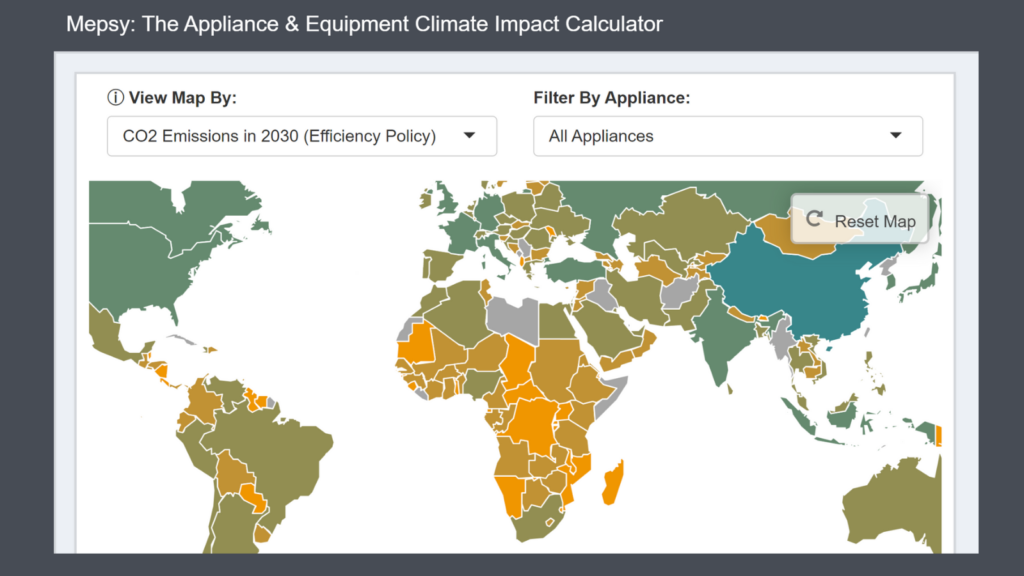
This week CLASP introduces Mepsy, a new planning tool designed to help policymakers, researchers, and others assess the climate and energy impacts of appliance energy efficiency policy scenarios.
Increasing the energy efficiency of household appliances and commercial equipment is a fast, cost-effective, and reliable means of mitigating carbon emissions. Efficiency standards (often called MEPS, for minimum energy performance standards) are a key building block in most national plans to meet the climate challenge, but the analytical tools used to support policy design have long been too difficult or expensive to use and customize.
CLASP developed Mepsy to address these issues and make rigorous efficiency policy analysis accessible to the widest possible audience. Mepsy is designed to help practitioners compare and prioritize among appliance and equipment policy options. The free online tool displays the energy and climate impacts of appliance efficiency standards for key energy-using products, and supports national, regional, and global analysis.
The model includes data for 162 countries and six of the top energy-using products – air conditioners, space heating equipment, refrigerator-freezers, electric motors, televisions, and ceiling and portable fans. Four more products – lighting, refrigerated display cases, residential hot water heaters, and distribution transformers – will be incorporated later this year. Together, these 10 appliances cover more than 75% of global residential and commercial energy use and more than 50% of global electricity use by industry.
“We have been using Mepsy to analyze global CO₂ reduction potentials since the Fall, and I’m excited to share this great new resource with our community. By providing user-friendly access to comprehensive, up-to-date information and a world-class calculation engine, Mepsy can help policymakers and analysts more effectively advance policies that benefit consumers and the climate,” said CLASP Chief Research Officer Steve Pantano.
The market and product efficiency data that support Mepsy analysis will be regularly updated to ensure that policy analysts are always working with the best information. Additional features and functions will be rolled out in the near future, including the capability to model the climate benefits of low-GWP refrigerants in cooling appliances.
Mepsy in Use
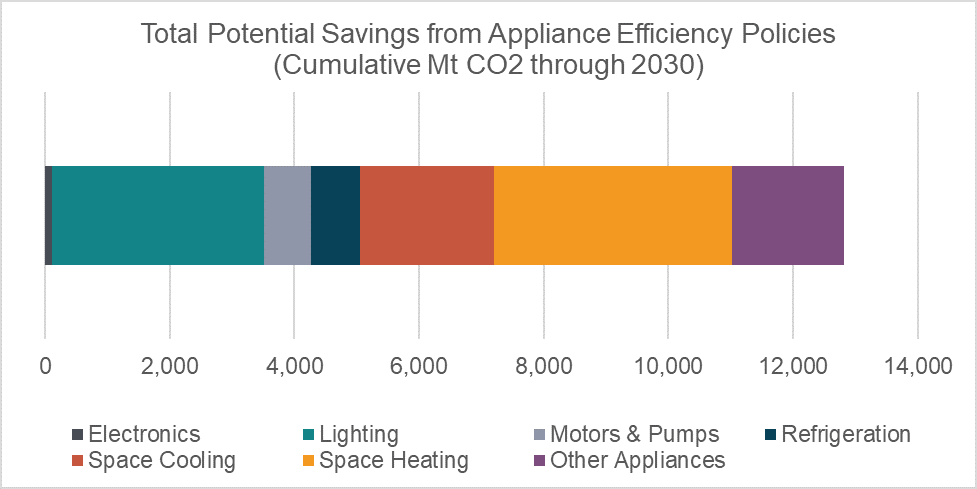
In addition to supporting online analysis and data visualization, Mepsy’s data download feature lets users extend their analysis offline. We used Mepsy in this way to evaluate the global CO₂ mitigation potential of a “best available technology” policy scenario for seven unique appliance types, demonstrating a breadth and depth of analysis that would not be possible with other tools. After modeling our target scenario we used the “data download” feature within Mepsy, then incorporated sector estimates from the International Energy Agency (IEA) Energy Technology Perspectives 2017 report to reflect the contribution from “other appliances” not yet included in Mepsy.
The result, shown in the graph below, is an estimate of the total “addressable market” for appliance energy efficiency policies for climate change mitigation.
How it Works
Mepsy calculates product energy use according to a “bottom-up” accounting approach. The model uses appliance shipments and retirements to determine the number of appliances in use in a country, then incorporates the energy performance of locally-representative products, typical usage patterns, the climate-intensity of the national grid, and other variables to analyze the electricity use, carbon dioxide emissions, and consumer energy costs associated with a given policy scenario.
Some of the challenges to appliance energy use modeling include that efficiency data are often proprietary, and information about ownership in certain countries is not available at all. Mepsy addresses these challenges by using appliance shipment data from reputable market research firms, and filling gaps in country-level data with evidence from similar markets. Information about product lifetimes, efficiency, capacity, and usage data are derived from a range of published sources. CLASP validated the model results against published estimates by United for Efficiency, the IEA, and Deutsche Gesselschaft für Internationale Zusammenarbeit (GIZ).
In publishing Mepsy as a freely available online tool, CLASP aims to make appliance efficiency policy more accessible and impactful. We welcome questions, comments and suggestions at mepsy@clasp.ngo, and look forward to sharing updates about new features and functions in the near future.
Click here to access Mepsy from the CLASP homepage. For general information about the model, see this Introduction to Mepsy. Details on the data and analytical approach are address in this guide to the Mepsy Methodology & Assumptions. User instructions are included in this Quick-Start Guide. Learn more about CLASP’s analytical tools on our website.