Brazil’s Rapid AC Overhaul Offers a Blueprint for Sustainable Cooling
The country phased out outdated ACs at record speed, cutting consumer costs, energy demand, and emissions.

Reading time: 3:30
With a recent effort to improve its air conditioner efficiency policies, Brazil proved that smart planning and thoughtful partnerships can help countries fast-track climate change mitigation and improve social equity.
As climate change continues to drive temperatures higher, threatening health and livelihoods, air conditioners remain out of reach for millions of people around the world. In Latin America and the Caribbean, only 15% of households in the warmest areas own ACs.
Increasing access to air conditioners is part of the solution. But to avoid further worsening climate change, it’s critical for these ACs to be energy efficient and use climate-friendly refrigerants. This is because inefficient units drive up energy demand and increase planet-warming emissions, while some refrigerants are potent greenhouse gases thousands of times more harmful than CO2.
Energy efficiency can also help address one of the main barriers that’s preventing many people from owning an air conditioner: affordability. The high upfront cost of these appliances puts them out of reach for many households. Additionally, inefficient models can be expensive to run, driving up electricity bills. Improving energy efficiency can help lower operating costs and make cooling more affordable overall.
As demand for ACs is rising in Latin America and the Caribbean, putting the right policies in place will protect both people and planet. Brazil’s example shows how it’s done.
The policies that transformed Brazil’s market
Today, Brazil has the most efficient room air conditioner market in Latin America and the Caribbean. More than half of units sold there meet or exceed leading global efficiency standards.
Just a few years ago, the picture looked very different. Brazil’s appliance efficiency labeling program, first introduced in 1984, is one of the oldest in the world. But until recently, it offered little real guidance to consumers looking for ACs, since it had only two categories and labeled around 70% of all air conditioners as “efficient.”
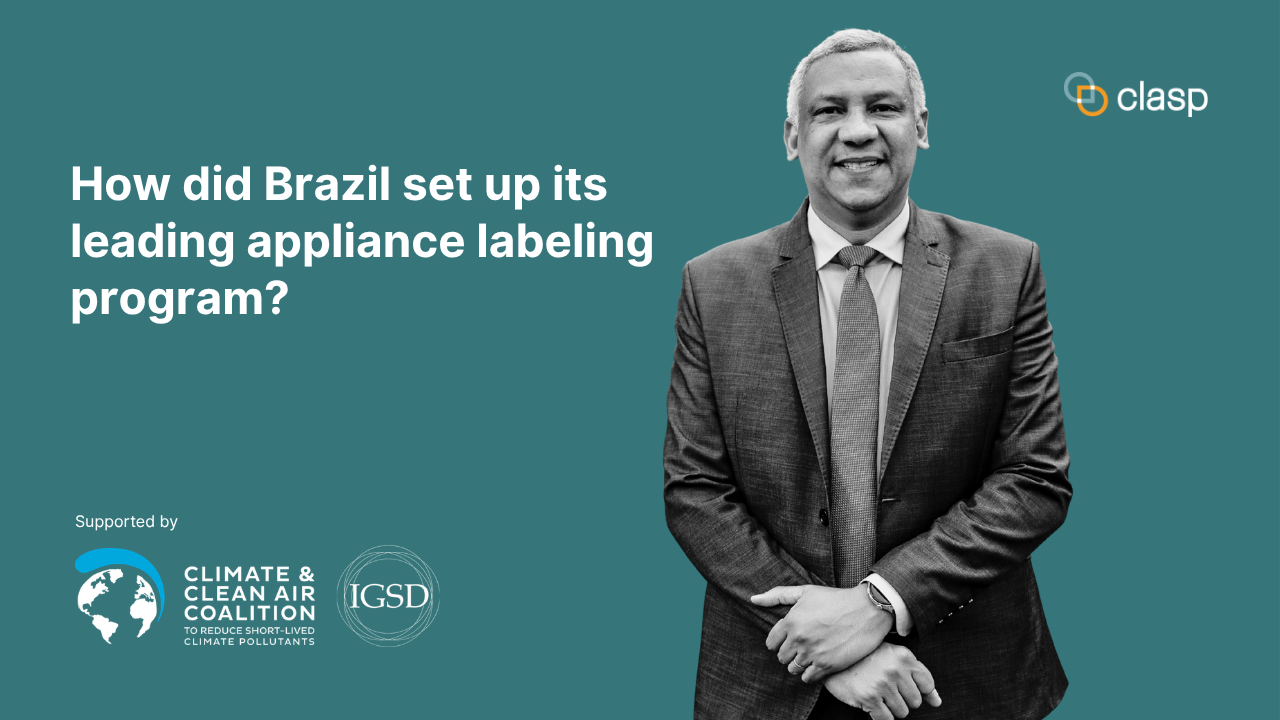
That changed in 2020, when INMETRO, the federal agency responsible for appliance labeling, introduced a more rigorous classification system with a wider range of performance tiers.
Today, more than 60% of consumers report relying on appliance labels to guide their purchasing decisions. What’s more, 85% of the ACs sold in Brazil use inverter technology, which is more efficient than non-inverter alternatives.
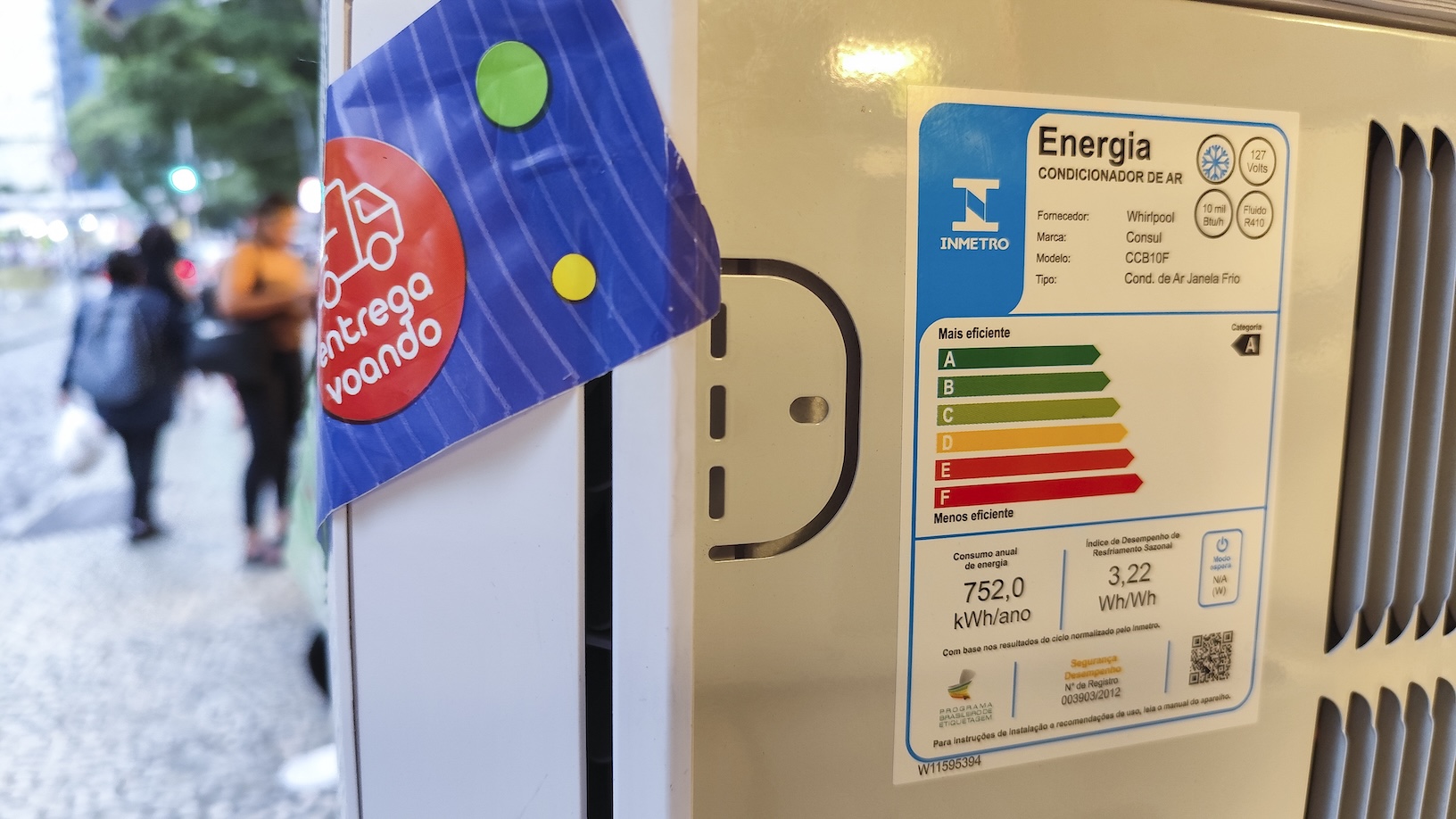
Energy label at an appliance store in Rio de Janeiro, Brazil.
CLASP
“This shows that consumers have already understood that the most efficient equipment is also the best choice for everyday use,” says Hercules Souza, head of INMETRO’s regulatory division.
But labels alone didn’t drive this transformation. Brazil also aligned energy labeling, appliance efficiency standards, and endorsement programs (in which efficient units are recognized with a government seal) into a coherent policy package that accelerated the shift to more efficient technologies.
As Alexandra Albuquerque Marciel, an energy efficiency projects coordinator at Brazil’s Ministry of Mines and Energy, puts it, the key was “straight dialogue between the different agencies in charge of these policies.”

The government also enlisted the support of international appliance efficiency policy experts at CLASP. Our staff worked alongside Brazilian policymakers throughout this process, providing data, global insights, and technical analysis to inform policy design and align new regulations with global best practice while ensuring they reflected local market realities.
Industry was part of the solution
Policymakers often fear that strengthening appliance efficiency standards will have negative impacts on local industry. Brazil, home to the largest AC manufacturing sector in Latin America and the Caribbean, shows the opposite: Well-designed policies can actually strengthen domestic manufacturing.
From the outset, policymakers worked closely with manufacturers to set clear timelines, incorporate feedback, and allow time for transition. “Dialogue is super important,” Hercules Souza emphasizes. “Don’t do anything hastily . . . the [manufacturing] sector must be part of the discussion.” Without industry buy-in, he notes, policies risk being unrealistic or hard to implement, undermining progress.
Moreover, producing more efficient appliances allows manufacturers to compete globally. “Industry also has an international market to fulfill,” Alexandra Albuquerque Marciel says.
A model for other countries
The results of these efforts speak for themselves. The standards currently in place are expected to save 8 million megawatt-hours of electricity annually while avoiding 4 million tons of greenhouse gas emissions.
A planned revision in 2028 is projected to expand these impacts dramatically, achieving electricity savings of 284 million megawatt-hours—nearly four times the amount of electricity Itaipu, one of the world’s most productive hydroelectric plants, supplies to Brazil each year. This will reduce grid stress, lower costs for consumers, and cut greenhouse gas emissions.

While policymakers in Brazil are already looking ahead to further tighten their efficiency policies, the speed of their cooling market transformation offers a strong example for other countries to follow. By bringing together policymakers, industry, and international experts, Brazil’s government ensured that these policies are smart, inclusive, and implementable.
Both regionally and globally, many countries are at a similar inflection point as Brazil six years ago. Since policy decisions often shape cooling markets for years, governments have the potential to realize major benefits for public health and climate over time.
The takeaway from Brazil is simple: Efficient cooling doesn’t require a trade-off between keeping people cool and supporting domestic manufacturing. Instead, strong AC policies represent an opportunity to protect people from rising temperatures, reduce costs, strengthen industry, and cut emissions all at once.
Sources
CLASP. “Lessons from Cooling Champions: The Impact of Brazil’s Leading Efficiency Policies.” YouTube video, 1:16. February 26, 2026. https://www.youtube.com/watch?v=MYOZ-aZD_5k.
CLASP. “Lessons from Cooling Champions: How collaboration made Brazil’s leading efficiency policies possible.” YouTube video, 1:00. February 26, 2026. https://www.youtube.com/watch?v=4fHWFwPBvz8&list=PLvc9P9LzyLdNO6aabS7a6uURfkQo24o61&index=8.
CLASP. “Lessons from Cooling Champions: How Brazil’s Labeling Program Transformed Their Market.” YouTube video. March 24, 2026. https://www.youtube.com/watch?v=mPYWx6V22Uo&list=PLvc9P9LzyLdNO6aabS7a6uURfkQo24o61&index=2.
CLASP and IGSD (2026). Pathways to prevent environmental dumping of climate-harming room air conditioners in Latin America and the Caribbean. https://doi.org/10.70098/JCRA7148. Produced with support from the Climate and Clean Air Coalition.