CLASP research helps set the stage for climate-friendly, efficient cooling in Indonesia
CLASP tested air conditioners in Indonesian homes to generate evidence for stronger efficiency policies.


Home to over 280 million people, Indonesia is one of the world’s top 20 emitters of greenhouse gases. With temperatures rising, the government’s Nationally Determined Contribution (NDC) commits to reducing emissions while continuing to support the nation’s economic growth.
Meeting both of these goals requires a strong focus on air conditioning. With global warming driving temperatures ever higher and the nation’s middle class growing, more Indonesians are buying ACs. By 2050, 85% of households in the country are expected to own ACs. But while this will create important quality-of-life benefits, it also poses risks. Today, low-efficiency ACs dominate the Indonesian market. Unless this changes, increased AC use will result in a significant rise in emissions and electricity usage across the country, jeopardizing the nation’s climate goals and raising consumers’ electricity bills.
One of the easiest and most cost-effective ways to make air conditioners more efficient and affordable is to improve national policies that determine the energy efficiency of appliances produced and sold in the market.
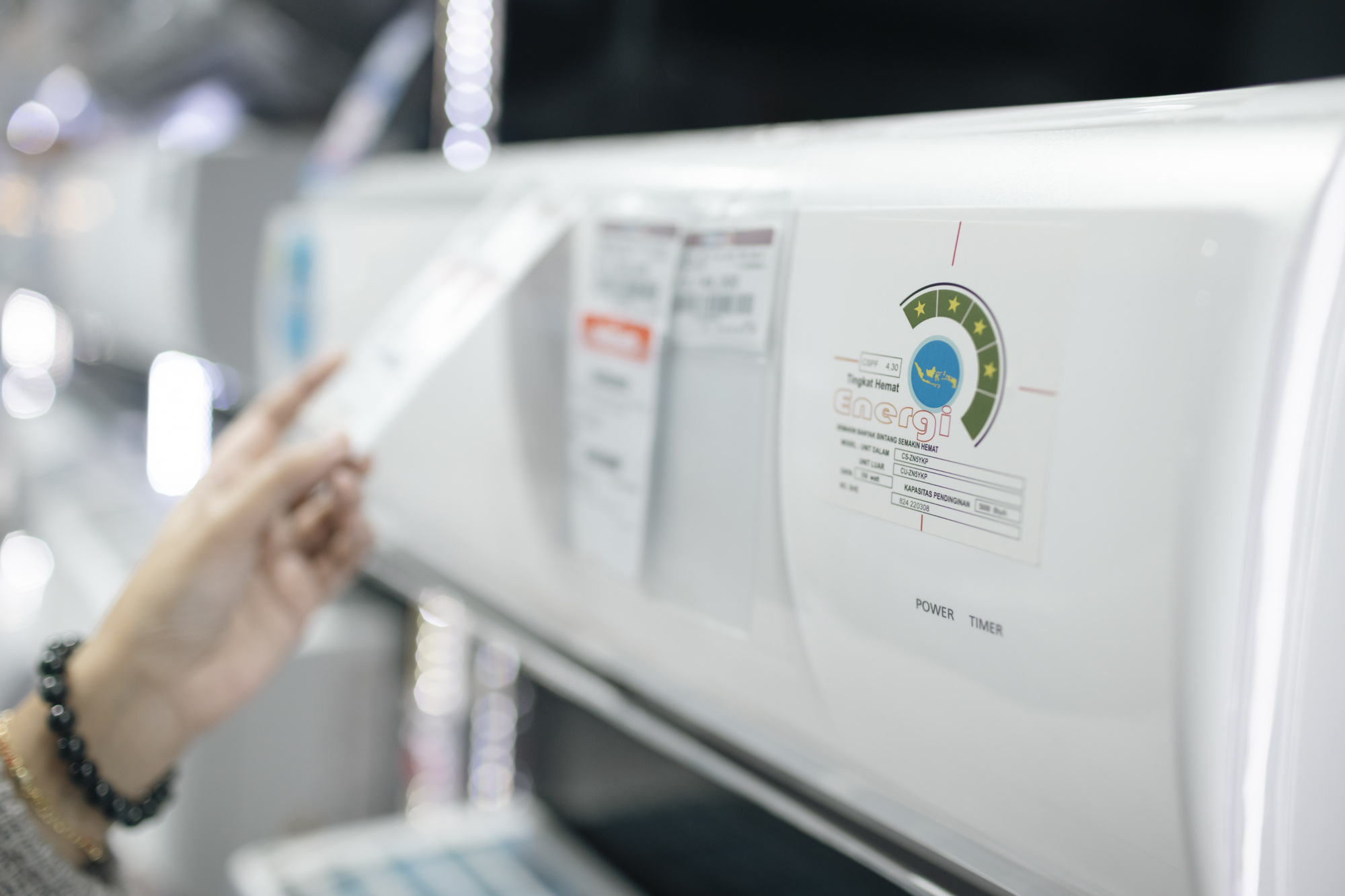
An air conditioner in Indonesia with an energy rating label
CLASP
Setting realistic and effective AC efficiency standards requires rigorous data on air conditioner performance. The Indonesian government, with technical support from CLASP, undertook a recent project to strengthen this evidence base.
We partnered with India’s CEPT University, University of Indonesia and other local universities, government and industry representatives, and certified AC technicians to study one important aspect of air conditioners: the difference in energy consumption between inverter and non-inverter technology.
Most air conditioners fall into these two types. An inverter AC can adjust how much power it uses depending on the cooling needed in the space, using less energy to maintain the right temperature. A non-inverter AC, on the other hand, repeatedly switches on and off to cool the room, which tends to consume more energy.
CLASP studied the energy consumption of these two technologies over a period of six months in three Indonesian cities: Jakarta, Medan, and Bali. In each location, two identical homes with identical bedroom conditions were identified. One home was fitted with an inverter AC and the other with a non-inverter unit, allowing researchers to compare their electricity usage under the same conditions.
The results showed:
- Inverter ACs consistently used less electricity. For example, in Medan, inverter units used 54.6% less electricity than the non-inverter unit.
- The difference in energy use remained steady throughout the testing period, with inverter ACs consistently using less electricity.
Research has also shown that while inverter ACs cost more upfront, their lower electricity usage means households typically recover the extra cost in a few years through reduced electricity bills and continue saving afterward.
By providing empirical data to stakeholders and policymakers in Indonesia and elsewhere, CLASP aims to support stronger efficiency standards for air conditioners. These policies can help bring more efficient models to the market and encourage large-scale production, which can ultimately reduce the cost of operating ACs, helping more people stay cool.