
Appliance Energy Efficiency Opportunities: China 2013
China is the world’s largest producer and consumer of household appliances, lighting, and equipment, and has one of the most comprehensive appliance energy efficiency programs in the world. However, there are tremendous opportunities to capture additional savings through more stringent policies for major energy-consuming appliances.
In 2013, CLASP published the report, Appliance Energy Efficiency Opportunities: China 2013, which synthesizes – for the first time – technological, market, consumer, and international perspectives to identify further opportunities for energy savings and provide high-level strategic guidance and policy recommendations.
The study indicates that tremendous energy savings are available through revised appliance energy efficiency policies for nine prioritized products, shown below.

By revising standards to reflect the energy performance of the best products currently on the market, China can save 189 TWh of electricity per year, equivalent to removing 37 coal-fired power plants, in 2020.
Market Analysis of China Energy Efficient Products
The market for domestic appliances in China has flourished in recent years due to increases in personal income, the speed of urbanization, and the population’s desire to improve their quality of life. Without policy intervention to reduce the amount of energy consumed by these products, their projected electricity consumption will rise from 591 TWh per year in 2012 to 748 TWh per year in 2020, and to 821 TWh per year in 2030. This represents a 39% increase within 18 years.
In a unique perspective that combines market research and policy analysis, Market Analysis of China Energy Efficient Products (MACEEP) identifies where China’s appliance energy efficiency policies are not keeping pace with emerging technologies or rapid market shifts, and estimates potential energy savings under different policy scenarios.
The analysis covers nine domestic appliances: fixed and variable speed air conditioners, induction cookers, copy machines, monitors, refrigerators, rice cookers, televisions, and washing machines. Among others, MACEEP offers the following conclusions and recommendations for Chinese policymakers:
- China could save 1,057 TWh of electricity – roughly equivalent to the annual carbon emissions from 15.5 million passenger vehicles – by 2030 simply by raising the energy efficiency of all nine products to that of the most efficient models currently available.
- Adopting relatively simple revisions to the energy efficiency requirements for induction cookers, monitors, refrigerators, rice cookers, and washing machines would result in immediate energy savings of at least 269 TWh cumulatively by 2030.
- A large proportion of products in China’s market already qualify for energy efficiency Tiers 1 and 2 of the China energy label. Restricting Tiers 1 and 2 to only the top 5% and 10% of energy efficient products in the market, respectively, will encourage the encourage the development and purchase of new high-performance products.
- The number of products that qualify for China’s national appliance subsidy program is too high to effectively promote the development and adoption of higher efficiency products. The study recommends only providing subsidy report for products at Tier 1 or higher.
MACEEP is the first third-party analysis of China’s appliance market, drawing on independently-collected public data. The project team presented the analysis and associated policy recommendations to the China National Institute of Standardization (CNIS) in May of this year.
This study was a collaboration between CLASP, Top10 China, and the China Sustainable Energy Foundation, with significant support from Jeffcott Associates and Kevin Lane Oxford Ltd.
Market analysis for China’s energy efficient products
Total residential electricity consumption in China has increased more than 10% per year since 2007. This is mainly due to wider use of electric equipment. The Chinese government wishes to improve products’ energy efficiency. There are already 48 MEPS in place for residential and industrial products and the China Energy Label covers 27 products. Several rebate programs have been put into place to promote high efficiency products.
The objective of the study by Top10 and CLASP is to analyse the current market status of efficient products, calculate potential energy savings and provide policy recommendations.
Nine major products were selected for the analysis: fixed and variable speed air conditioners, refrigerators, washing machines, TVs, rice cookers, induction cookers, monitors and copiers.
Detailed market data was gathered from a number of sources. From this large amount of data, the analysis showed that:
- The model shares of products under each energy efficiency tier vary greatly among products and technologies.
- The relationship between energy efficiency and capacity varies according to products, but the absolute energy consumption increases with the capacity for all the products.
- MEPS and energy label thresholds influence pricing strategies of energy efficient products.
CLASP and CNIS Translate Compliance Counts into Chinese
In 2010, CLASP and Mark Ellis & Associates published the first, one-of-its-kind MV&E Guidebook, Compliance Counts: A Practitioner’s Guidebook on Best Practice Monitoring, Verification, and Enforcement for Appliance Standards & Labeling. The Guidebook provides step-by-step guidance for policymakers and S&L practitioners to design and implement robust and effective MV&E frameworks.
Compliance with appliance S&L is critically important for all economies; however, there are often limited guidance and resources on MV&E international best practices available for policymakers and S&L program practitioners.
In collaboration with Chinese National Institute for Standardization (CNIS), CLASP has undertaken an effort to make the Guidebook accessible to Chinese-speaking policymakers, program managers, and S&L practitioners by translating the full volume into Chinese.
The MV&E Guidebook is also available in Russian.
International Comparison of Product Certification and Verification Methods for Appliances 21-NOV-2012
The International Comparison of Product Certification and Verification Methods for Appliances study endeavors to:
- Review international best practices for product certification and verification as they relate to the enforcement of appliance standards and labeling programs in the U.S., E.U., Australia, Japan, Canada, and China; and,
- Provide recommendations to the Chinese government for the implementation of improved certification processes related to their mandatory standards and labeling program so as to increase compliance rates and energy savings potential.
Enforcement of appliance standards and consumer trust in appliance labeling are important foundations in the development of a more energy efficient economy. Product certification and verification increase compliance rates, which in turn increase both energy savings and consumer trust.
Practices for product certification and verification vary across the world, with some programs focusing solely on either certification or verification (such as in Australia and Canada) and other programs focusing on both (such as ENERGY STAR in the U.S.). Accreditation practices for testing laboratories and certification bodies also vary, with some appliance standards and labeling programs building databases to house all information on products and compliance.
The number of products covered by China’s mandatory standards program and labeling program has rapidly increased in recent years up to 44 products and 23 products, respectively. The Chinese government is currently seeking to improve the compliance rate for these products without reinventing its current organizational structure.
Based on a review of international practices in product certification and verification, the authors of this study offer the following recommendations to the Chinese government in the development of a more robust MV&E system:
- Organize certification bodies.
- Mandate certification process.
- Allow witness testing.
- Adapt from international standards.
- Standardize verification testing.
Introducing third party product certification and verification for the Chinese government’s mandatory standards and labeling programs has the potential to significantly improve compliance levels without heavy administrative burden.
BUENAS Scenarios Estimate Cost-Effective and Technical Savings Potential for MEPS in 13 Major World Economies
The Bottom-Up Energy Analysis System (BUENAS) is a policy analysis tool created by Lawrence Berkeley National Laboratory (LBNL) and supported by CLASP and the Super-efficient Equipment and Appliance Deployment (SEAD) Initiative.
BUENAS provides estimates of potential CO2 ,energy savings and financial impacts for a wide range of residential, commercial, and industrial end uses. BUENAS enables consistent comparison of the impacts of energy efficiency standards & labeling (S&L) policies across major economies.
LBNL developed two scenarios – cost-effective potential (CEP) and best available technology (BAT) – to project potential savings from implementing policies of various stringencies in 13 major economies. The economies covered in these scenarios are Australia, Brazil, China, Canada, the European Union, India, Indonesia, Japan, Mexico, Russia, South Korea, and the United States. For these two scenarios, BUENAS includes a range of residential and industrial end uses. The commercial sector is not covered.
Cost-Effective Potential Scenario
The CEP scenario identifies policies that would maximize energy and CO2 emissions savings while saving consumers money if implemented in the world’s major economies. CEP policies are determined according to the cost of conserved energy of various design options or technologies. CEP scenario results enable policymakers to assess the energy and CO2 savings potentials of cost-effective policies and prioritize S&L policies that have the largest impact while benefiting consumers.
Based on the CEP scenario, the estimated global savings are:
- 770 terawatt hours (TWh) of electricity in 2020 and 1,500 TWh in 2030;
- Reduced energy consumption in 2030 of 17% in the residential sector and 4% in the industrial sector;
- 540 million tons (Mt) of CO2 emissions annually in 2020 and 1,000 MtCO2 in 2030; and
- Cumulative consumer financial benefits of 1,500 billion USD from 2015-2030.
Best Available Technology Scenario
The BAT scenario models the impacts that would result if economies adopted MEPS mandating the most efficient already available product or technologies across all end-uses. The BAT targets represent the maximum achievable energy-efficient designs, based on super efficient emerging technologies or designs combining most efficient components already commercially available. BAT scenario results provide estimates of energy efficiency technical potential, or the maximum potential savings that would result from implementation of MEPS requiring BAT in 13 economies.
Based on the BAT scenario, the estimated global savings are:
- 1,200 terawatt hours (TWh) of electricity in 2020 and 2,300 TWh in 2030;
- Reduced energy consumption in 2030 of 27% in the residential sector and 6% in the industrial sector;
- 860 million tons (Mt) reduction in annual CO2 emissions by 2020 and 1,700 MtCO2 by 2030; and
- Emissions reductions from electricity generation equal to 60% of the total reduction needed to remain under 450 ppm CO2 by 2030.
Authors:
CEP: Virginie E. Letschert, Nicholas Bojda, Jing Ke, and Michael A. McNeil
BAT: Virginie E. Letschert, Louis-Benoit Desroches, Jing Ke, and Michael A. McNeil
China Ramps up Market Transformation Initiatives to Promote Energy Efficient Appliances
On May 18, 2012, the China National Institute of Standardization (CNIS) held a ceremony for the 2011 cycle of the National Lead List awards program. Officially known as the National Lead List of Excellent Enterprises and Energy-saving Products (中国节能产品企业榜), the program aims to advance energy conservation and carbon emissions reduction by motivating manufacturers to voluntarily improve the production and purchase of energy efficient products.
The program ranks manufacturers along criteria such as average energy efficiency ratio and total energy saved from all products sold, as well as energy efficiency levels of individual products. A total of 25 Chinese companies across ten product categories were recognized as energy efficiency business leaders. Every year the rankings are publicized nationally, and winning manufacturers are presented with certificates by leaders and officials of the Chinese Government, industry associations, and test labs. CLASP’s China Director, Steven Zeng, was invited to present one of the leading awards for this awards cycle.
In 2011, CLASP and the China Sustainable Energy Project (CSEP) supported CNIS in expanding the number of product categories in one of the three awards under the Lead List program. This year, the two organizations are supporting CNIS as it considers expanding the Lead List program to include retailers as well as manufacturers, which has the potential to drive the deployment of more energy efficient products to China’s market. CLASP is leading the effort to provide information to CNIS on similar awards programs in the U.S. and Japan.
In addition to the expansion of the Lead List program, the China State Council announced in May that it would allocate CNY 26.5 billion (approximately 4.2 billion USD) in subsidies to promote the purchase of energy-saving household appliances such as air conditioners, flat-panel TVs, refrigerators, washing machines, and water heaters for one year. One month later, Chinese electronics retailer Gome announced that it would establish a special fund containing CNY 1 billion (157 million USD) to support the implementation of this policy.
In conjunction with the consumer awareness campaign for China’s energy label that CNIS launched in June, these activities indicate an increased emphasis on market transformation initiatives for energy efficient products in China.
Related Articles:
Subsidy for Energy-Saving Appliances
Gome Launches CNY1 Billion Fund To Promote Energy-saving Home Appliances
CNIS Launches Major Consumer Awareness Campaign for China Energy Label
In June 2012, the China National Institute of Standardization (CNIS) initiated a consumer awareness campaign displaying large-scale informative posters in ten Beijing subway stations.
The posters explain the China Energy Label’s scale – green for most efficient; red for least – and encourage consumers to “Beat the Energy Tiger at Home.” Beijing’s metro is the busiest and most crowded in the world. The posters were displayed for four weeks, with an estimated 45 million passenger views or more.
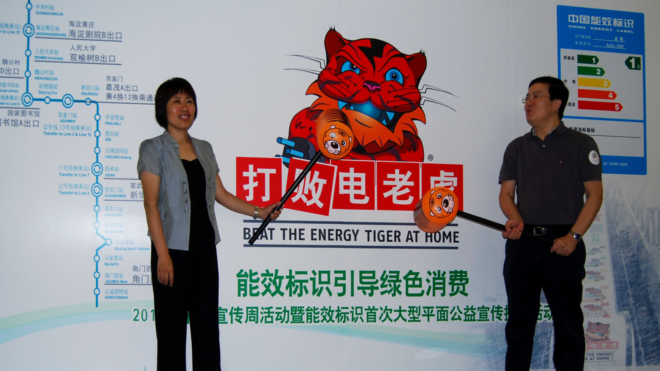
The campaign – a collaborative effort between CLASP and the China Sustainable Energy Program (CSEP) – was launched in response to a CLASP-supported study indicating low overall consumer comprehension of the China Energy Label. The study found that while 61.5% of surveyed consumers have seen the comparative label and can recognize it, only 18.3% have a deeper understanding of the label and use it to make purchasing decisions.
The Chinese government, which has implemented the comparative energy label for over 25 products, is committed to increasing public awareness and comprehension of the label in order to pull the Chinese market to higher levels of efficiency. This campaign marks China’s first significant effort to promote and deepen understanding of the comparative energy labeling program since its launch in 2005.
Mr. Lu Wenbin, Director of the Energy Efficiency Department of the China National Development and Reform Commission (NDRC), which oversees energy efficiency policies in China, participated in the campaign’s opening ceremony on June 2nd to express his strong support of the campaign.
CLASP’s China team, in collaboration with CSEP, will assess the campaign’s impacts and work with CNIS to expand the initiative to a national scale.
Major energy efficiency S&L forum in China provides opportunity for Asian countries to share S&L best practices and international experiences
On November 15-16, 2011, the China National Institute of Standardization (CNIS) organized the Asia Energy Efficiency Standards and Labeling (S&L) Forum to share international S&L experiences and best practices among stakeholders from across Asia and the wider international S&L community. The Forum was co-sponsored by CLASP, the Energy Foundation, and the International Copper Association (ICA), and drew 100 representatives from China, the US, the EU, and other countries from across Asia.
In his keynote speech, Mr. Jin Ming Hong, the Director of Energy Efficiency at the China National Development and Reform Commission (NDRC), highlighted the importance of international collaboration to national S&L, saying, “International organizations such as CLASP and the Energy Foundation have extended great support to the development of China’s energy labeling system in the past years. China has achieved significant energy saving through our S&L programs, and we will continue to learn from international best practices and share our experience with other countries. This Forum is a great chance for us to exchange our information and share experiences.”
CLASP sponsored the participation of four international experts who presented and discussed the following topics at the Forum:
- International best practices from the US, EU, and Korea, including:
- US ENERGY STAR and EnergyGuide programs;
- EU Energy-related Products (ERP) Directive, Energy Labeling Directive, and Eco-label; and
- Korean S&L programs;
- International collaboration among policy makers and technical experts through the Super-efficient Equipment and Appliance Deployment (SEAD) Initiative;
- International review of energy efficiency S&L programs; and
- CLASP’s research on International Harmonization and mutual recognition of energy efficiency S&L programs.
Additionally, CNIS reviewed S&L developments in China and shared future prospects for China’s energy efficiency S&L programs.
Forum participants – which included government S&L officials, research institutes, appliance industry associations, national test laboratories and manufacturers – recognized that the widespread adoption of S&L has great potential to help Asia address energy efficiency, energy security and climate change concerns. The Forum provided a highly useful platform for Asian countries to share their S&L experiences and learn from international best practices. To provide continued support for this collaboration, Deputy Director of CNIS Zhang Xin announced a plan to organize the second Asia EE S&L Forum in Shanghai in 2012.
The workshop agenda and presentations are available below.
Download Files:
Asia Energy Efficiency Standards & Labeling Forum Agenda
Presentations:
Assessing the Potential for Energy Savings with China’s ES&L Program
SEAD Initiative
US ENERGY STAR and EnergyGuide Programs
EU ERP Directive, Energy Labeling Directive, and Eco-label
Energy Efficiency S&L Programs in Korea
International Harmonization and Mutual Recognition of ES&L Programs
Opportunities for Success and CO₂ Savings from Appliance Energy Efficiency Harmonisation
This report presents findings of an extensive investigation of the energy efficiency standards and labeling programs in place in China, the EU, India, Japan, and the USA.