
BRICS Meets to Discuss Global Efficiency Standards
On 28 June, CLASP participated in an international workshop hosted by The China National Institute of Standardization (CNIS) with representatives from the BRICS nations. The “BRICS Workshop on Carbon Peaking and Carbon Neutrality Standards” built on the alliance’s desire to transition to a greener, lower-carbon, and circular economy, in alignment with the Paris Agreement. CNIS led the session, focusing on how to support other BRICS countries to take maximum advantage of energy efficiency standards in their own climate agendas.
This type of knowledge exchange is critical for influencing world economies and allow countries with different experiences share lessons for effective mobilization. BRICS consists of highly populous countries (Brazil, Russia, India, China, and South Africa) with rapidly increasing appliance markets. This shift in energy demand will continue to have an enormous global impact on energy usage and subsequent energy-related emissions. Facilitating the expansion of energy efficiency programs through international partnerships is a key component of quickly reaching our collective climate goals.
CNIS shared their experience with efficiency standards and their role in dramatically reducing energy consumption and associated GHG emissions. They presented their legal and technical framework as an example for further strengthening the existing programs of the other four member countries.
Policymakers from Brazil and South Africa emphasized the importance of CLASP’s role in improving national energy efficiency policy for several priority products. The Research Institute at the Environmental Industrial Policy Centre in Russia also expressed interest in future collaboration on efficiency regulations beyond appliances, like agriculture and industry. Our team will continue to participate in international knowledge sharing among BRICS entities, working together toward a more efficient future.
Brazil and China Meet to Discuss the Future of Cooling MEPS
On 17 March, CLASP convened government representatives and experts from China and Brazil for a discussion on energy efficiency policies for multi-connected air conditioner systems. This collaborative gathering included participants from the Chinese National Institute for Standardization (CNIS), the Brazilian Ministry of Mines and Energy, and the National Electricity Conservation Program (Procel), as well as energy efficiency consultants from Mitsidi in Brazil. China currently leads the world in technical requirements multi-connected AC systems, which are primarily used in commercial buildings.
Commercial AC market in Brazil
Brazil’s commercial air conditioning market is populated equally by three system types: variable refrigerant flow (VRF), packaged and chilled water. VRFs are significantly more energy efficient than the other two system types, primarily due to their use of inverter technology. Building commercial AC standards to increase the uptake of VRFs and continually improve VRF efficiency is critical to achieving energy savings in Brazil’s commercial cooling market.
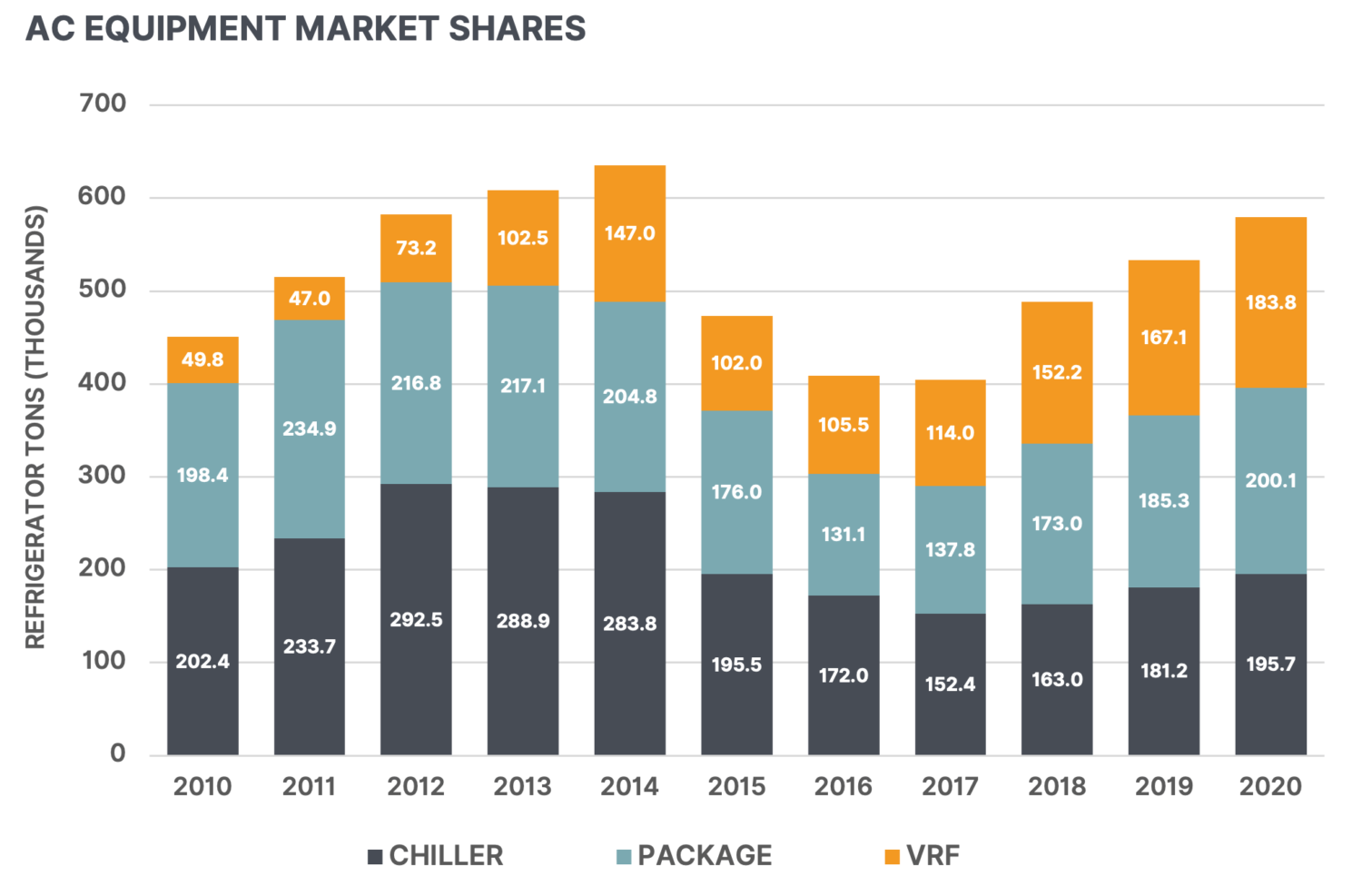
VRF commercial air conditioning units have grown on average 15% per year since 2011 and haven't reached their peak yet.
Source: revistadofrio.com.br/mercado-de-vrf-continua-em-expansao
But in Brazil, increasing the inverter market share is no easy task. There are currently no minimum energy performance standards (MEPS) for central AC equipment, so any regulation would have to be built from the ground up. The lack of regulation also means that the market is flooded with older, less efficient models, and owners of less efficient buildings have no incentive to replace existing systems.
China strengthens multi-connected AC policy
During the meeting, CNIS shared how they formulated their own multi-connected AC policy. Ten years after its initial adoption, China began a revision process, with the main goal of combatting climate change with stricter standards. Their current plan aims to eliminate low-efficiency products, strengthen existing MEPS and efficiency labeling grades, and lead the world in high efficiency regulations. The revision, which will go into effect in November 2022, has the potential to prevent 206 Mt in CO₂ emissions (206,000,000 tonnes) by 2030 and will move the Chinese market to 100% inverter units.
The new standards referenced international benchmarks, with the final proposal including a Grade 1 label (the most efficient tier) that supersedes all previously set requirements. The lowest threshold of China’s multi-connected AC MEPS is on par with existing standards in the EU and US. For Brazil, this benchmarking approach could help position their first-ever multi-connected AC MEPS and ensure ambitious yet realistic goals.
At present, Mitsidi is in the exploratory phase of their market assessment, collecting data through interviews with various stakeholders and secondary research. As Brazil looks to create their own commercial AC regulations, this interchange provided an excellent starting point for a successful course of action. CLASP is looking forward to supporting this effort and aid the Brazilian Ministry of Mines and Energy in their goal of drafting a policy that would be adopted by the end of 2023.
Partners


Policy Opportunities for More Efficient Residential Water Heating
Recognizing the importance of water heating energy consumption, CLASP initiated this study in collaboration with Waide Strategic Efficiency and several other partners to identify the policy opportunities for more efficient water heaters in three of the largest economies in the world: China, India, and the US. This study provides policymakers and technical experts with the following resources:
- In-depth gap analysis of existing policy coverage of water heaters
- Derivation of energy, CO₂, and economic savings scenarios from the systematic move towards a more efficient mix of water heating technologies
- Country specific policy recommendations embracing a suite of policy measures including standards and labeling that will stimulate more efficient water heating technology.
Key Policy Recommendations
Based on the results of policy review and gap analysis, this study recommends stronger and more coherent policies for all three economies analyzed. However, the precise policies recommended vary by economy.
- Technology neutral policy measures: Allow easy comparison of the overall energy performance of different water heating technologies to help clarify the value proposition of the different choices available.
- Raising awareness: Help explain and promote the value proposition of high efficiency water heaters to consumers so they feel informed and empowered to select the most efficient and cost effective technology choices.
- Incentives to support high efficiency water heater deployment: Provide incentives to support the deployment of the more efficient solar and heat pump water heaters, so that their adoption rates increase and their incremental costs compared to traditional less efficient choices decline due to learning curve effects.
China Celebrates Energy Label’s 10th Anniversary, Launches Smartphone App
On June 13th, the Chinese Government will celebrate the 10th anniversary of its highly successful appliance energy efficiency label, known as the China Energy Label (CEL).
 CLASP is helping the China National Institute of Standardization (CNIS) develop and launch a smartphone application (or “app”) that will make it easier for consumers to find more efficient products that match their needs. With the app, shoppers can scan a QR code (a two-dimensional barcode) – which CNIS developed for the CEL in 2014 with CLASP’s support – and the app will provide immediate and relevant additional information about the scanned product to inform their buying decisions. CLASP is excited that, with the launch of the CEL app, the use of new smartphone technologies to assist shoppers in purchasing energy efficient products is beginning to emerge as consumer education best practice.
Launched in 2005 with the support of CLASP and other groups, the CEL is a mandatory labeling program that has helped transform the Chinese market towards highly efficient appliances and saved more than 400TWh of electricity, according to CNIS. The CEL covers more than 30 product categories and, according to a recent consumer survey by CLASP and All China Marketing Research (ACMR), over 97% of urban consumers claim to have seen the China Energy Label, and about 75% correctly understand how the label differentiates between efficient and inefficient products.
High levels of consumer awareness and comprehension of the CEL have been a significant part of the labeling program’s success to date. CLASP expects the new QR code and smartphone app to make the CEL more user-friendly and ultimately more effective as a policy tool.
 For example, the new app will allow consumers to compare multiple products based on annual energy consumption, and explain more complex information, such as the energy efficiency index, an alternative measurement used for products like TVs. To help CNIS develop the app, CLASP identified how Chinese consumers currently use the CEL to inform their buying decisions, determined which information presented on the CEL is hard to comprehend, and uncovered additional product information consumers desire. CNIS used this analysis to design a highly consumer-focused app.
The app also has the potential to serve as a market surveillance tool, allowing market supervisors to more effectively monitor discrepancies between a product’s registry information and the information displayed on its label. The app may help prevent manufacturers from falsely labeling their products as more efficient than they truly are, facilitating uptake of the best and most energy efficient products.
CLASP is hopeful that the new CEL app reflects an emerging best practice in consumer education. According to the SEAD Initiative, China’s smartphone app for the CEL is the fifth of its kind, following Thailand, Sweden, Europe, and Australia/New Zealand.
Together, CNIS’ new QR code and smartphone app will improve the CEL program by empowering Chinese consumers and market supervisors with more information that will further shift the market toward efficient products, and ultimately reduce sources of local pollution and global climate change.
Learn more:
New Study Considers the Harmonization Potential of TV Efficiency Policies and Test Methods in SEAD and APEC Economies
Global television sales continue to grow as product prices steadily decline, and TVs now account for an estimated 3% to 8% of global residential energy use. Improving the energy efficiency of TVs becomes increasingly important against this backdrop, in order to offset the potential energy and environmental impacts of continued growth in television sales. TV supply chains are global in nature, however, and global action around TV efficiency is hindered by competing national and regional policies governing TV energy use. Efforts to facilitate improvement in TV efficiency worldwide would therefore benefit from the establishment of a level international playing field around TV energy performance requirements and associated test methods.
A new study by the SEAD Initiative seeks to advance international harmonization of TV energy efficiency policies by analysing the test methods and performance requirements currently in use around the world, identifying opportunities for achieving greater international policy alignment. This study was carried out in support of the Asia-Pacific Economic Cooperation (APEC)Collaborative Assessment of Standards and Testing Methods (CAST), with specific focus on SEAD and APEC economies, including Australia, China, the European Union, India, Japan, Korea, the Philippines, the United States, and Vietnam.
Test Methods
This report examines a total of 6 test methods for TVs, finding that the largest differences between test methodologies exist among the largest markets most active in policy development (i.e. the EU, the US, and China). The study finds that two standards are most relevant to international harmonization efforts—the International Electrochemical Commission (IEC) 62087 method and China’s GB 24850-2013 method—and that greater harmonization between these testing approaches is essential to allowing future comparisons between products in China and other regions.
Other key findings related to TV test methodology include:
- TV test methods need to constantly evolve due to the rapid rate of TV technology development, to ensure that testing results are representative of actual in-home energy consumption.
- Sample preparation is key. Sample preparation (i.e. the way that TV settings are configured in preparation for testing) is the biggest disruptive influence that limits that comparability of energy test results across countries.
- Some policy requirements add testing divergence. Key areas of policy that are related to testing and would benefit from greater harmonization include: i) illuminance levels used for testing a TV’s Automatic Brightness Control (ABC) feature, ii) incentives for ABC testing, and iii) approaches to peak luminance levels.
Energy Performance Requirements
TV energy efficiency policies from 13 regions are analyzed, totaling over 70 different energy performance thresholds. Despite televisions everywhere being very similar in technology, this analysis reveals considerable global variation in TV energy efficiency policy. Several underlying reasons for these differences are identified, including:
- resource constraints among policymaking bodies;
- limited availability of market assessments to support policymaking;
- regional politics;
- unaligned policy schedules or policy revision cycles; and
- concerns that more stringent policies might negatively impact product availability and cost.
To advance greater policy harmonization around energy performance requirements for TVs, this study proposes a series of benchmark performance levels, which policymakers can use as a foundation for setting their own local policies and label schemes. In addition, this study recommends a number of resources that could assist policymakers to achieve cost effective efficiency improvements in TVs, including:
- Information on policy cost and potential savings, to support a shift toward the highest energy efficiency level that is feasible but not expected to occur in the absence of further policy action; and
- Steps for applying this study’s benchmark performance levels in their region, supported by the provision of electronic tools and training.
Despite the variation in energy performance requirements and test methodologies identified in this study, the authors none-the-less conclude that global harmonization of test methodologies, and even performance levels, could be made a reality within a few years.
This study was written by Stephen Fernandes, Catriona McAlister, Anson Wu, and Robert Harrison of Intertek Plc; Jeremy Tait of Tait Consulting; Keith Jones of Digital CEnergy Australia; and Anette Michel from Top Ten Europe. The project was funded by the Australian Government, with support from the SEAD initiative and CLASP.
Assessment of Testing Capacity Facilitates Compliance Collaboration in the APEC Region
Compliance testing is one of the most fundamental components in a monitoring, verification, and enforcement (MV&E) framework because it verifies whether a product lives up to its energy efficiency claims. However, it is often one of the most challenging and resource-intensive to implement – especially for developing economies.
As identified at the previous Compliance Workshop hosted in Beijing in June 2012, many APEC economies have limited resources and access to information required to establish successful market surveillance MV&E regimes. To address this common challenge, the Asia-Pacific Economic Cooperation Expert Group of Energy Efficiency & Conservation (APEC EGEE&C) – in collaboration with S2E4 and many other partners – to conduct a comprehensive survey identifying qualified testing facilities and analyze cost-effective policy options for conducting compliance testing.
The assessment surveys have identified some 250 qualified testing laboratories across 17 APEC economies. Economies with the largest manufacturing capacities, China and the USA, were found to have the most testing facilities. In smaller economies, there was insufficient testing capacity to support all of the appliance energy efficiency policies they had in place. To compensate for insufficient testing capacity, the assessment recommends that small economies leverage test facilities from neighboring economies. For example, due to Vietnam’s constrained laboratory capacity to test domestic refrigerators, a laboratory in Thailand has been officially designated by the Vietnamese authorities to certify this product category.

Benchmarking Analysis Compares Linear Fluorescent Lighting Policies in Six Economies
Lighting accounts for about 15% of global energy consumption and nearly 6% of greenhouse gas emissions. Linear fluorescent lighting (LFL) is one of the most popular lighting technologies used in the commercial, industrial and outdoor sectors. Around 3 billion LFLs are manufactured each year, which are responsible for producing around 58% of the world’s artificial light. Although LEDs may well be the “light source of the future,” LFLs still dominate the current landscape due to their efficacy, long lifetimes and cost-effectiveness.
Recognizing the importance of LFLs in overall lighting energy consumption, CLASP, Beletich Associates, Erik Page & Associates, and Ballarat Consulting initiated this LFL mapping and benchmarking analysis to assess market trends and perform international comparisons of policies in major economies around the world. The study lays the technical foundation for strong and comparable energy performance requirements at the global level, and to pull the market towards higher levels of product efficiency.
This study provides detailed market analysis of linear florescent lamps and ballasts in six economies that represent a significant proportion of the world market for LFLs: Australia, Canada, China, the European Union, India and the US. The economies studied already have well-harmonized test procedures for linear fluorescent lamps. Thus lamp metrics used in these economies can be compared directly, without the need for any conversion or normalization.
The study is divided into three components:
- S&L policy analysis: The S&L policy analysis component includes a review of existing S&L initiatives and characteristics for linear fluorescent lamps and ballasts in the selected economies.
- Market assessment: The market assessment component establishes LFL characteristics in different economies by comparing the market sizes and trends as well as the energy performance of products offered on the market.
- Lamp testing: The testing component compares and highlights energy performance differences of LFLs in various economies. A small number of lamps from China, Europe (UK), India and the US were sampled and tested in order to derive insights into the performance of commonly available lamps in large economies.
Data on China’s Computer Market Reveal Half of Models Already Meet ENERGY STAR Version 6
The California Energy Commission (CEC) and the US Department of Energy (DOE) are in the process of setting the first minimum energy performance standards (MEPS) for computers in the US. As part of this process, CEC and DOE are referring to the ENERGY STAR qualified product list to evaluate the energy consumption profile of computers and create appropriate policy measures. This product list, however, only provides a partial view of computer energy consumption on the US market. For a number of reasons, including qualification costs and non-qualifying power supplies, a significant number of desktop and laptop models are not typically registered under the ENERGY STAR program.
To fill this information gap and contribute to a more comprehensive view of the market, CLASP and partners Fiona Brocklehurst and Jonathan Wood collected technical and performance data on China’s computer market. All computer models sold in China are required to be registered in a public online database, providing a more complete view of the market than is available in the US. Our analysis found that 47% of manufacturers listed in this database are also listed in the US database of ENERGY STAR-qualifying computers, and these manufacturers account for 79% of models sold in China. Thus, China’s computer market provides relevant insights for the US.
This report assesses the performance of computers in China’s database with reference to typical energy consumption (TEC) requirements for ENERGY STAR versions 5.2 and 6.0 to estimate the share of computers that could meet these requirements in the US. The analysis reveals the following key conclusions. As of August, 2013:
- 92% of desktops and 98% of notebooks in the Chinese market could meet ENERGY STAR v5.2 TEC limits.
- 49% of desktops in China’s market could meet energy consumption limits 30% lower than ENERGY STAR v5.2, which is roughly equivalent to ENERGY STAR v6.0.
- 57% of notebooks could meet energy consumption limits 40% below ENERGY STAR v5.2, which is roughly equivalent to ENERGY STAR v6.0.
These results suggest that a large share of computers in the US market likely already meet ENERGY STAR v6 levels. It is important to note, however, that due to differences in test methods, this study only examines energy consumption levels relative to ENERGY STAR v5.2, and extrapolates them to ENERGY STAR v6. In addition, the study focuses on typical energy consumption only; it does not assess the other ENERGY STAR requirements such as power supply efficiency and power management, as this information was not available in China’s database.
CLASP shared this analysis and an accompanying study, Energy Consumption of Gaming Computers in the US Market, with the DOE and CEC in October for consideration during their standard-development processes. CEC plans to release a draft of its proposed computer MEPS this month.
This report was written for CLASP by Fiona Brocklehurst of Ballarat Consulting and Jonathan Wood of Tenvic Ltd., with support from Pierre Delforge of NRDC. Chinese data was collected by Anson Wu of Hansheng Ltd.
New CLASP Study Analyses Changes in the Market for Energy Efficient Products in China
China is the world’s largest manufacturing hub for household appliances. For many appliances, the country has also become the global leader in domestic sales. A broad range of appliances have been widely adopted among urban households over the past two decades, and more recently the penetration of appliances into rural areas has been accelerating. The Chinese government has prioritized efforts to address rising energy demand from increasing appliance ownership, implementing a number of policies and programs that encourage the production, sale, and use of high-efficiency products.
In 2013, CLASP partnered with Top10 China and several international experts to produce Market Analysis of China Energy Efficient Products (MACEEP), a first-of-its kind, third-party analysis of the size, shape, and efficiency of China’s domestic appliance market. This study combined market research and policy analysis to identify where China’s appliance energy efficiency policies were not keeping pace with emerging technologies or rapid market shifts, and to estimate potential energy savings under different policy scenarios.
Building on key findings from this initial research, the current study, 2014 Market Analysis of China Energy Efficient Products (MACEEP 2014), examines how the appliance market in China has evolved, explores the impact of new regulations on some of the products analyzed in the original MACEEP, and expands that analysis to include other significant energy-using appliances in the domestic sector.
MACEEP 2014’s analysis of six domestic appliances—air conditioners, instantaneous gas and electric water heaters, refrigerators, televisions, and washing machines—demonstrates that the actions taken to date by Chinese policymakers have resulted in substantial improvements in the energy efficiency of these products. However, the analysis also shows additional opportunities for energy and cost savings that could result from further actions.
Within the six appliance analyses presented in MACEEP 2014, a total of 43 recommendations are made for improving energy efficiency policy in China, ranging from refining the energy label to the technical revision of standards. In each case these recommendations are specific to individual appliances and justified on the evidence presented. A number of overarching themes are also identified, highlighting where adjustments can be made to efficiency policies across a range of appliances, in order to maximize energy savings and accelerate market transformation towards high-efficiency products.
The study was written by Jayond Li, Yang Yu, and Steven Zeng of CLASP’s China office, with additional technical and editorial support from Stuart Jeffcott and review by Mike Scholand.
Preliminary Analysis Conducted by CLASP and Waide Strategic Efficiency Informs Water Heater Benchmarking
In most economies, water heating appliances are some of the most energy-consuming, and typically account for 15% to 25% of energy in the residential sector. Globally, heating water in the residential sector may use as much as 11 petajoules per year.
CLASP conducts product and policy benchmarking studies to inform policymakers about opportunities to raise the ambition of national policies in order to maximize energy savings and CO2 emissions reductions. Benchmarking policies and products is challenging due to incomparability of products and standards in different parts of the world, different approaches to performance testing, and lack of or unavailability of critical data.
Particularly, water heaters are one of the most complex product categories due to a large variety of product types, technologies, and fuels used for heating water. Traditionally, energy efficiency standards and labels have set performance requirements for water heaters by type (e.g., storage electric water heater, gas instantaneous water heater, etc.), thus inhibiting the comparison across water heater technology classes.
To address this challenge, CLASP and Waide Strategic Efficiency conducted a preliminary analysis on water heaters to identify future research needs that will lead to the successful benchmarking of policy settings for this product category, and will thereby support policymakers in better understanding their options to improve water heater energy efficiency.
The study provides an overview of various water heating technologies, test methods, and energy efficiency of residential water heaters in eight economies, including in Australia, Brazil, Canada, China, European Union, India, Korea, and the US.
The study is divided into the following three main components:
Task 1 – product definition
- Definition of relevant product classes or categories, discussed in section 2
- Listing and assessment of country data sources i.e. a listing of test procedures and regulations, presented in sections 3-10 by economy.
Task 2 – mapping
- Mapping of product characteristics in selected countries, presented in section 11
- Mapping of existing standards and labelling initiatives and a description of their characteristics, presented in section 12
- Identification and initial comparison of test procedures, presented in section 13.
Task 3 – benchmarking
- Identification of potential issues in test results comparison that would need to be addressed in a full benchmarking study, presented in section 14
- Analysis of knowledge gaps that need to be addressed in a full benchmarking study, discussed in section 15.