
Seeding Appliance Efficiency in Brazilian Media
In Brazil, energy costs are skyrocketing while renewable capacity struggles to keep pace with increasing demand. During this unprecedented challenge, appliance and equipment energy efficiency stands out as an essential tool for managing energy demand and cutting costs.
In 2025, CLASP and Bori trained local journalists on the impacts and opportunities of appliance efficiency in Brazil, connecting the topic to real-world challenges faced by Brazilians, like increasing demand for space cooling. The program enabled reporters to deliver compelling and nuanced efficiency coverage to the public through mainstream media as Brazil geared up to host COP30 and interest in climate solutions peaked.
The impact was broad and immediate: Over 750 media stories on appliance efficiency were published in Brazilian media from the start of 2025 to COP30. Combined with CLASP’s other efforts, the initiative helped elevate efficiency at COP30, spotlighting it as a key climate solution at the year’s most important climate talks.
The InfoEnergia Mentorship
CLASP and Bori’s InfoEnergia Mentorship nurtured a new era of energy journalism in Brazil. The program aimed to equip local media with the training and contacts needed to integrate efficiency stories into regular reporting beats.
In many markets, journalists may lack the background needed to cover climate and energy topics and their impact. Regular reporting about the connection between appliance efficiency and key issues like cooling access, grid reliability, and cost of living is critical for building public awareness and political will.
A cohort of 25 participants, selected from a pool of 100 applicants, participated in the six-week, eight-session workshop. The sessions featured speakers from across the efficiency sector, from policymakers and technical experts to private sector leaders and academics. Journalists learned about the energy efficiency policymaking process in Brazil and heard first-hand insights about the economic, environmental, and livelihood impacts of efficient appliances within the national context, with specialized conversations on topics like cooling and energy equity in the Amazon.
Participants boasted bylines in dozens of Brazil’s most prominent media outlets—including Amazônia Vox, O Povo, and O Estado de São Paulo —and ranged from early career reporters to deeply established experts in the climate and energy reporting space. Nearly 70% of participants identified as women.
Each journalist published a final story that was submitted for the InfoEnergia Award, an accolade recognizing excellence in energy efficiency reporting. Journalist Cley Medeiros of Jornal A Critica was honored with the top award for his piece “Energy efficiency is ignored in 76% of air conditioning bids in the Amazon.” Reflecting on his experience in the program, Medeiros said, “For a long time, I’ve wanted to understand why the public sector has been unable to drive the energy transition we need here in the Amazon, so I am very happy for this opportunity. I want to thank my colleagues from InfoEnergia who were part of this journey. Thank you for being drivers of transformation in journalism!” [translated from Portuguese].
Impactful investments in local media ecosystems
Accurate, nuanced reporting on climate and energy topics and how they impact people’s lives is essential for a practical, just and durable energy transition. The InfoEnergia Mentorship successfully broadened and mainstreamed coverage of appliance and equipment energy efficiency. Increasing public awareness about the impacts and opportunities for energy efficiency in Brazil contributed to momentum for action at COP, driven by key moments including mentions in the COP President’s plenary remarks and Brazil’s industrial agency dedicating a full day to efficiency programming, helping to advance efficiency momentum globally.
Making Efficient, Affordable Fans the New Standard in India
With temperatures soaring globally due to climate change, India is one of the places on the planet most at risk of extreme heat. Ceiling fans are widely used, with 90% of households relying on fans as their only form of space cooling.
Over a period of three years, CLASP partnered with both the Indian government and private sector to drastically improve the affordability and availability of efficient fans. A major part of the effort was working with small and medium enterprises to build their capacity to produce more efficient fans.
The results have been catalytic. Together, CLASP and our partners have cut energy demand from cooling, while safeguarding jobs and strengthening local supply chains, and making efficient fans more affordable to the people who need them.
A Systems Approach to Efficient Cooling Access
For many households in India, a ceiling fan can turn a space from unbearable to livable, enabling productivity, schoolwork, comfort, and health. With total stock projected to reach 1 billion by 2038, improving fan efficiency represents a major opportunity to cut energy demand. At the beginning of this project, fans accounted for about 40% of residential electricity consumption.
In 2023, CLASP supported India’s Bureau of Energy Efficiency to improve the energy efficiency policy for ceiling fans. The policy enacted a huge shift in the market, making formerly 5-star labeled fans (most efficient) now 1-star (least efficient), and raising the baseline efficiency by over 25%.
Meeting these standards, however, was challenging for medium and small enterprise (MSME) manufacturers, which produced roughly 40% to 50% of fans. Without support, these manufacturers risked losing their market share, which would lead to job losses, a weakened domestic supply chain, and, subsequently, over-reliance on imports to meet cooling demand in India.
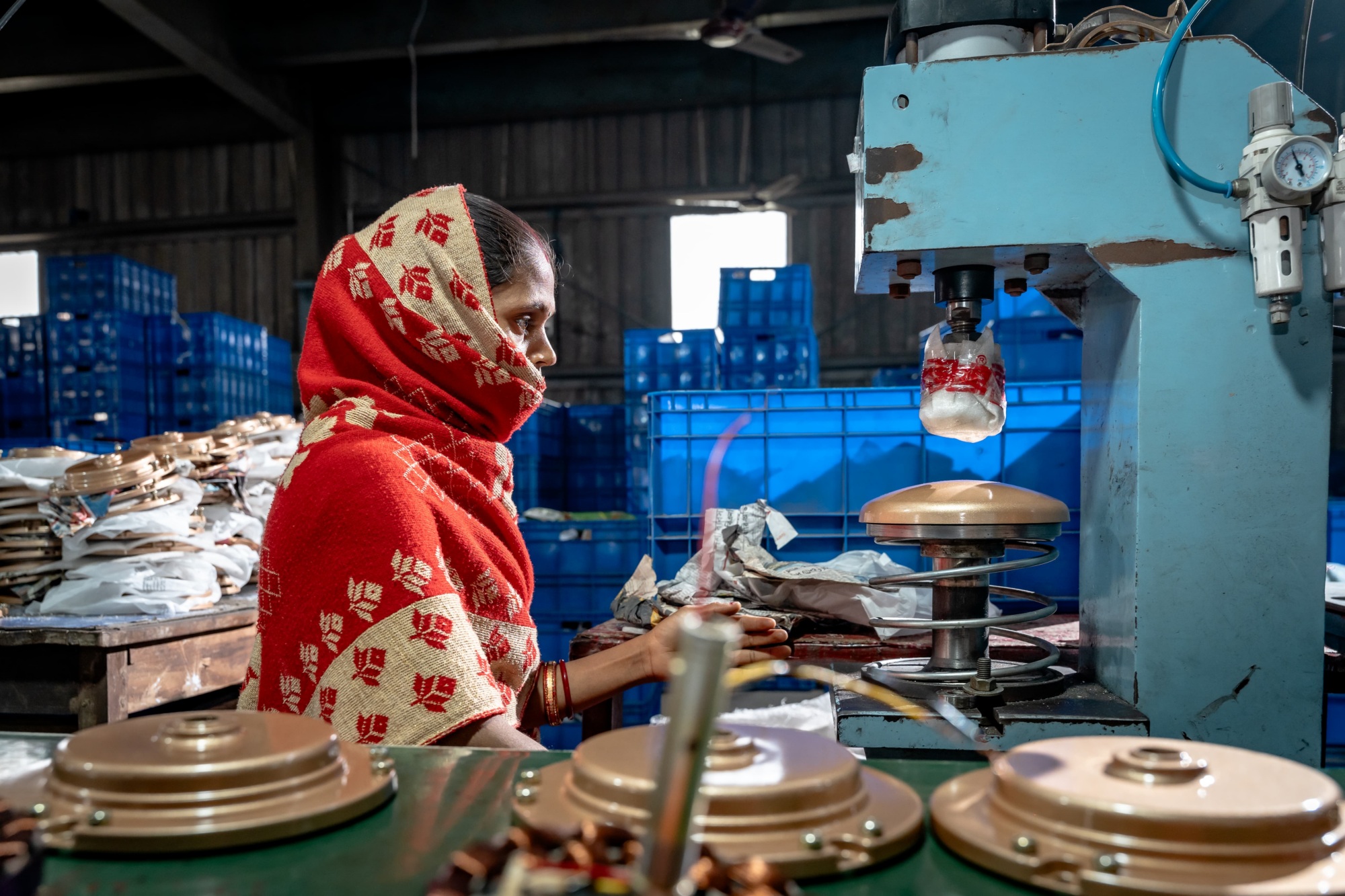
Fan manufacturing facility in Kolkata, India
Image credit: CLASP
To prevent this, CLASP worked closely with MSMEs to build their capacity to produce more efficient fans and participate in functions of the policy program, including testing, certification, and technical committees. MSMEs now have a seat at the table in the policy process, further edifying domestic businesses and contributing to long-term policy durability.
CLASP also partnered with Energy Efficient Services Limited, a state-owned energy service company, to develop a bulk procurement initiative for super-efficient fans. The initiative sought to drive down the cost of 5-star, or most efficient, ceiling fans through economies of scale, ensuring they were more available and affordable to a wider range of consumers.
Better Cooling for People, Prosperity & Planet
More efficient cooling supports India’s national climate goals and Thermal Comfort for All agenda. But this initiative also demonstrates that holistic climate action can strengthen businesses, energy security, and benefit regular people.
Our impact in numbers:
- Cut 159 Mt CO2 by 2050 and reduced demand by 218 TWh
- Lowered ceiling fan purchase price by over 25%
- 3x more manufacturers producing the technology
- Tripled the number of 5-star labelled, or most efficient fans, available on the market, with production volumes increasing by 63%
- 65% increase in medium and small enterprise participation in the policy program