
The Role of Appliances in Achieving Gender Equality and Energy Access for All
Energy-efficient off-grid appliances are essential to ensuring the advantages of electricity translate into measurable social and economic benefits for the millions of households without access to modern energy. Evidence from the Efficiency for Access Coalition and ENERGIA finds the benefits of modern energy are not reaching those who need it most. Decisions about the appliances households purchase are often gendered, with women having less of an influence than men.
This policy brief offers compelling evidence for why governments should include energy-efficient appliances a part of a holistic approach to achieving universal energy access and underscores the importance for addressing gender bias in incentive and program design. Recommendations for the donor community are also presented.
Download the report here: The Role of Appliances in Achieving Gender Equality and Energy Access for All
About Efficiency for Access
Efficiency for Access is a global coalition working to promote renewable and energy efficient appliances to deliver clean energy to the world’s poorest people. It is coordinated jointly by CLASP and the UK’s Energy Saving Trust.
What Does It Take To Break a Solar Water Pump?
Solar water pumps hold the potential to transform the agriculture sector across sub-Saharan Africa by offering a clean, cost-effective long-term irrigation solution for millions of smallholder farmers. However, very little is known about product performance in real-world settings, consumer experiences, and actual impact of these products on end-users. To learn more about this unique product, CLASP met with a company pioneering off-grid product testing in Western Kenya.
Solar water pumps (SWP) are a reliable irrigation option for remote areas, particularly areas where grid power is erratic or not available, or during periods of fuel shortages or price volatility. Studies
have shown that SWP can dramatically improve farmers’ quality of life, mainly through increased income, better yields, and greater savings. Access to water also improves farmers’ resilience to climate shocks, such as unreliable rainfall patterns and drought.
Despite the potential benefits, SWP uptake is very low across East Africa. One of the biggest challenges facing the off-grid SWP industry is poor understanding of product use and customer needs. Field testing presents an opportunity to input consumer feedback into product design and ensure that products are appropriately designed for harsh climates.
In February, CLASP’s Nya Abagi and Jeff Stottlemyer traveled to Kisumu, Kenya to meet with Kijani Testing to learn more about their approach to SWP field testing. Kijani is a new company that aims to provide comprehensive field-testing and quality assurance services for emerging technologies in East Africa.
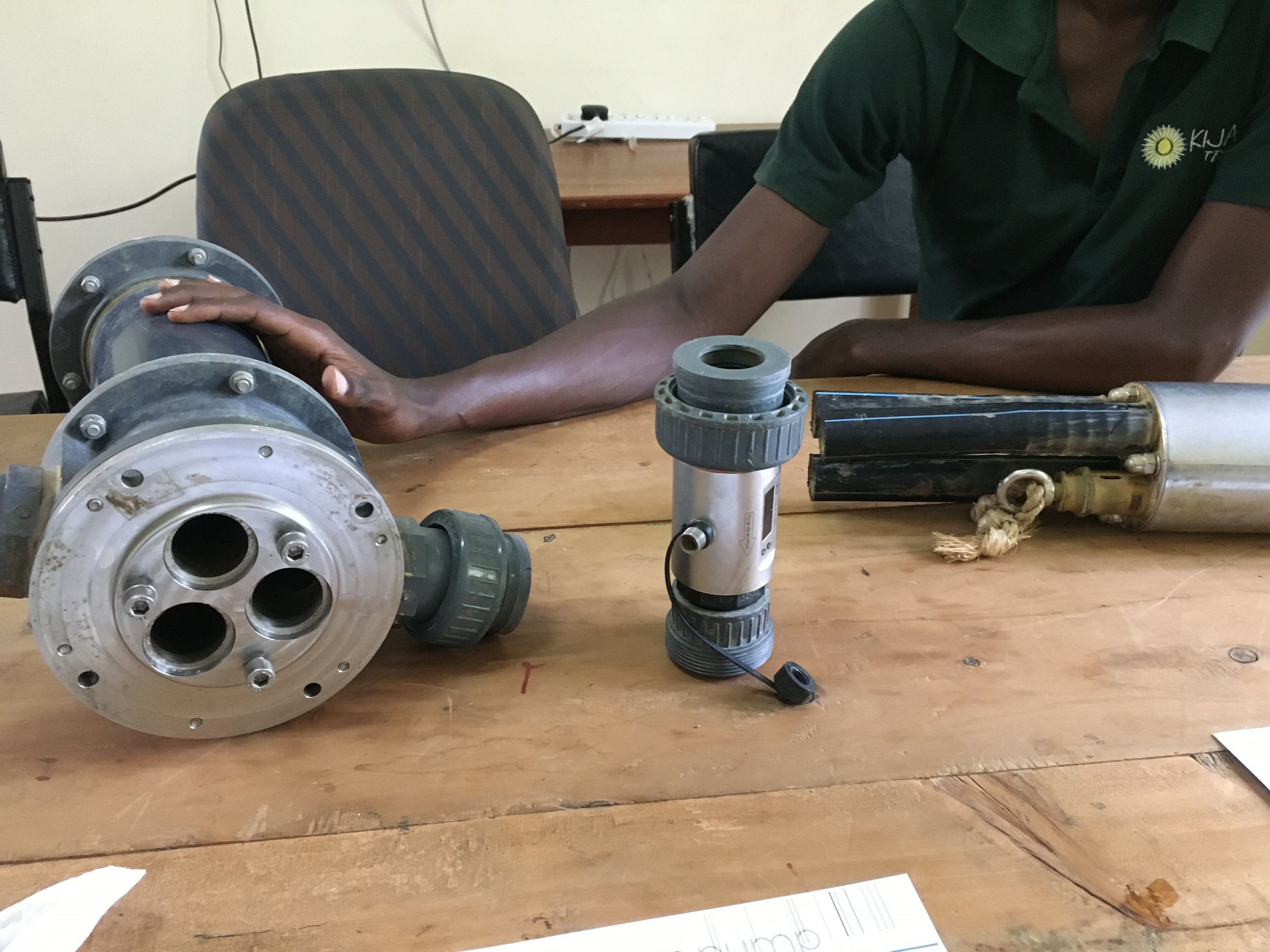
Kinya Kimathi, Projects Director at Kijani, welcomed the CLASP team and provided a tour of the office. Recognizing the importance of local testing, Kijani conducts durability lab tests to push products to the limit and intentionally try to break them down in order to understand product weaknesses.
“Thousands of life changing innovations are unsuccessful due to a lack of understanding of the target market. At the very least, product designers need to be able to answer these two questions – is your product bringing value to the customer? What is the user experience? The most effective way to get these answers is by having your product out in the field, in customers’ hands.”
The team monitors product performance in customers’ homes by collecting quantitative data through a series of remote monitors. They also conduct site visits to answer questions from the remote monitoring data and learn more about the product use cases.
In order to better understand SWP use cases and impacts on consumer lives, CLASP spent the afternoon with a Johnson Ogal, a farmer who has been using two SWP for more than two years. Ogal draws his water from a well on his farm and uses the pumps to mainly irrigate citrus trees.
The pump has enabled Ogal to substantially increase his productivity, “My forty-seven citrus trees now flower continuously and I am able to also grow bananas, pumpkins, tomatoes, and a variety of other vegetables,” Ogal explained. During the dry season, he also uses his pump to provide water to the community.
“The solar water pump is better than my diesel pump because I don’t have to pay for diesel now. I like it because solar is free of charge and does not require manual labor.” Ogal admitted that drawing water from his well was a time and energy intensive task. Check out the pump in action.
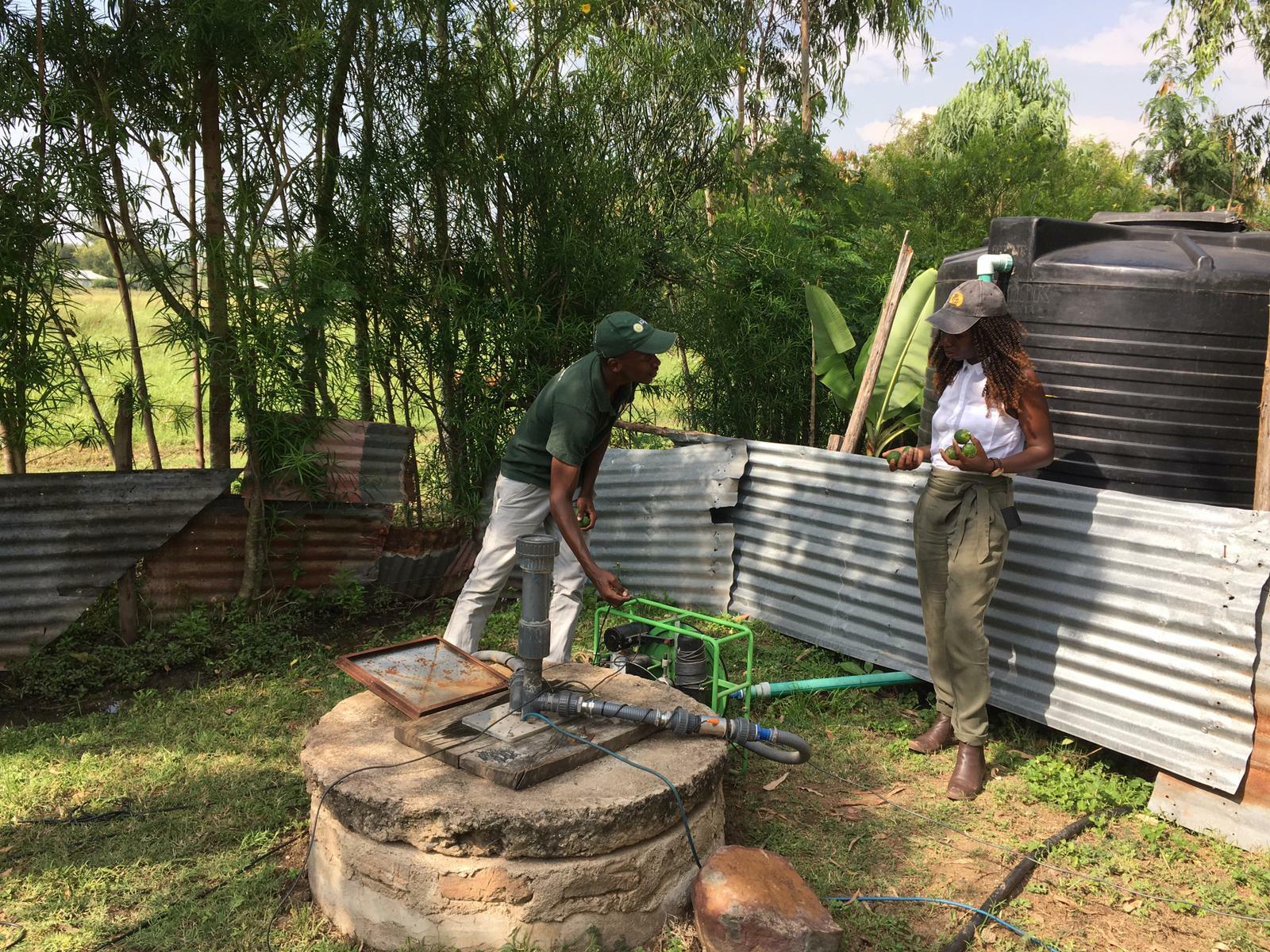
For the typical off-grid consumer, solar water pumps are a large investment. High-cost coupled with hard environmental conditions like high ambient temperatures and humidity common in off-grid regions make product design, quality and durability critically important considerations in product design. Field testing ensures that products brought to market will meet unique environmental challenges and consumer needs.
Through the Efficiency for Access Coalition, CLASP is seeking qualified consultants to support a series of field testing projects focused on SWP and refrigerators. Over the next two years, the Coalition will also be running a consumer awareness campaign in Kenya to share the benefits and encourage the uptake of solar water pumps among smallholder farmers.
New Report Explores How to Close the Diesel-Solar Gap in Off-Grid Milling
Most communities in sub-Saharan Africa rely on cereals like maize for their dietary needs. Rural, off-grid communities often use diesel-powered milling equipment to displace the need for labor-intensive manual processing. Despite their relatively low upfront costs, diesel mills are expensive to operate, difficult to run, and harmful to the environment. Furthermore, the placement of many diesel mills also creates unintended negative consequences for women and girls who often have to travel far distances to have their crops milled.
Solar-powered mills offer a reliable and sustainable alternative to diesel mills. Under the Efficiency for Access Coalition in partnership with Energy 4 Impact (E4I), CLASP collaborated on a pilot test and study of Agsol solar milling equipment in Kenya, Uganda, and Tanzania. Agsol, a Kenya-based agro-processing appliance manufacturer, has developed an energy-efficient solar mill that operates a brushless DC motor. Through the pilot, CLASP and E4I assessed the product’s market viability, including its ability to meet consumer demand, generate a profit, and compete with incumbent milling technology.
Results indicate that, while solar mills have market potential, they are not yet commercially viable because they cannot fully compete with their diesel counterparts. This report outlines several actions that manufacturers, suppliers, donor, investors and policymakers can take to close the commercial viability gap for solar mills. Key recommendations include:
- Increase funding for prototype field testing to find the right balance in mill cost, throughput, and efficiency for operators and consumers.
- Improve consumer financing mechanisms and incentives that improve affordability by reducing capital cost.
- Conduct market research to discover and reach untapped markets.
- Integrate the provision of agricultural equipment into national policies and clarify taxes and duty exemptions for solar mills.
Read the full report.
Solar Milling: Exploring Market Requirements to Close the Commercial Viability
Many communities in sub-Saharan Africa rely on diesel-powered milling equipment to process important staple crops. Solar-powered electric mills offer a reliable and sustainable alternative to expensive and polluting diesel-powered mills. This report uses data collected from field testing results of solar mills in East Africa to analyze the market requirements for solar mills and assess their commercial viability. Its findings present opportunities for improving solar milling technology and recommendations for how to close the commercial viability gap between diesel and solar.
Download the full report here: Rapid Product Assessment: A New Approach to Testing Productive Use Appliances
About Efficiency for Access
Efficiency for Access is a global coalition working to promote renewable and energy efficient appliances to deliver clean energy to the world’s poorest people. It is coordinated jointly by CLASP and the UK’s Energy Saving Trust.
2019 State of the Off-Grid Market Report Finds Appliances on the Edge of Transformational Growth
The 2019 State of the Off-Grid Appliance Market Report analyzes major market trends for off-grid TVs, fans, and refrigerators across eight representative markets in South Asia and sub-Saharan Africa. Building on the inaugural 2017 State of the Appliance Market Report, which presented the first-ever snapshot of the off-grid appliance market, this exciting new report indicates continued maturity in the off-grid appliances market, with companies increasingly responding to consumer prioritization of quality and personal need, and demand for financing options. This exciting new report establishes its outlook as a fast-growing and attractive market which needs concerted action to be unlocked; and seeks to mobilize investment and policy support into the sector to accelerate growth.
The broader market ecosystem has seen widespread shifts as well, with policymakers, regulators, investors, and development actors placing a greater emphasis on energy-efficient off-grid appliances and the role they play in delivering higher tiers of energy access.
Key findings include:
- There is a significant potential market for off-grid appliances. We estimate the addressable market for off-grid appliances is large at USD 12.6 at the end of 2018, with the potential to double to over 25 billion in 2030. We predict improvements in affordability due to higher incomes and declining retail prices and better access to consumer finance will drive increases in market potential.
- The range of off-grid appliances available in the market has expanded. The television market shows signs of increased affordability, efficiency, and competition. Variations in product specification and price indicate the off-grid fan market is disaggregated and regionally specific. Finally, the refrigerator market remains nascent and in need of technology and product development to improve price and performance.
- Consumer affordability is the most significant constraint for growth. On the demand side, consumers cannot afford the retail price of an off-grid appliance without financing. On the supply side, producers struggle to lower the retail price due to high distribution costs. Access to finance for consumers, product innovators, and distributors will be critical to achieving scale.
- Many governments recognize the important decentralized energy solutions play in achieving universal energy access, yet off-grid appliances are not explicitly included in national electrification plans. Communicating the value of off-grid appliances and the role they play in enhancing sustainable development can help move governments forward in defining clear regulations that promote appliances and help crowd in donor support for further electrification.
- Accelerating market growth for off-grid appliances will require a concerted effort across a wide array of actors. Governments should further recognize the importance of driving energy demand through weak- and off-grid appropriate appliances within their electrification initiatives and take policy action accordingly. Donors and impact investors should continue to finance off- and weak-grid appliances. Industry players should be required to adopt responsible consumer lending practices. Global white goods players should be supported and incentivized to recognize the large financial opportunity in weak- and off-grid appropriate appliances — in particular, the USD 10 billion television opportunity.
Off-grid solar systems provide an estimated 73 million households with access to modern energy services globally. Energy-efficient off-grid appropriate appliances allow users of decentralized energy solutions to unlock the benefits and improved quality of life that stem from access to electricity by enabling them to increase productivity while maximizing the efficiency of their system. The 2019 State of the Off-Grid Appliance Market Reports demonstrates the opportunity for TVs, fans, and refrigerators to be a turnkey in electrification efforts.
By unlocking latent demand for energy services, off-grid appliances can deliver significant economic, health, education, and quality of life benefits for an estimated 60 million households worldwide. Products today have continued to develop in their efficiency, but the keys to reaching this market potential are greater affordability through financing and economies of scale, broader customer awareness through marketing, and deeper insight into consumer needs. The industry is poised for an exciting growth trajectory and should work together with ecosystem partners to continue proving the demand for energy access and providing off-grid customers access to a better lifestyle.
2019 State of the Off-Grid Market Report
Off-grid appropriate appliances enable households to enjoy the benefits and improved quality of life that come from expanded access to energy by allowing them to effectively and efficiently make use of distributed energy solutions. The 2017 State of the Off-Grid Appliance Market Report presented the first-ever snapshot of the off-grid appliance market for televisions (TVs), fans, and refrigerators. Since then, the off-grid appliance market has continued to mature, with companies increasingly responding to consumer prioritization of quality and personal need, and demand for financing options. The broader market ecosystem has seen widespread shifts as well, with policymakers, regulators, investors, and development actors placing a greater emphasis on energy-efficient off-grid appliances and the role they play in delivering higher tiers of energy access.
The 2019 State of the Off-Grid Appliance Market Report analyzes the major market trends for off-grid appropriate TVs, fans, and refrigerators across eight representative markets in South Asia and sub-Saharan Africa. This report aims to size the existing market and estimate the addressable market in 2030. It also identifies barriers to market growth and identifies the steps companies, governments, and development actors can take to accelerate growth.
Download the 2019 State of the Off-Grid Appliance Market report to learn more.
About Efficiency for Access
Efficiency for Access is a global coalition working to promote renewable and energy efficient appliances to deliver clean energy to the world’s poorest people. It is coordinated jointly by CLASP and the UK’s Energy Saving Trust.
2019 Global LEAP Awards Winners and Finalists
We are excited to announce the results of the 2019 Global LEAP Awards Solar Water Pump and Off-Grid Refrigerator Competitions. The 2019 Awards identified the world’s best and most innovative refrigerators and pumps designed for use with small-scale distributed solar energy systems, with support from UK aid and Power Africa’s Beyond the Grid Initiative.
Detailed information about all 53 Winners and Finalists—including product performance data and sales contact information—is available in the 2019 Global LEAP Awards Off-Grid Refrigerator and Solar Water Pump Buyer’s Guides.
Off-grid refrigerators and solar water pumps have the potential to drive significant development impacts. Approximately 95% of farmed land in sub-Saharan Africa and 60% of land in South Asia relies solely on unpredictable seasonal rainfall to meet water needs. Solar water pumps can play an important role in delivering a sustainable water supply to millions of unelectrified smallhold farmers in these regions, increasing yields and improving livelihoods. Refrigeration provides a wide range of benefits, from improving human health and productivity to enabling new income-generating activities for small businesses and entrepreneurs while reducing the domestic burden on women and children.
“Many off-grid solar companies are expanding into the household and productive use appliance market, with particular interest in refrigerators and solar water pumps, but don’t know how to find the right products. The Global LEAP Awards provides critical market intelligence on product quality and performance, helping these companies scale up quickly,” said Andrew Herscowitz, Coordinator of Power Africa.
The results of the Off-Grid Refrigerator Competition demonstrated substantial gains in the efficiency of best-in-class products from the 2017 Global LEAP Awards, with 2019 Winners averaging 28% greater overall efficiency compared to 2017 Winners. However, these products remain too costly for most off-grid customers. To address this, the results released today also included the Global LEAP Awards’ first-ever innovation prizes focused on affordability, sponsored by UK aid.
“Off-grid refrigeration can help transform people’s lives, but too few people today can afford the best available technologies. The Global LEAP Affordability Prizes are rewarding innovations to help refrigeration become far more widely available,” said Professor Charlotte Watts, DFID Chief Scientific Advisor.
The Consumer Affordability Prize, for commercial innovations that make it easier for customers to purchase products, was awarded to Devidayal Solar Inc. for improvements to their logistics and after-sales services as well as new financing options for rural customers that together will drive down the overall cost of their products. The Unit Cost Affordability Prize, for technical innovations that reduce the cost to manufacture products, was awarded to Youmma for R&D focused on driving continued efficiency gains in the compressors and inverters used in their products, as well as partnerships with local manufacturers in target markets to pilot local assembly. Each company will receive a £50,000 cash prize.
All Global LEAP Awards winners and finalists undergo testing by accredited laboratories for their energy performance, quality, and reliability, and an evaluation by a panel of off-grid market experts.
For more information about the Global LEAP Awards, visit www.globalleapawards.org.
A collection of videos featuring previous Global LEAP Awards Winners and Finalists is available on vimeo.
2019 Global LEAP Awards Buyer’s Guide for Solar Water Pumps
The Global LEAP Awards Buyer’s Guide is a catalog of the world’s best off-grid appliances. This edition contains information about solar water pumps that were named Winners and Finalists in the 2019 Global LEAP Awards. The Buyer’s Guide serves as a procurement tool for off-grid solar companies and distributors, and provides general market intelligence to other interested stakeholders. It includes rated product specifications, performance metrics based on laboratory testing, and sales contact information.
The Global LEAP Awards identify one Winner as the best overall product nominated for each size and form factor-based category, with other high-quality products in that category identified as Finalists. The 2019 Global LEAP Awards Solar Water Pump Buyer’s Guide lists twenty-seven solar water pumps designed for 1 to 5-acre smallholder farmers.
Download the 2019 Global LEAP Awards Buyer’s Guide for Solar Water Pumps.
About Efficiency for Access
Efficiency for Access is a global coalition working to promote renewable and energy efficient appliances to deliver clean energy to the world’s poorest people. It is coordinated jointly by CLASP and the UK’s Energy Saving Trust.
New Analysis from Efficiency for Access Provides Detail on the Solar Water Pump Market in sub-Saharan Africa and South Asia Like Never Before
New research from Efficiency for Access offers insights on the solar water pump market in sub-Saharan Africa and South Asia like never before, underscoring a growing business case for promotion and adoption. Energy-efficient and affordable solar water pumps have the potential to be a critical enabler of economic growth and security for more than 500 million smallholder farmers worldwide. Approximately 95% of farmed land in sub-Saharan Africa and 60% of land in South Asia relies solely on unpredictable seasonal rainfall to meet water needs. Situated at the heart of the water-food-energy nexus, solar water pumps can play an important role in delivering a sustainable water supply in an increasingly climate-sensitive world, all while reducing or preventing harmful greenhouse gas emissions and improving the incomes and resilience of rural households worldwide.
The solar water pump industry is at an important inflection point, with technology increasingly well-adapted for small-scale users and prices on the decline. Declining costs in photovoltaic technology had led to irrigation products better tailored for smallholder farmers. While the upfront cost of a solar water pump remains high, potential fuel cost savings and income gains from high-value crops would allow some farmers to break even on their investment within 12-18 months. These, improvements in affordability coupled with high potential latent demand and underrepresented sales data in sub-Saharan Africa and India, indicate growing opportunities for solar water pumps to drive sustainable development.
The current addressable market in sub-Saharan Africa and India is estimated at USD 15.6 billion, representing 4.9 million units. Over the next decade, the market in sub-Saharan Africa is expected to triple to USD 1.6 billion by 2030, while the market in India may contract from USD 15.1 billion due to the removal of a government subsidy. Markets are unique and constantly evolving from very different baselines. As such, market potential varies greatly depending on incumbent technologies, smallholder incomes, commercial value chains, and the relative maturity of the solar industry. Still, analysis finds affordability remains one of the greatest challenges to achieving scale across geographies.
Solar water pump technology needs to be accessible to the mass market of smallholder farmers across Sub-Saharan Africa and South Asia to realize its full potential. Industry players will need to respond in a coordinated manner to the severe affordability barriers faced by many farmers. To accelerate the growth and uptake of solar water pumps in sub-Saharan Africa and South Asia, five broad types of interventions could be introduced:
- –Policy incentives that create favorable policy environments that link off-grid solar irrigation to broader national development agendas;
- –Financial solutions that promote innovative financing models (e.g. PAYGO, leasing, asset loans, off-taker structures) that expand access to finance for consumers;
- –Technological improvements that reduce prices and better tailor products to smallholder farmers;
- –Strengthened partnerships across the value chain among product manufacturers, distributors, finance providers, and organizations that have access to end customers; and
- –Expanded research on solar water pumps that equips businesses with the information needed and enables governments and donors to design targeted interventions.
The precise combination of interventions most critical to stimulate solar water pump penetration in specific nations will vary by market maturity. Interventions should be tailored to the structure of the agriculture sector, the existence of incumbent technologies, the development of the solar industry, and the size and wealth of smallholder farmers.
The findings of this report present the solar water pump industry as one on the cusp of transition: the quantity, quality, and general interest in the technology have grown considerably in recent years. If markets are properly cultivated, solar water pumps can help deliver considerable progress toward the United Nations Sustainable Development Goals, enhancing the wellbeing and prosperity of people and planet.
Read the full report and visit Efficiency for Access to learn more about how CLASP is working to develop markets for energy-efficient off-grid appliances.
Solar Water Pump Outlook 2019: Global Trends and Market Opportunities
The solar water pump industry is at an important inflection point, with technology increasingly well-adapted for small-scale users and prices on the decline. Declining costs in photovoltaic technology had led to irrigation products better tailored for smallholder farmers. While the upfront cost of a solar water pump remains high, potential fuel cost savings and income gains from high-value crops would allow some farmers to break even on their investment within 12-18 months.
This report offers insights on the solar water pump market in sub-Saharan Africa and South Asia like never before. Analysis underscores a growing business case for promotion and adoption—with an addressable market estimated at USD 15.6 billion—and identifies solutions to barriers preventing market scale.
Download the full report here: Solar Water Pump Outlook 2019: Global Trends and Market Opportunities
About Efficiency for Access
Efficiency for Access is a global coalition working to promote renewable and energy efficient appliances to deliver clean energy to the world’s poorest people. It is coordinated jointly by CLASP and the UK’s Energy Saving Trust.