
Fans
Fans are a low-cost cooling solution used all over the world. Higher energy efficiency makes them more effective and cheaper to run.

Everything you need to know about fans
The electric fan, first introduced in the late 1800s1, is one of the world’s most widely used cooling appliances.
Where are fans used?
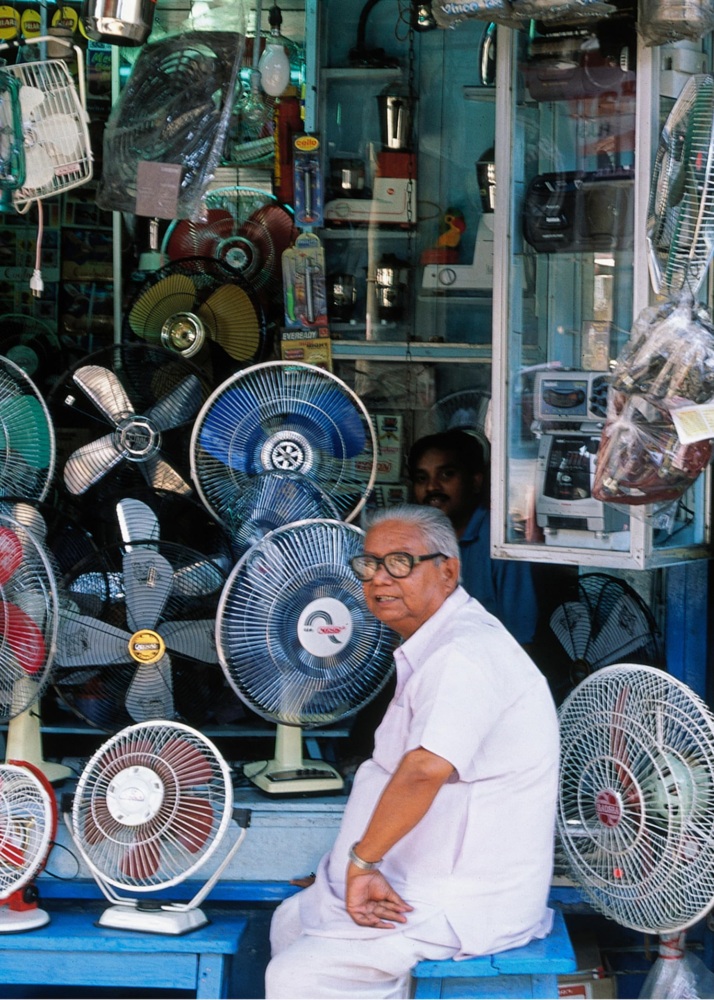
Fans can be found almost everywhere in the world that experiences hot weather.
As a relatively low-cost cooling solution, they’re used by people of all income levels and in many kinds of spaces, both indoors and out.
How do fans work?
Fans have motors that spin blades to circulate air, helping people stay comfortable in hot weather. Counterintuitively, fans don’t actually make the space around them colder.
In fact, they can actually increase the temperature of the surrounding air, since the motors that power them generate heat. Despite this, fans make us feel cooler because the moving air they produce heightens the processes our bodies use to regulate temperature: evaporation (of sweat) and convection (i.e., skin exchanging heat with the surrounding air).2 Because of how fans affect the human body, they’re much less effective in extreme heat. The World Health Organization recommends turning them off when temperatures rise above 40° C (104°F).3
Fans, when used in combination with air conditioners, help reduce overall cooling energy demand. They are one of the fastest-growing appliance categories in countries like India, making it critical to address their energy consumption even if individual units consume less.
Why are fans important for climate adaptation and sustainable development?
Fans serve a particularly important role in hot, humid low- and medium-income countries. As the planet warms, it’s becoming more difficult for people there to safely go about their daily business and earn a livelihood. Most can’t afford air conditioners, which have a relatively high purchase price and often lead to high energy bills.
Fans offer a much more affordable, accessible solution for all but the hottest days. In India, for example, 90% of households4 rely on fans for cooling, while only 8%5 have access to air conditioners.
For the hundreds of millions of people in these countries who either lack access to the power grid or have only unreliable access to electricity6, solar-powered fans offer an important cooling solution.
In places like Bangladesh and Pakistan where blackouts have occurred and electricity is expensive, some people use solar fans even when grid connections are available, helping them save money and prevent unpredictable disruptions.
Fans are in particularly high demand in medical clinics in low- and middle-income countries due to the critical importance of maintaining comfortable conditions for patients and medical workers alike.
How do fans contribute to climate change and power grid instability?
Individual fans don’t use much energy, but in places where they’re ubiquitous, they collectively place massive demands on power networks. In India, for example, fans account for more than 40%7 of residential energy use.8
In places where electricity is generated by burning fossil fuels, this power demand translates to significant greenhouse gas emissions. In Pakistan alone, fans were responsible for 20 megatons (Mt) of emissions in 2022. If present trends continue, these emissions could reach 176 Mt by 2030.9
Many of these emissions can be avoided by making fans more efficient.
CLASP has identified 10 appliances critical to fighting climate change and improving people's lives. Fans are one.
[Photo: Shutterstock]

[Photo: Monica Tiwari]
[Photo: Shutterstock]
What is the solution?
- Increasing the energy efficiency of all fans in use will cool our homes, businesses, schools, and hospitals while using less electricity, generating fewer climate emissions, and lowering users’ energy bills.
- Efficient fan technology already exists; it just needs to be deployed across the world.
How can we achieve this?
Governments
- Develop, promote, and incentivize the production, import, and national adoption of energy-efficient fans.
- Invest in and increase access to renewable energy options for homes and business to power fans sustainably.
- Set policies to phase out the production, trade, and sale of inefficient fans.
- Use labels to indicate and promote the most efficient models.
- Ensure that building standards and codes provide efficient fans as the default.
Fan manufacturers
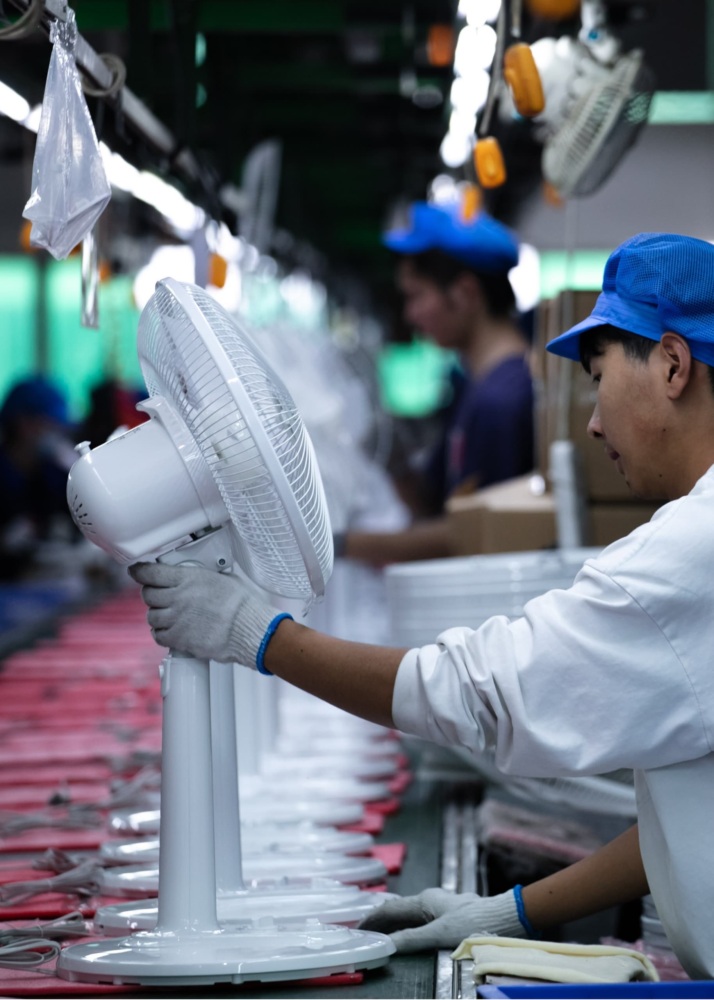
- Invest in research and development to improve the efficiency and affordability of fans to match global best practice.
- Abandon the production and export of inefficient fans and challenge competitors to do the same.
Consumers and consumer groups
- Choose the most efficient fans you can afford to lower your energy bills, improve your health, and reduce your carbon footprint.
- Increase the insulation, shade, and the layers of glazing on your windows to keep your home or business cool.
- Advocate to increase national awareness of the health, cost, and environmental benefits of efficient fans.
- Contact government representatives to request ambitious efficiency policies for all appliances.
Recent News



Are you a policymaker working on fans? Explore CLASP's free tools:
Net Zero Appliances NDC Toolkit
- Learn how (and why) to maximize the potential of appliance efficiency in NDCs.
World's Best MEPS: Tracking Leaders in Appliance Energy Efficiency Standards
- Find the world’s most ambitious energy performance standards for six key appliances and equipment.
Mepsy: The Appliance & Equipment Climate Impact Calculator
- Analyze efficiency policy options for key appliances across 162 countries.
CLASP's work on fans impacts:


0. ”Schuyler skaats wheeler,” Journal of the American Institute of Electrical Engineers, vol. 42, no. 5, May 1923. DOI: 10.1109/JoAIEE.1923.6594135.
1. Meade, R. et al., ”A critical review of the effectiveness of electric fans as a personal cooling intervention in hot weather and heatwaves,” The Lancet Planetary Health, vol. 8, no. 4, April 2024. https://www.thelancet.com/journals/lanplh/article/PIIS2542-5196(24)00030-5/fulltext.
2. ”Heat and health,” World Health Organization, May 28, 2024. https://www.who.int/news-room/fact-sheets/detail/climate-change-heat-and-health.
3. Aggarwal, D. et al., ”Business Model for Scaling Up Super-Efficient Appliances: A Deep Dive on Ceiling Fans in India,” Council on Energy, Energy and Water, February 14, 2022. https://www.ceew.in/publications/business-model-to-scale-up-energy-efficient-appliances-ceiling-fans-india.
4. ”India’s Journey Towards Sustainable Cooling,” UNDP, January 2, 2024. https://www.undp.org/india/publications/indias-journey-towards-sustainable-cooling.
5. ”Tracking SDG7: The Energy Progress Report”, ESMAP, accessed July 8, 2024. https://trackingsdg7.esmap.org/.
6. Chunekar, A. and Sahasrabudhe, A. “Up in the air”, Prayas (Energy Group), April 20, 2023. https://energy.prayaspune.org/power-perspectives/up-in-the-air.
7. ”Cooling India: Energy-Efficient Fans for a Greener Tomorrow,” CLASP, November 21, 2023. https://www.clasp.ngo/updates/cooling-india-energy-efficient-fans-for-a-greener-tomorrow/.
8. ”Net Zero Heroes: Scaling Efficient Appliances for Climate Change Mitigation, Adaptation, and Resilience,” CLASP, November 2023. https://www.clasp.ngo/report/net-zero-heroes/case-studies/empowering-efficiency/.